
Pulp Fiction, 1954 · page 15 of 132
Astounding Science Fiction, British Edition — page 15: what you’re looking at
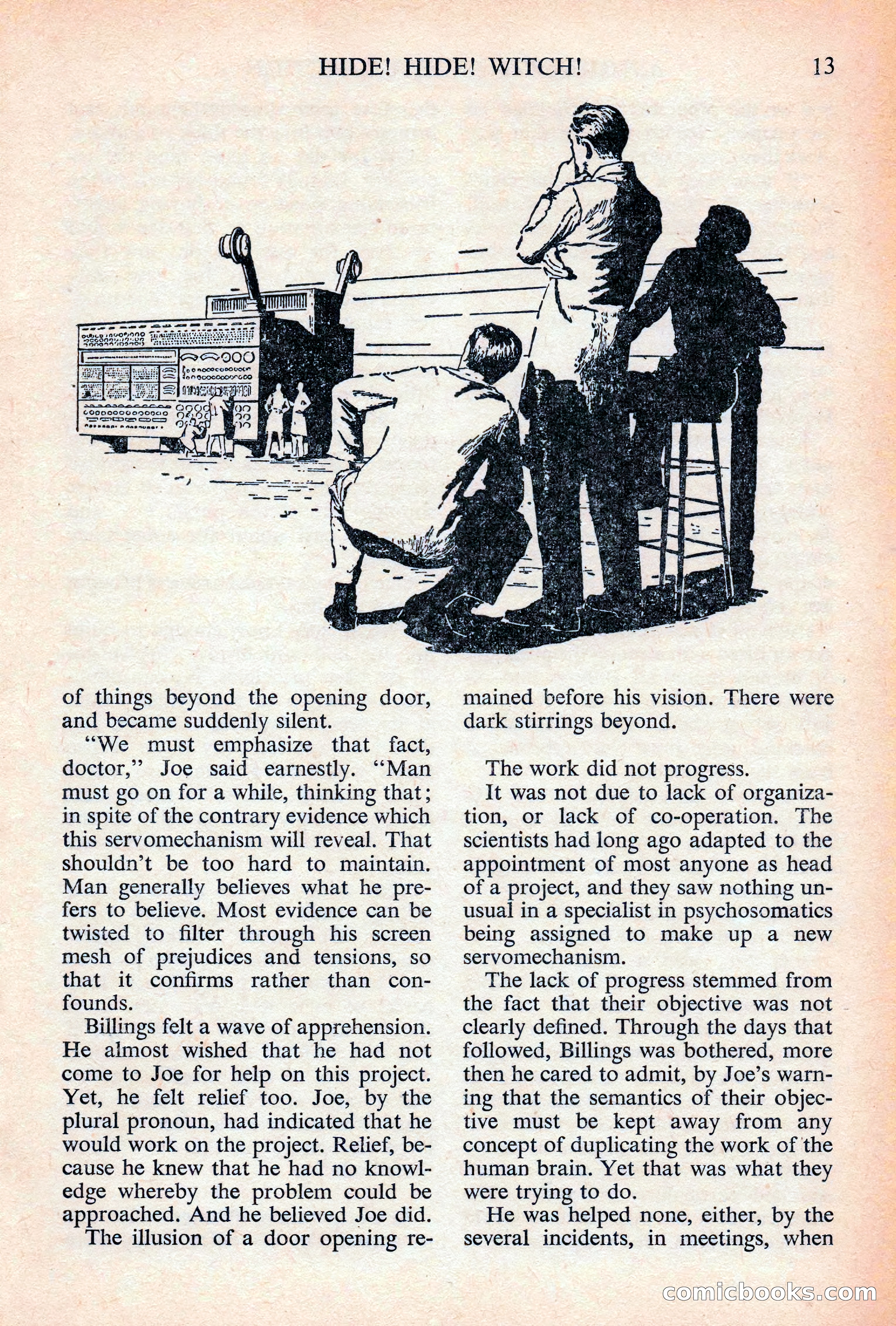
A restored page from Pulp Fiction, 1954. Page through the whole issue in the reader above.
📄 Transcribed text from this page (OCR, searchable)
Machine-transcribed from the original scan — historical spelling and the odd misread are preserved.
HIDE! HIDE! WITCH! 13 N4A7'.08 3589984055 of things beyond the opening door, and became suddenly silent. “We must emphasize that fact, doctor,” Joe said earnestly. ““Man must go on for a while, thinking that; in spite of the contrary evidence which this servomechanism will reveal. That shouldn’t be too hard to maintain. Man generally believes what he pre- fers to believe. Most evidence can be twisted to filter through his screen mesh of prejudices and tensions, so that it confirms rather than con- founds. Billings felt a wave of apprehension. He aimost wished that he had not come to Joe for help on this project. Yet, he felt relief too. Joe, by the plural pronoun, had indicated that he would work on the project. Relief, be- cause he knew that he had no knowl- edge whereby the problem could be approached. And he believed Joe did. The illusion of a door opening re- é 3 } 1 : ¥ : - eo In ay ee . * ‘ \¥ ne ry \ Pee eS ‘ scat ae Be & 2," es as RRS mained before his vision. There were dark stirrings beyond. The work did not progress. It was not due to lack of organiza- tion, or lack of co-operation. The scientists had long ago adapted to the appointment of most anyone as head of a project, and they saw nothing un- usual in a specialist in psychosomatics being assigned to make up a new servomechanism. The lack of progress stemmed from the fact that their objective was not clearly defined. Through the days that followed, Billings was bothered, more then he cared to admit, by Joe’s warn- ing that the semantics of their objec- tive must be kept away from any concept of duplicating the work of the human brain. Yet that was what they were trying to do. He was helped none, either, by the several incidents, in meetings, when connicloooks.c© in