
Pulp Fiction, 1954 · page 14 of 132
Astounding Science Fiction, British Edition — page 14: what you’re looking at
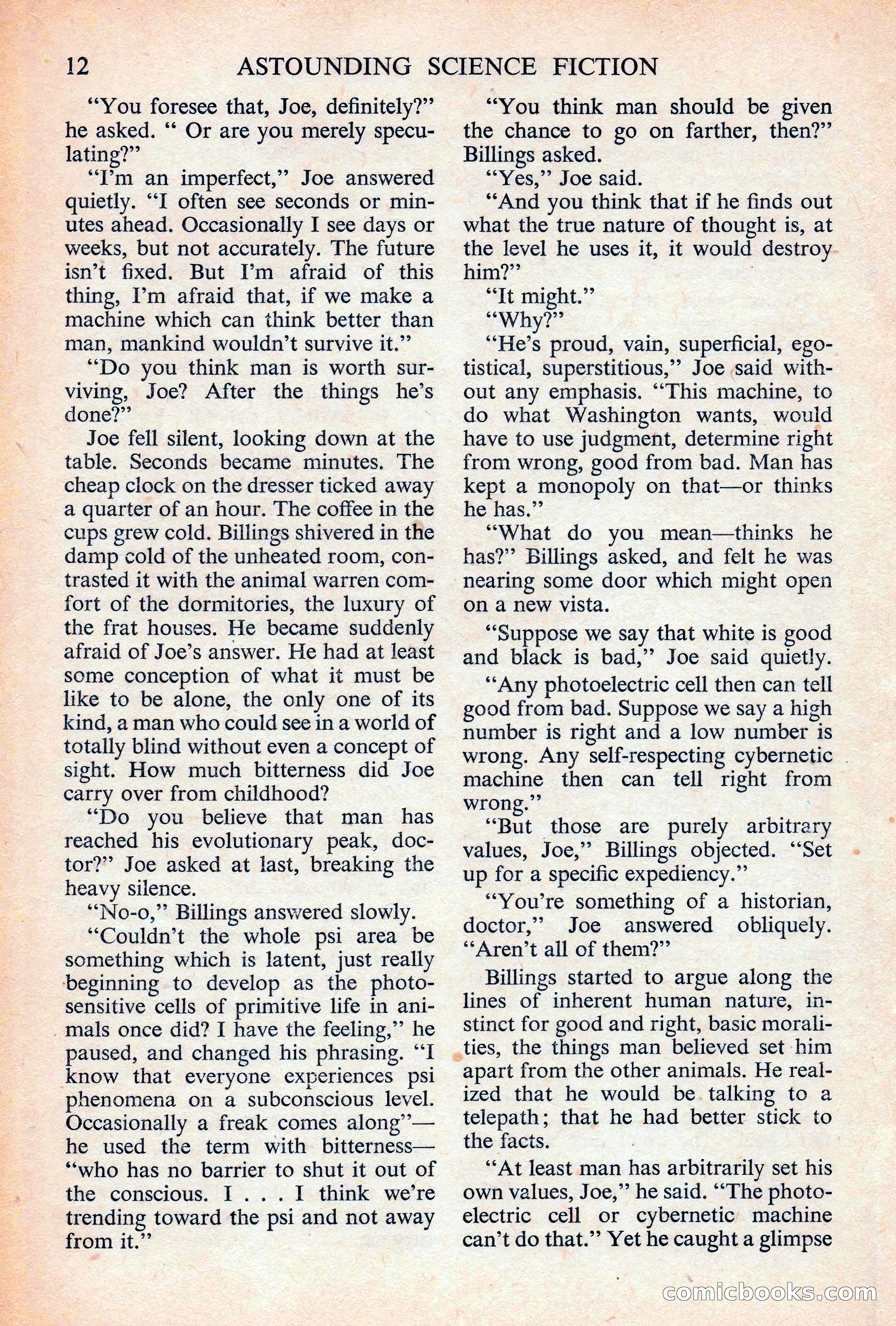
A restored page from Pulp Fiction, 1954. Page through the whole issue in the reader above.
📄 Transcribed text from this page (OCR, searchable)
Machine-transcribed from the original scan — historical spelling and the odd misread are preserved.
12 ASTOUNDING SCIENCE FICTION “You foresee that, Joe, definitely?’ he asked. “* Or are you merely specu- lating?” “T’m an imperfect,” Joe answered quietly. “I often see seconds or min- utes ahead. Occasionally I see days or weeks, but not accurately. The future isn’t fixed. But I’m afraid of this thing, I’m afraid that, if we make a machine which can think better than man, mankind wouldn’t survive it.”’ ‘Do you think man is worth sur- viving, Joe? After the things he’s done?” Joe fell silent, looking down at the table. Seconds became minutes. The cheap clock on the dresser ticked away a quarter of an hour. The coffee in the cups grew cold. Billings shivered in the damp cold of the unheated room, con- trasted it with the animal warren com- fort of the dormitories, the luxury of the frat houses. He became suddenly afraid of Joe’s answer. He had at least some conception of what it must be like to be alone, the only one of its kind, a man who could see in a world of totally blind without even a concept of sight. How much bitterness did Joe carry over from childhood? “Do you believe that man has reached his evolutionary peak, doc- tor?” Joe asked at last, breaking the heavy silence. ““No-o,” Billings answered slowly. “Couldn’t the whole psi area be something which is latent, just really ‘beginning to develop as the photo- sensitive cells of primitive life in ani- mals once did? I have the feeling,’’ he paused, and changed his phrasing. “I know that everyone experiences psi phenomena on a subconscious level. Occasionally a freak comes along’’— he used the term with bitterness— “who has no barrier to shut it out of the conscious. I... I think we’re trending toward the psi and not away from it.” “You think man should be given the chance to go on farther, then?” Billings asked. “Yes,” Joe said. ‘And you think that if he finds out what the true nature of thought is, at the level he uses it, it would destroy him?” “Tt might.” “Why?” ‘“He’s proud, vain, superficial, ego- tistical, superstitious,” Joe said with- out any emphasis. ““This machine, to do what Washington wants, would have to use judgment, determine right from wrong, good from bad. Man has kept a monopoly on that—or thinks he has.” “What do you mean—thinks he has?” Billings asked, and felt he was nearing some door which might open on a new vista. “Suppose we say that white is good and black is bad,’”’ Joe said quietly. “Any photoelectric cell then can tell good from bad. Suppose we say a high number is right and a low number is wrong. Any self-respecting cybernetic . machine then can tell right from wrong.” “But those are purely arbitrary values, Joe,” Billings objected. “‘Set up for a specific expediency.” “You’re something of a historian, doctor,” Joe answered obliquely. “Aren’t all of them?” Billings started to argue along the lines of inherent human nature, in- stinct for good and right, basic morali- ties, the things man believed set him apart from the other animals. He real- ized that he would be talking to a telepath; that he had better stick to the facts. “At least man has arbitrarily set his own values, Joe,” he said. ““The photo- electric cell or cybernetic machine can’t do that.” Yet he caught a glimpse connicloooks.c© nl