
Pulp Fiction, 1954 · page 16 of 132
Astounding Science Fiction, British Edition — page 16: what you’re looking at
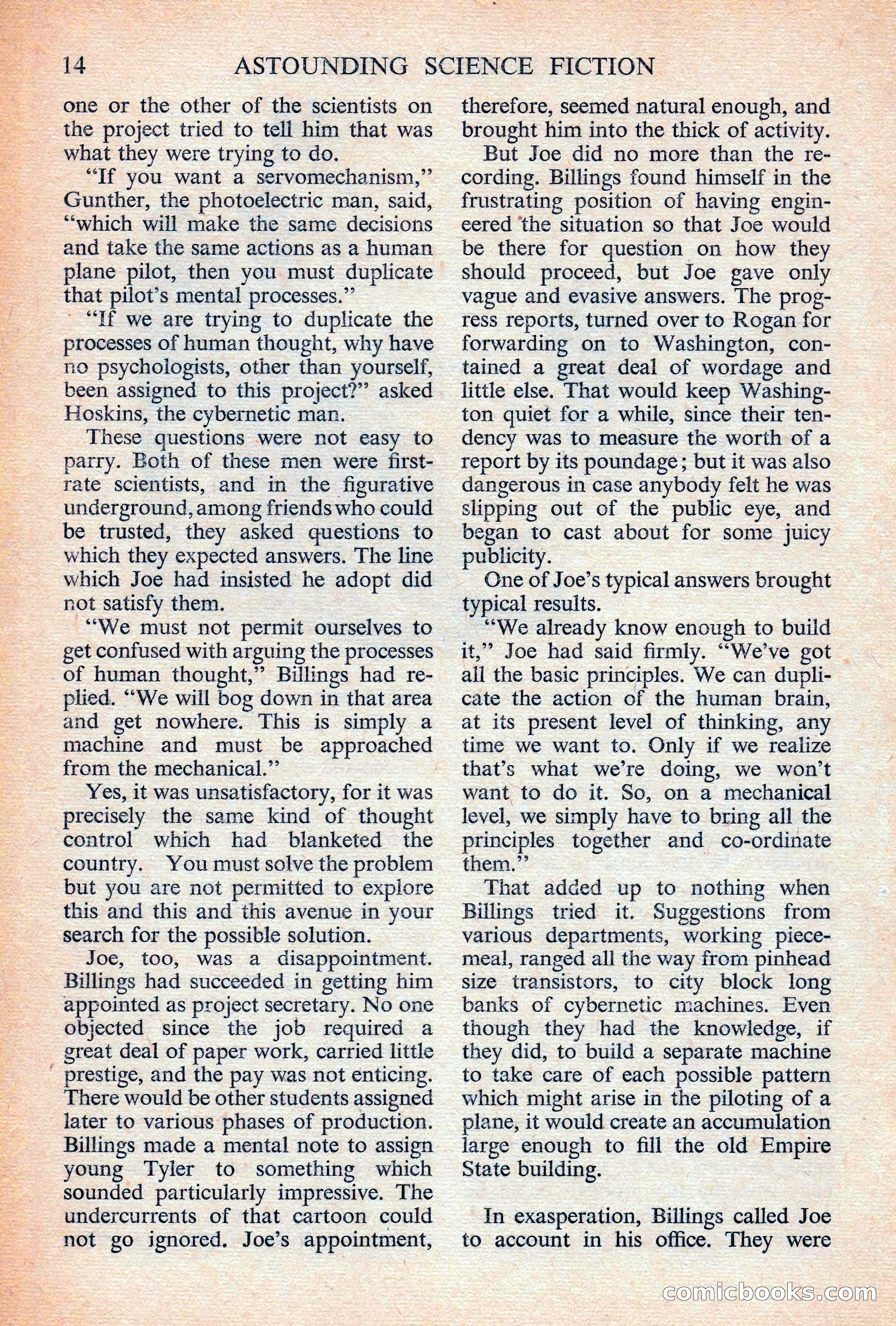
A restored page from Pulp Fiction, 1954. Page through the whole issue in the reader above.
📄 Transcribed text from this page (OCR, searchable)
Machine-transcribed from the original scan — historical spelling and the odd misread are preserved.
14 ASTOUNDING SCIENCE FICTION one or the other of the scientists on the project tried to tell him that was what they were trying to do. “If you want a servomechanism,”’ Gunther, the photoelectric man, said, “which will make the same decisions and take the same actions as a human plane pilot, then you must duplicate that pilot’s mental processes.” - “If we are trying to duplicate the processes of human thought, why have no psychologists, other than yourself, been assigned to this project?” asked Hoskins, the cybernetic man. These questions were not easy to parry. Both of these men were first- rate scientists, and in the figurative underground, among friends who could be trusted, they asked questions to which they expected answers. The line which Joe had insisted he adopt did not satisfy them. “We must not permit ourselves to get confused with arguing the processes of human thought,” Billings had re- plied. “We will bog down in that area and get nowhere. This is simply a machine and must be approached from the mechanical.” Yes, it was unsatisfactory, for it was precisely the same kind of thought control which had blanketed the country. You must solve the problem but you are not permitted to explore this and this and this avenue in your search for the possible solution. Joe, too, was a disappointment. Billings had succeeded in getting him appointed as project secretary. No one objected since the job required a great deal of paper work, carried little ' prestige, and the pay was not enticing. There would be other students assigned later to various phases of production. Billings made a mental note to assign young Tyler to something which sounded particularly impressive. The undercurrents of that cartoon could not go ignored. Joe’s appointment, therefore, seemed natural enough, and brought him into the thick of activity. But Joe did no more than the re- cording. Billings found himself in the frustrating position of having engin- eered ‘the situation so that Joe would be there for question on how they should proceed, but Joe gave only vague and evasive answers. The prog- ress reports, turned over to Rogan for forwarding on to Washington, con- tained a great deal of wordage and little else. That would keep Washing- ton quiet for a while, since their ten- dency was to measure the worth of a report by its poundage; but it was also dangerous in case anybody felt he was slipping out of the public eye, and began to cast about for some juicy publicity. One of Joe’s typical answers brought typical results. “We already know enough to build it,’ Joe had said firmly. ““We’ve got all the basic principles. We can dupli- cate the action of the human brain, at its present level of thinking, any time we want to. Only if we realize that’s what we’re doing, we won’t want to do it. So, on a mechanical level, we simply have to bring all the principles together and co-ordinate them.”’ That added up to nothing when Billings tried it. Suggestions from various departments, working piece- meal, ranged ali the way from pinhead size transistors, to city block long banks of cybernetic machines. Even though they had the knowledge, if they did, to build a separate machine to take care of each possible pattern which might arise in the piloting of a plane, it would create an accumulation large enough to fill the old Empire State building. In exasperation, Billings called Joe to account in his office. They were Connicloooks.<© in