
Pulp Fiction, 1954 · page 11 of 132
Astounding Science Fiction, British Edition — page 11: what you’re looking at
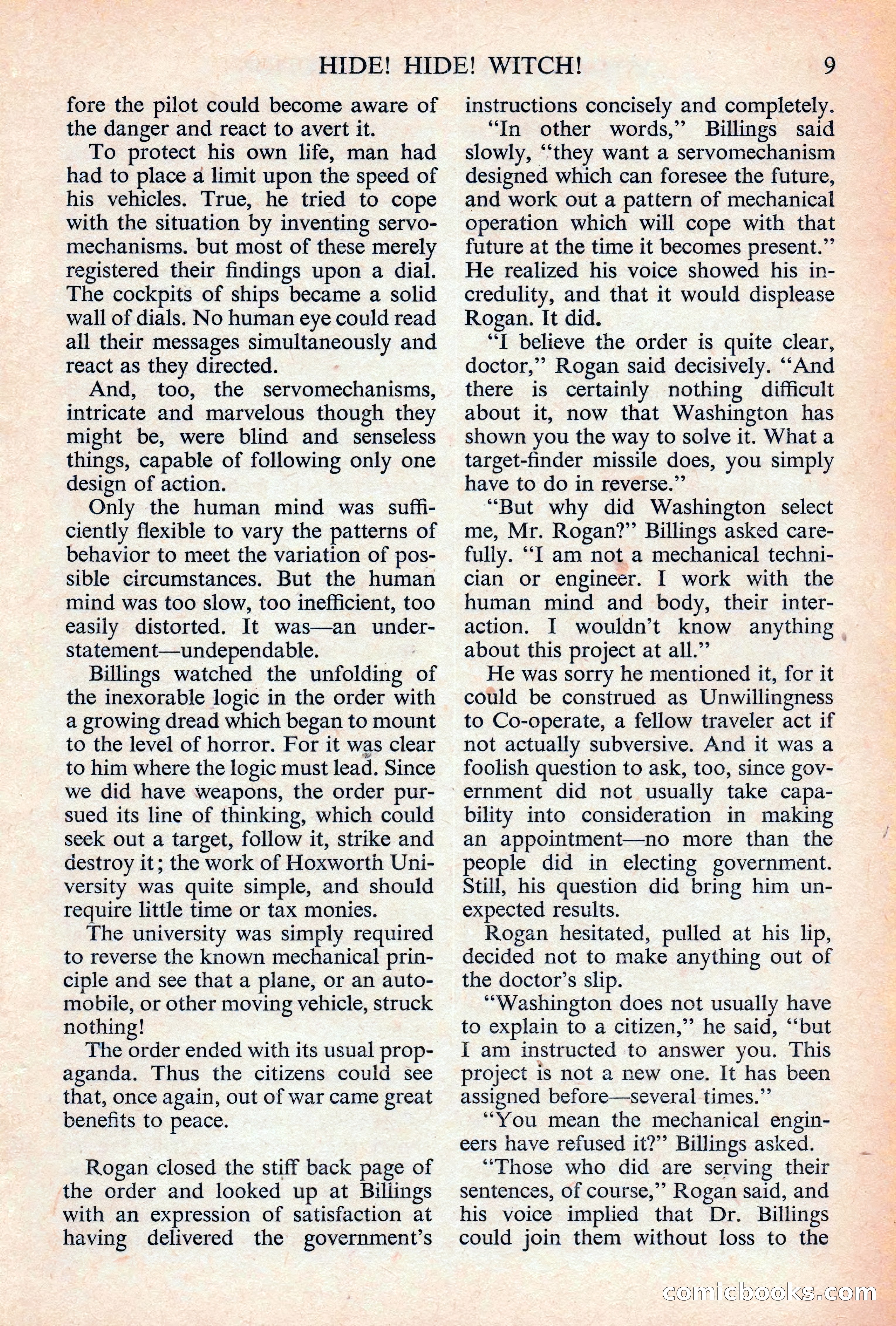
A restored page from Pulp Fiction, 1954. Page through the whole issue in the reader above.
📄 Transcribed text from this page (OCR, searchable)
Machine-transcribed from the original scan — historical spelling and the odd misread are preserved.
HIDE! HIDE! WITCH! 9 fore the pilot could become aware of the danger and react to avert it. To protect his own life, man had had to place a limit upon the speed of his vehicles. True, he tried to cope with the situation by inventing servo- mechanisms. but most of these merely registered their findings upon a dial. The cockpits of ships became a solid wall of dials. No human eye could read all their messages simultaneously and react as they directed. And, too, the servomechanisms, intricate and marvelous though they might be, were blind and senseless things, capable of following only one design of action. Only the human mind was suffi- ciently flexible to vary the patterns of behavior to meet the variation of pos- sible circumstances. But the human mind was too slow, too inefficient, too easily distorted. It was—an _ under- statement—undependable. Billings watched the unfolding of the inexorable logic in the order with a growing dread which began to mount to the level of horror. For it was clear to him where the logic must lead. Since we did have weapons, the order pur- sued its line of thinking, which could seek out a target, follow it, strike and destroy it; the work of Hoxworth Uni- versity was quite simple, and should require little time or tax monies. The university was simply required to reverse the known mechanical prin- ciple and see that a plane, or an auto- mobile, or other moving vehicle, struck nothing! The order ended with its usual prop- aganda. Thus the citizens could see that, once again, out of war came great benefits to peace. Rogan closed the stiff back page of the order and looked up at Billings with an expression of satisfaction at having delivered the government’s instructions concisely and completely. “In other words,’ Billings said slowly, “they want a servomechanism designed which can foresee the future, and work out a pattern of mechanical operation which will cope with that future at the time it becomes present.” He realized his voice showed his in- credulity, and that it would displease Rogan. It did. “I believe the order is quite clear, doctor,” Rogan said decisively. “And there is certainly nothing difficult about it, now that Washington has shown you the way to solve it. What a target-finder missile does, you simply have to do in reverse.” “But why did Washington select me, Mr. Rogan?” Billings asked care- fully. “I am not a mechanical techni- cian or engineer. I work with the human mind and body, their inter- action. I wouldn’t know anything | about this project at all.” He was sorry he mentioned it, for it could be construed as Unwillingness to Co-operate, a fellow traveler act if not actually subversive. And it was a foolish question to ask, too, since goy- ernment did not usually take capa- bility into consideration in making an appointment—no more than the people did in electing government. Still, his question did bring him un- expected results. Rogan hesitated, pulled at his lip, decided not to make anything out of the doctor’s slip. “Washington does not usually have to explain to a citizen,” he said, “but I am instructed to answer you. This project is not a new one. It has been “You mean the mechanical engin- eers have refused it?” Billings asked. “Those who did are serving their sentences, of course,”’ Rogan said, and his voice implied that Dr. Billings could join them without loss to the Cconnicloooks.€c@ im