
Pulp Fiction, 1954 · page 10 of 132
Astounding Science Fiction, British Edition — page 10: what you’re looking at
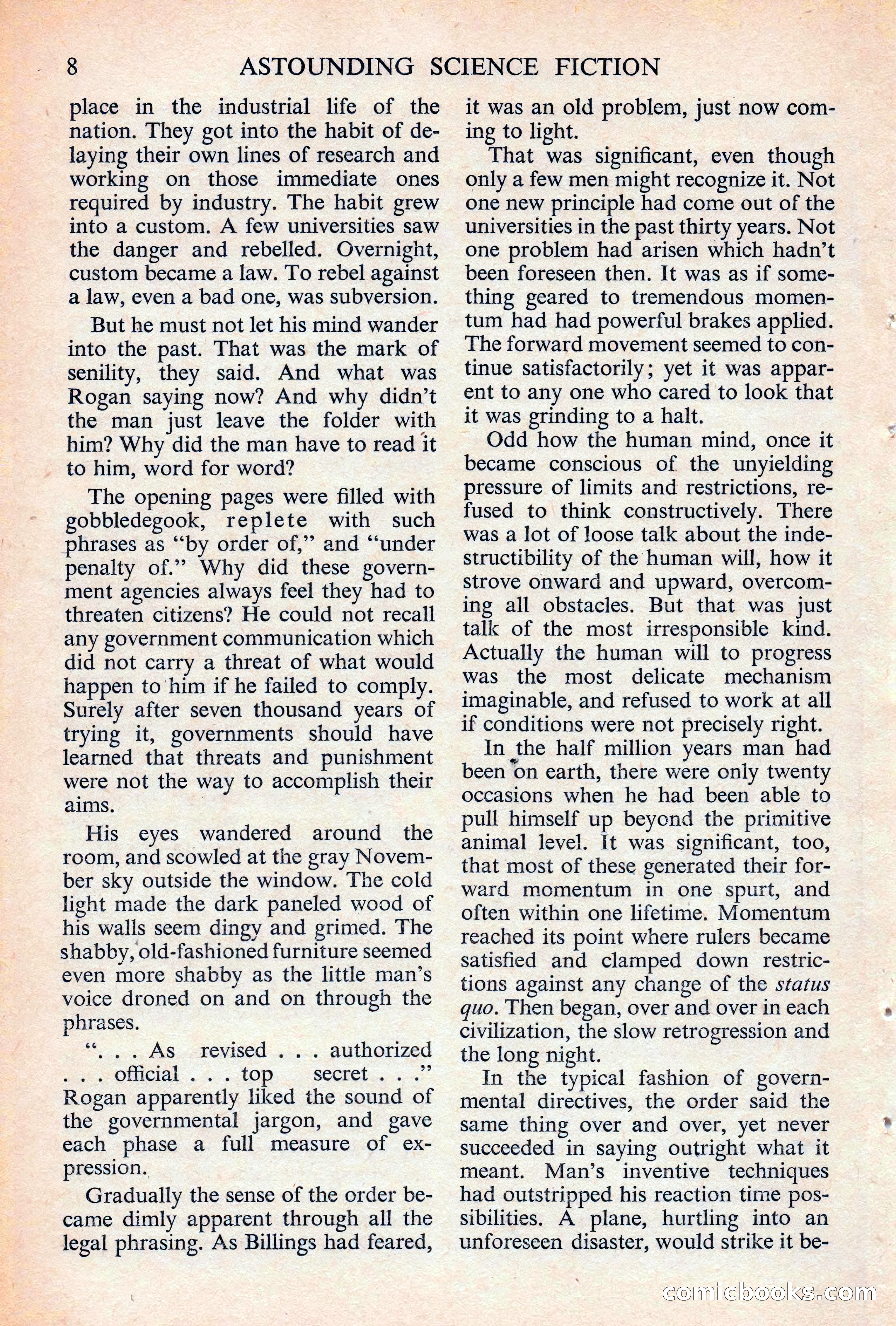
A restored page from Pulp Fiction, 1954. Page through the whole issue in the reader above.
📄 Transcribed text from this page (OCR, searchable)
Machine-transcribed from the original scan — historical spelling and the odd misread are preserved.
8 ASTOUNDING SCIENCE FICTION place in the industrial life of the nation. They got into the habit of de- laying their own lines of research and working on those immediate ones required by industry. The habit grew into a custom. A few universities saw the danger and rebelled. Overnight, custom became a law. To rebel against a law, even a bad one, was subversion. But he must not let his mind wander into the past. That was the mark of senility, they said. And what was Rogan saying now? And why didn't the man just leave the folder with him? Why did the man have to read it to him, word for word? The opening pages were filled with gobbledegook, replete with such phrases as “‘by order of,” and “under penalty of.” Why did these govern- ment agencies always feel they had to threaten citizens? He could not recall any government communication which did not carry a threat of what would happen to him if he failed to comply. Surely after seven thousand years of trying it, governments should have learned that threats and punishment were not the way to accomplish their aims. His eyes wandered around the room, and scowled at the gray Novem- ber sky outside the window. The cold light made the dark paneled wood of his walls seem dingy and grimed. The shabby, old-fashioned furniture seemed even more shabby as the little man’s voice droned on and on through the phrases. “|. . As revised . ... authorized . official . eetOD) 2 Seetet a ct Rogan apparently liked the sound of the governmental jargon, and gave each phase a full measure of ex- pression. Gradually the sense of the order be- came dimly apparent through all the legal phrasing. As Billings had feared, it was an old problem, just now com- ing to light. That was significant, even though only a few men might recognize it. Not one new principle had come out of the universities in the past thirty years. Not one problem had arisen which hadn’t been foreseen then. It was as if some- thing geared to tremendous momen- tum had had powerful brakes applied. The forward movement seemed to con- tinue satisfactorily; yet it was appar- ent to any one who cared to look that it was grinding to a halt. Odd how the human mind, once it became conscious of the unyielding pressure of limits and restrictions, re- fused to think constructively. There was a lot of loose talk about the inde- structibility of the human will, how it strove onward and upward, overcom- ing all obstacles. But that was just talk of the most irresponsible kind. Actually the human will to progress was the most delicate mechanism imaginable, and refused to work at all if conditions were not precisely right. In the half million years man had been ‘on earth, there were only twenty occasions when he had been able to pull himself up beyond the primitive animal level. It was significant, too, that most of these generated their for- ward momentum in one spurt, and often within one lifetime. Momentum reached its point where rulers became satisfied and clamped down restric- tions against any change of the status guo. Then began, over and over in each civilization, the slow retrogression and the long night. In the typical fashion of govern- mental directives, the order said the same thing over and over, yet never succeeded in saying outright what it meant. Man’s inventive techniques had outstripped his reaction time pos- sibilities. A plane, hurtling into an unforeseen disaster, would strike it be- conmlicloooks.c© iin