
Pulp Fiction, 1954 · page 12 of 132
Astounding Science Fiction, British Edition — page 12: what you’re looking at
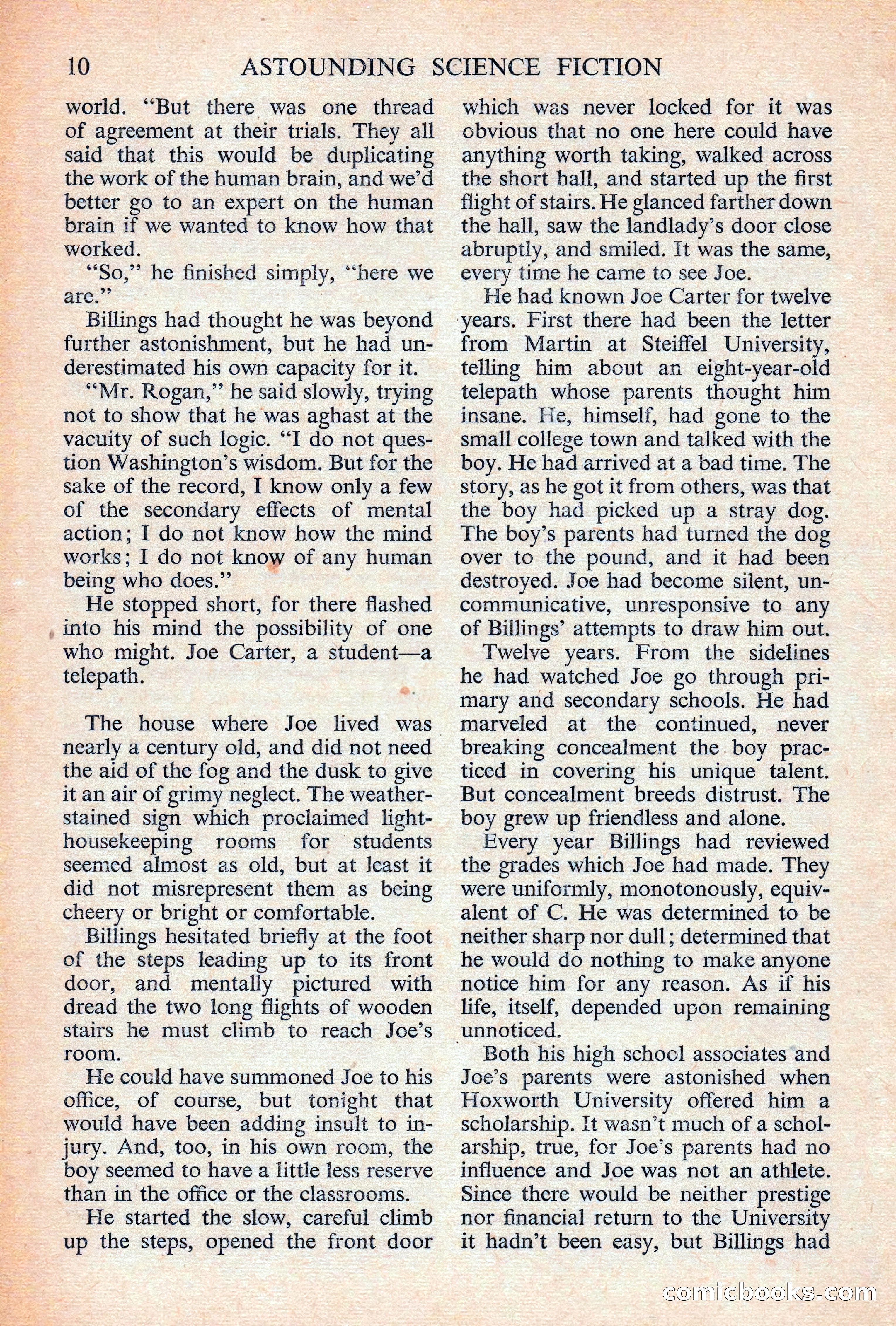
A restored page from Pulp Fiction, 1954. Page through the whole issue in the reader above.
📄 Transcribed text from this page (OCR, searchable)
Machine-transcribed from the original scan — historical spelling and the odd misread are preserved.
10 ASTOUNDING SCIENCE FICTION world. “But there was one thread of agreement at their trials. They all said that this would be duplicating the work of the human brain, and we’d better go to an expert on the human brain if we wanted to know how that worked. “So,” he finished simply, “here we are.” Billings had thought he was beyond further astonishment, but he had un- derestimated his own capacity for it. “Mr. Rogan,” he said slowly, trying not to show that he was aghast at the vacuity of such logic. “I do not ques- tion Washington’s wisdom. But for the sake of the record, I know only a few of the secondary effects of mental action; I do not know how the mind works; I do not know of any human being who does.” He stopped short, for there flashed , into his mind the possibility of one who might. Joe Carter, a student—a telepath. The house where Joe lived was nearly a century old, and did not need the aid of the fog and the dusk to give it an air of grimy neglect. The weather- stained sign which proclaimed light- housekeeping rooms for students seemed almost as old, but at Jeast it did not misrepresent them as being cheery or bright or comfortable. Billings hesitated briefly at the foot of the steps leading up to its front door, and mentally pictured with dread the two long flights of wooden stairs he must climb to reach Jce’s room. He could have summoned Joe to his office, of course, but tonight that would have been adding insult to in- jury. And, too, in his own room, the boy seemed to have a little less reserve than in the office or the classrooms. He started the slow, careful climb up the steps, opened the front door which was never locked for it was obvious that no one here could have anything worth taking, walked across the short hall, and started up the first flight of stairs. He glanced farther down the hall, saw the landlady’s door close abruptly, and smiled. It was the same, every time he came to see Joe. He had known Joe Carter for twelve years. First there had been the letter from Martin at Steiffel University, telling him about an eight-year-old telepath whose parents thought him insane. He, himself, had gone to the small college town and talked with the boy. He had arrived at a bad time. The story, as he got it from others, was that the boy had picked up a stray dog. The boy’s parents had turned the dog over to the pound, and it had been destroyed. Joe had become silent, un- communicative, unresponsive to any of Billings’ attempts to draw him out. Twelve years. From the sidelines he had watched Joe go through pri- mary and secondary schools. He had marveled at the continued, never breaking concealment the boy prac- ticed in covering his unique talent. But concealment breeds distrust. The boy grew up friendless and alone. Every year Billings had reviewed the grades which Joe had made. They were uniformly, monotonously, equiv- alent of C. He was determined to be neither sharp nor dull; determined that he would do nothing to make anyone notice him for any reason. As if his life, itself, depended upon remaining unnoticed. Both his high school associates and Joe’s parents were astonished when Hoxworth University offered him a scholarship. It wasn’t much of a schol- arship, true, for Joe’s parents had no influence and Joe was not an athlete. Since there would be neither prestige nor financial return to the University it hadn’t been easy, but Billings had Conniieclooolkks.c© iin