
Pulp Fiction, 1954 · page 9 of 132
Astounding Science Fiction, British Edition — page 9: what you’re looking at
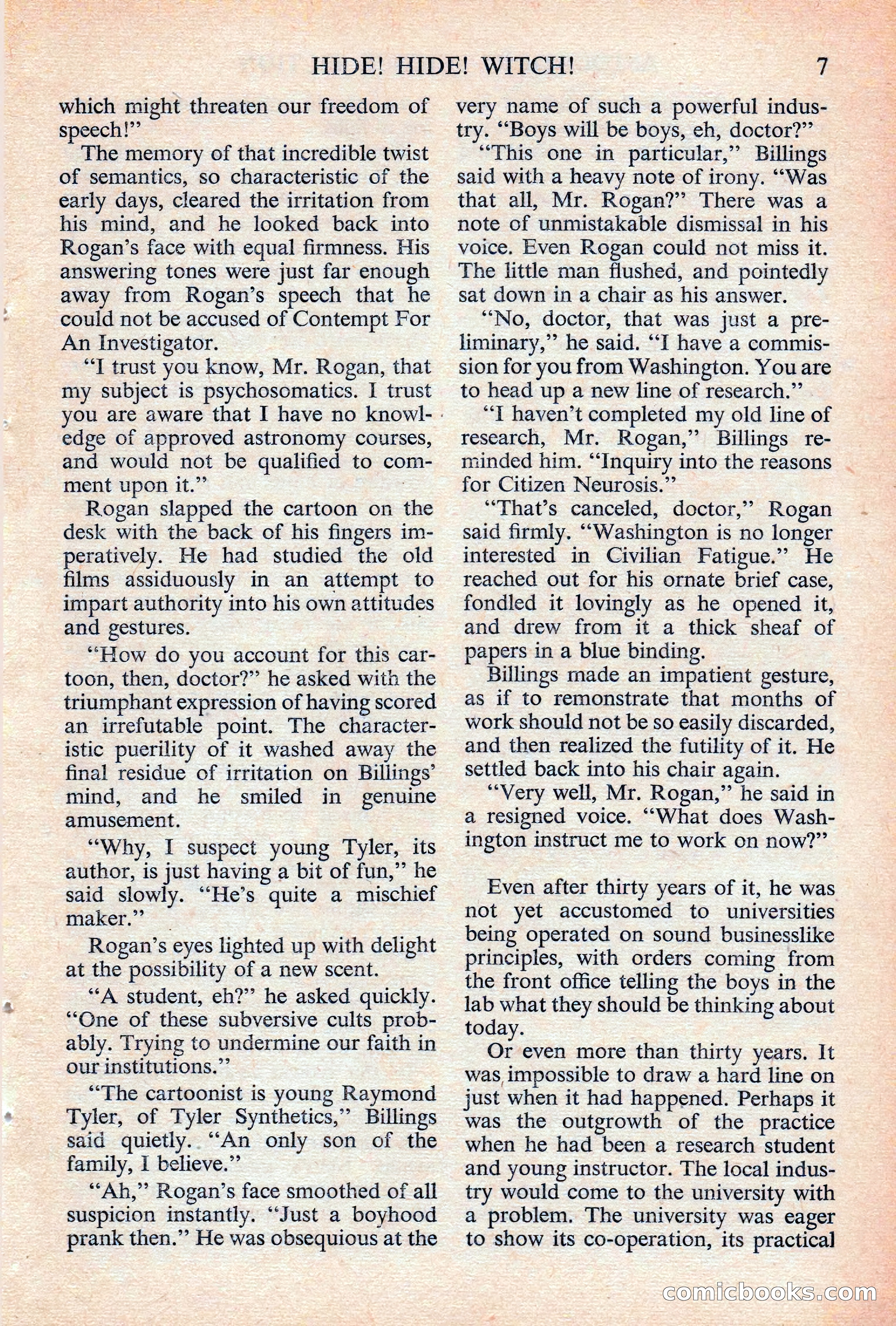
A restored page from Pulp Fiction, 1954. Page through the whole issue in the reader above.
📄 Transcribed text from this page (OCR, searchable)
Machine-transcribed from the original scan — historical spelling and the odd misread are preserved.
HIDE! HIDE! WITCH! 7 which might threaten our freedom of speech!”’ The memory of that incredible twist of semantics, so characteristic of the early days, cleared the irritation from his mind, and he looked back into Rogan’s face with equal firmness. His answering tones were just far enough away from Rogan’s speech that he could not be accused of Contempt For An Investigator. “T trust you know, Mr. Rogan, that my subject is psychosomatics. I trust you are aware that I have no knowl- - edge of approved astronomy courses, and would not be qualified to com- ment upon it.’ Rogan slapped the cartoon on the desk with the back of his fingers im- peratively. He had studied the old films assiduously in an attempt to impart authority into his own attitudes and gestures. ‘““How do you account for this car- toon, then, doctor?” he asked with the triumphant expression of having scored an irrefutable point. The character- istic puerility of it washed away the final residue of irritation on Billings’ mind, and he smiled in genuine amusement. “Why, I suspect young Tyler, its author, is just having a bit of fun,” he said slowly. “He’s quite a mischief Maker, Rogan’s eyes lighted up with delight at the possibility of a new scent. “A student, eh?’’ he asked quickly. “One of these subversive cults prob- ably. Trying to undermine our faith in our institutions.” “The cartoonist is young Raymond Tyler, of Tyler Synthetics,” Billings said quietly. “An only son of the family, I believe.”’ “Ah,” Rogan’s face smoothed of all suspicion instantly. “Just a boyhood prank then.”’ He was obsequious at the very name of such a powerful indus- try. “Boys will be boys, eh, doctor?” “This one in particular,” Billings said with a heavy note of irony. ““Was that all, Mr. Rogan?” There was a note of unmistakable dismissal in his voice. Even Rogan could not miss it. The little man flushed, and pointedly sat down in a chair as his answer. “No, doctor, that was just a pre- liminary,” he said. “I have a commis- sion for you from Washington. You are to head up a new line of research.” “I haven’t completed my old line of research, Mr. Rogan,” Billings re- ainded him. “Inquiry into the reasons for Citizen Neurosis.” “That’s canceled, doctor,” Rogan said firmly. “Washington i is no longer interested in Civilian Fatigue.’ He reached out for his ornate brief case, fondled it lovingly as he opened it, and drew from it a thick sheaf of papers in a blue binding. Billings made an impatient gesture, as if to remonstrate that months of work should not be so easily discarded, and then realized the futility of it. He settled back into his chair again. “Very well, Mr. Rogan,” he said in a resigned voice. ““What does Wash- ington instruct me to work on now?” Even after thirty years of it, he was not yet accustomed to universities being operated on sound businesslike principles, with orders coming from the front office telling the boys in the lab what they should be thinking about today. Or even more than thirty years. It was impossible to draw a hard line on just when it had happened. Perhaps it was the outgrowth of the practice when he had been a research student and young instructor. The local indus- try would come to the university with a problem. The university was eager to show its co-operation, its practical Cconmiclooolks.€c© im