
Pulp Fiction, 1954 · page 99 of 132
Astounding Science Fiction, British Edition — page 99: what you’re looking at
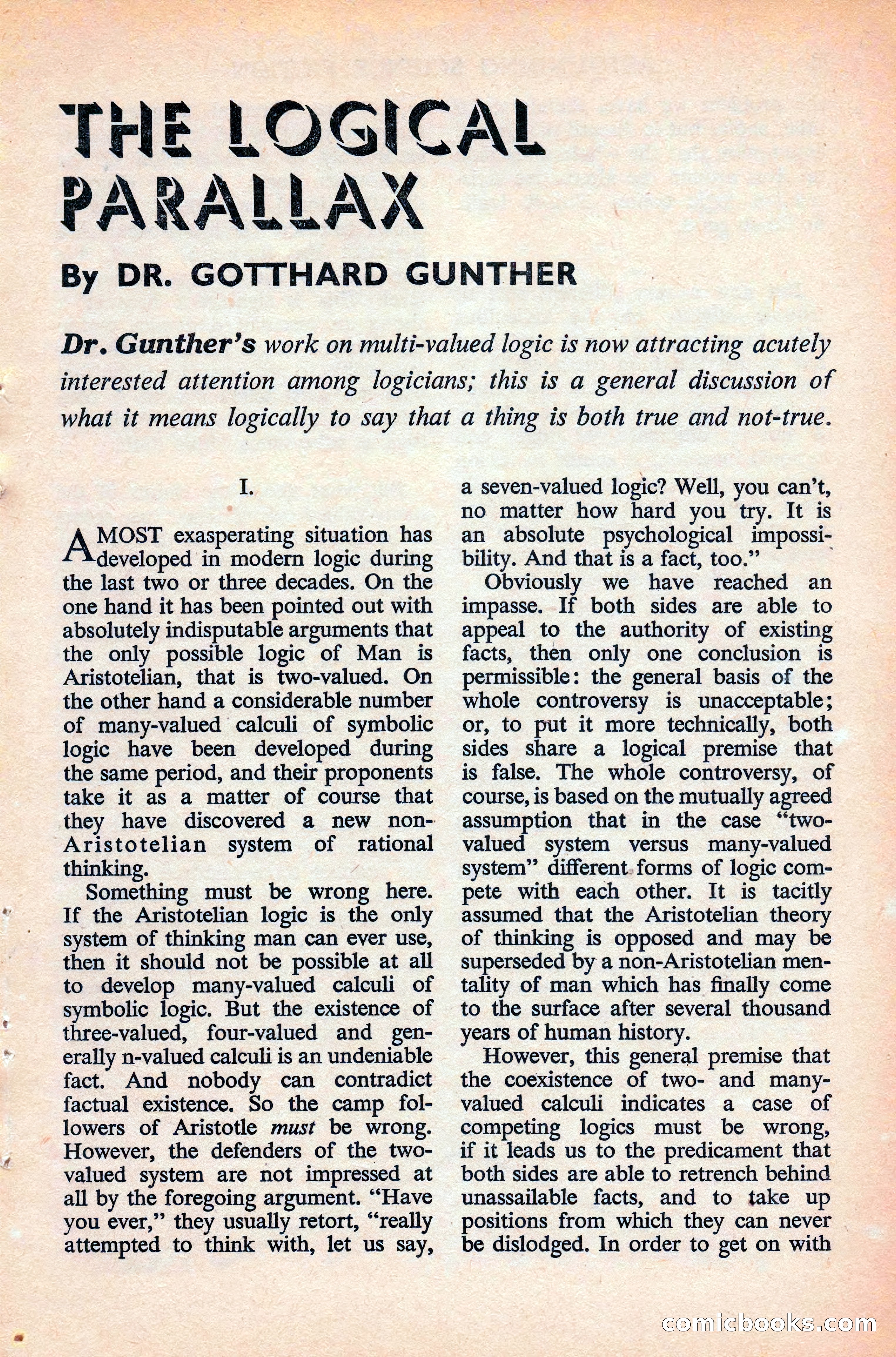
A restored page from Pulp Fiction, 1954. Page through the whole issue in the reader above.
📄 Transcribed text from this page (OCR, searchable)
Machine-transcribed from the original scan — historical spelling and the odd misread are preserved.
THE LOGICAL PARALLAX By DR. GOTTHARD GUNTHER Dr. Gunther’s work on multi-valued logic is now attracting acutely interested attention among logicians; this is a general discussion of what it means logically to say that a thing is both true and not-true. I, Ales exasperating situation has developed in modern logic during the last two or three decades. On the one hand it has been pointed out with absolutely indisputable arguments that the only possible logic of Man is Aristotelian, that is two-valued. On the other hand a considerable number of many-valued calculi of symbolic logic have been developed during the same period, and their proponents take it as a matter of course that they have discovered a new non- Aristotelian system of rational thinking. Something must be wrong here. If the Aristotelian logic is the only system of thinking man can ever use, then it should not be possible at all to develop many-valued calculi of symbolic logic. But the existence of three-valued, four-valued and gen- erally n-valued calculi is an undeniable fact. And nobody can contradict factual existence. So the camp fol- lowers of Aristotle must be wrong. However, the defenders of the two- valued system are not impressed at all by the foregoing argument. “Have you ever,” they usually retort, “really attempted to think with, let us say, a seven-valued logic? Well, you can’t, no matter how hard you try. It is an absolute psychological impossi- bility. And that is a fact, too.” Obviously we have reached an impasse. If both sides are able to appeal to the authority of existing facts, then only one conclusion is permissible: the general basis of the whole controversy is unacceptable; or, to put it more technically, both sides share a logical premise that is false. The whole controversy, of course, is based on the mutually agreed assumption that in the case “two- valued system versus many-valued system” different. forms of logic com- pete with each other. It is tacitly assumed that the Aristotelian theory of thinking is opposed and may be superseded by a non-Aristotelian men- tality of man which has finally come to the surface after several thousand years of human history. However, this general premise that the coexistence of two- and many- valued calculi indicates a case of competing logics must be wrong, if it leads us to the predicament that both sides are able to retrench behind unassailable facts, and to take up positions from which they can never be dislodged. In order to get on with Comichooksnco im