
Pulp Fiction, 1954 · page 98 of 132
Astounding Science Fiction, British Edition — page 98: what you’re looking at
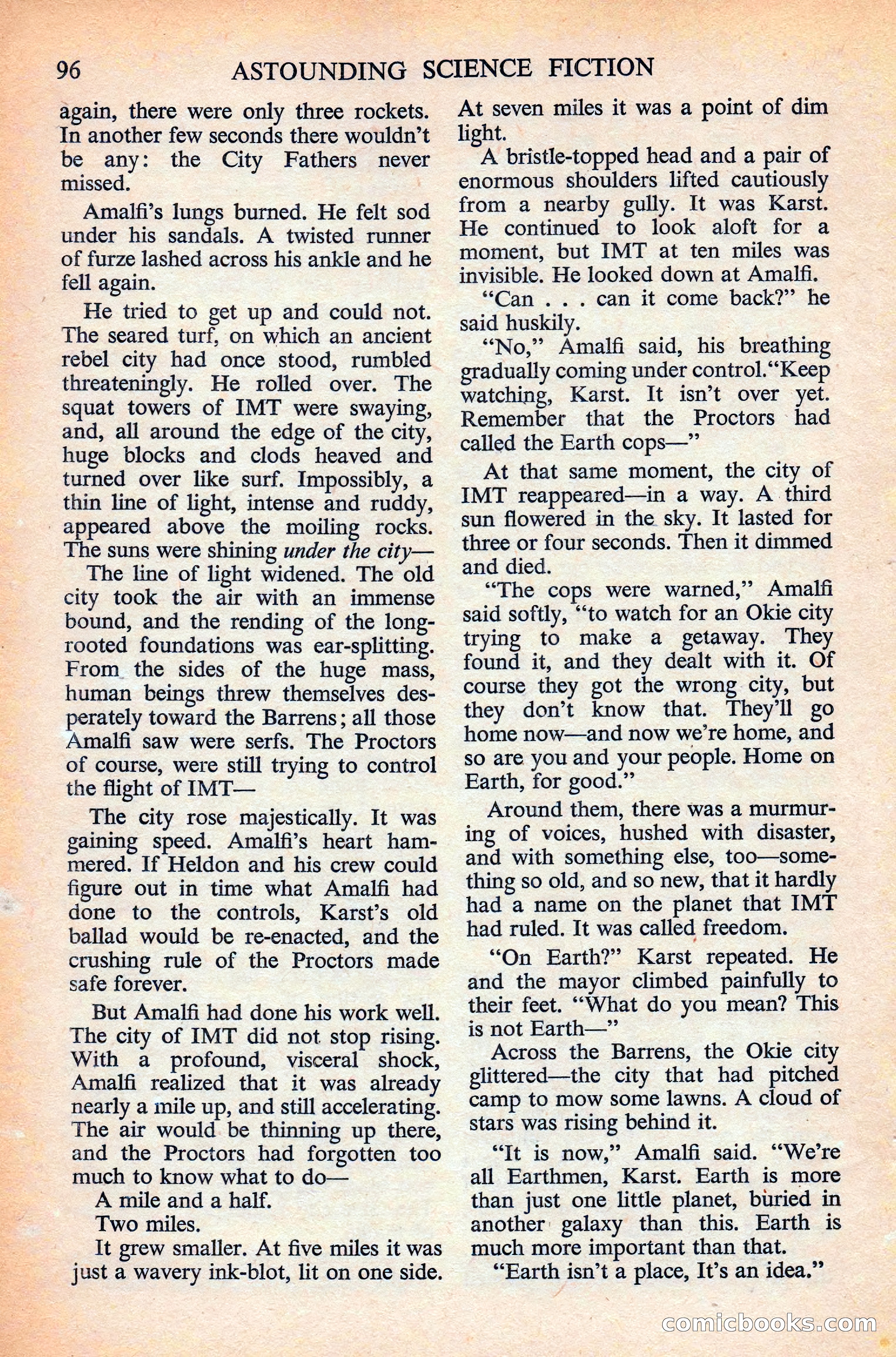
A restored page from Pulp Fiction, 1954. Page through the whole issue in the reader above.
📄 Transcribed text from this page (OCR, searchable)
Machine-transcribed from the original scan — historical spelling and the odd misread are preserved.
96 again, there were only three rockets. In another few seconds there wouldn’t be any: the City Fathers never missed. Amalfi’s lungs burned. He felt sod under his sandals. A twisted runner of furze lashed across his ankle and he fell again. He tried to get up and could not. The seared turf, on which an ancient rebel city had once stood, rumbled threateningly. He rolled over. The squat towers of IMT were swaying, and, all around the edge of the city, huge blocks and clods heaved and turned over like surf. Impossibly, a thin line of light, intense and ruddy, _ appeared above the moiling rocks. The suns were shining under the city— The line of light widened. The old city took the air with an immense bound, and the rending of the long- rooted foundations was ear-splitting. From the sides of the huge mass, human beings threw themselves des- perately toward the Barrens; all those Amalfi saw were serfs. The Proctors of course, were still trying to control the flight of IMT— The city rose majestically. It was gaining speed. Amalfi’s heart ham- mered. If Heldon and his crew could figure out in time what Amalfi had done to the controls, Karst’s old ballad would be re-enacted, and the crushing rule of the Proctors made safe forever. But Amalfi had done his work well. The city of IMT did not stop rising. With a profound, visceral shock, Amalfi realized that it was already nearly a mile up, and still accelerating. The air would be thinning up there, and the Proctors had forgotten too much to know what to do— A mile and a half. Two miles. It grew smaller. At five miles it was just a wavery ink-blot, lit on one side. ASTOUNDING SCIENCE FICTION At seven miles it was a point of dim light. A bristle-topped head and a pair of enormous shoulders lifted cautiously from a nearby gully. It was Karst. He continued to look aloft for a moment, but IMT at ten miles was invisible. He looked down at Amalfi. “Can... can it come back?” he said huskily. “No,” Amalfi said, his breathing gradually coming under control.““Keep watching, Karst. It isn’t over yet. Remember that the Proctors had called the Earth cops—” At that same moment, the city of IMT reappeared—in a way. A third sun flowered in the sky. It lasted for three or four seconds. Then it dimmed and died. “The cops were warned,” Amalfi said softly, “to watch for an Okie city trying to make a getaway. They found it, and they dealt with it. Of course they got the wrong city, but they don’t know that. They’ll go home now—and now we’re home, and so are you and your people. Home on Earth, for good.” Around them, there was a murmur- ing of voices, hushed with disaster, and with something else, too—some- thing so old, and so new, that it hardly had a name on the planet that IMT had ruled. It was called freedom. “On Earth?” Karst repeated. He and the mayor climbed painfully to their feet. ““What do you mean? This is not Earth—” Across the Barrens, the Okie city glittered—the city that had pitched camp to mow some lawns. A cloud of stars was rising behind it. “It is now,” Amalfi said. ““We’re all Earthmen, Karst. Earth is more than just one little planet, buried in another galaxy than this. Earth is much more important than that. “‘Rarth isn’t a place, It’s an idea.” Cconniclooolkks.c© iim