
Pulp Fiction, 1954 · page 100 of 132
Astounding Science Fiction, British Edition — page 100: what you’re looking at
A restored page from Pulp Fiction, 1954. Page through the whole issue in the reader above.
📄 Transcribed text from this page (OCR, searchable)
Machine-transcribed from the original scan — historical spelling and the odd misread are preserved.
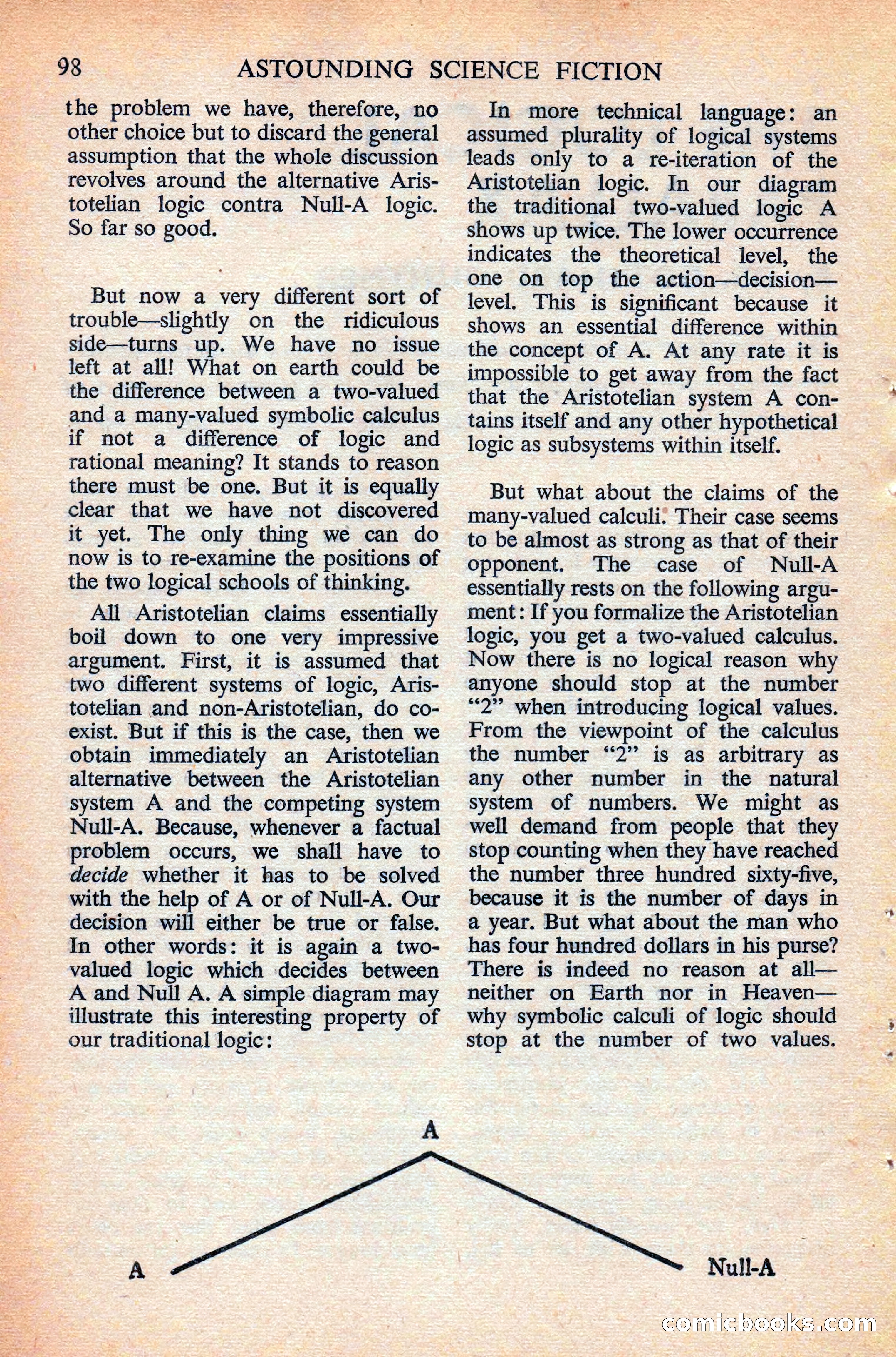
98 the problem we have, therefore, no other choice but to discard the general assumption that the whole discussion revolves around the alternative Aris- totelian logic contra Null-A logic. So far so good. But now a very different sort of trouble—slightly on the ridiculous side—turns up. We have no issue left at all! What on earth could be the difference between a two-valued and a many-valued symbolic calculus if not a difference of logic and rational meaning? It stands to reason there must be one. But it is equally clear that we have not discovered it yet. The only thing we can do now is to re-examine the positions of the two logical schools of thinking. All Aristotelian claims essentially boil down to one very impressive argument. First, it is assumed that two different systems of logic, Aris- totelian and non-Aristotelian, do co- exist. But if this is the case, then we obtain immediately an Aristotelian alternative between the Aristotelian system A and the competing system Null-A. Because, whenever a factual problem occurs, we shall have to decide whether it has to be solved with the help of A or of Null-A. Our decision will either be true or false. In other words: it is again a two- valued logic which decides between A and Null A. A simple diagram may illustrate this interesting property of our traditional logic: ASTOUNDING SCIENCE FICTION In more technical language: an assumed plurality of logical systems leads only to a re-iteration of the Aristotelian logic. In our diagram the traditional two-valued logic A shows up twice. The lower occurrence indicates the theoretical level, the one on top the action—decision— level. This is significant because it shows an essential difference within the concept of A. At any rate it is impossible to get away from the fact that the Aristotelian system A con- tains itself and any other hypothetical logic as subsystems within itself. But what about the claims of the many-valued calculi: Their case seems to be almost as strong as that of their opponent, The case of Null-A essentially rests on the following argu- ment: If you formalize the Aristotelian logic, you get a two-valued calculus. Now there is no logical reason why anyone should stop at the number “2” when introducing logical values. From the viewpoint of the calculus the number “2” is as arbitrary as any other number in the natural system of numbers. We might as well demand from people that they stop counting when they have reached the number three hundred sixty-five, because it is the number of days in a year. But what about the man who has four hundred dollars in his purse? There is indeed no reason at all— neither on Earth nor in Heaven— why symbolic calculi of logic should stop at the number of two values. Null-A COnMICOOKS. © im