
Pulp Fiction, 1954 · page 73 of 132
Astounding Science Fiction, British Edition — page 73: what you’re looking at
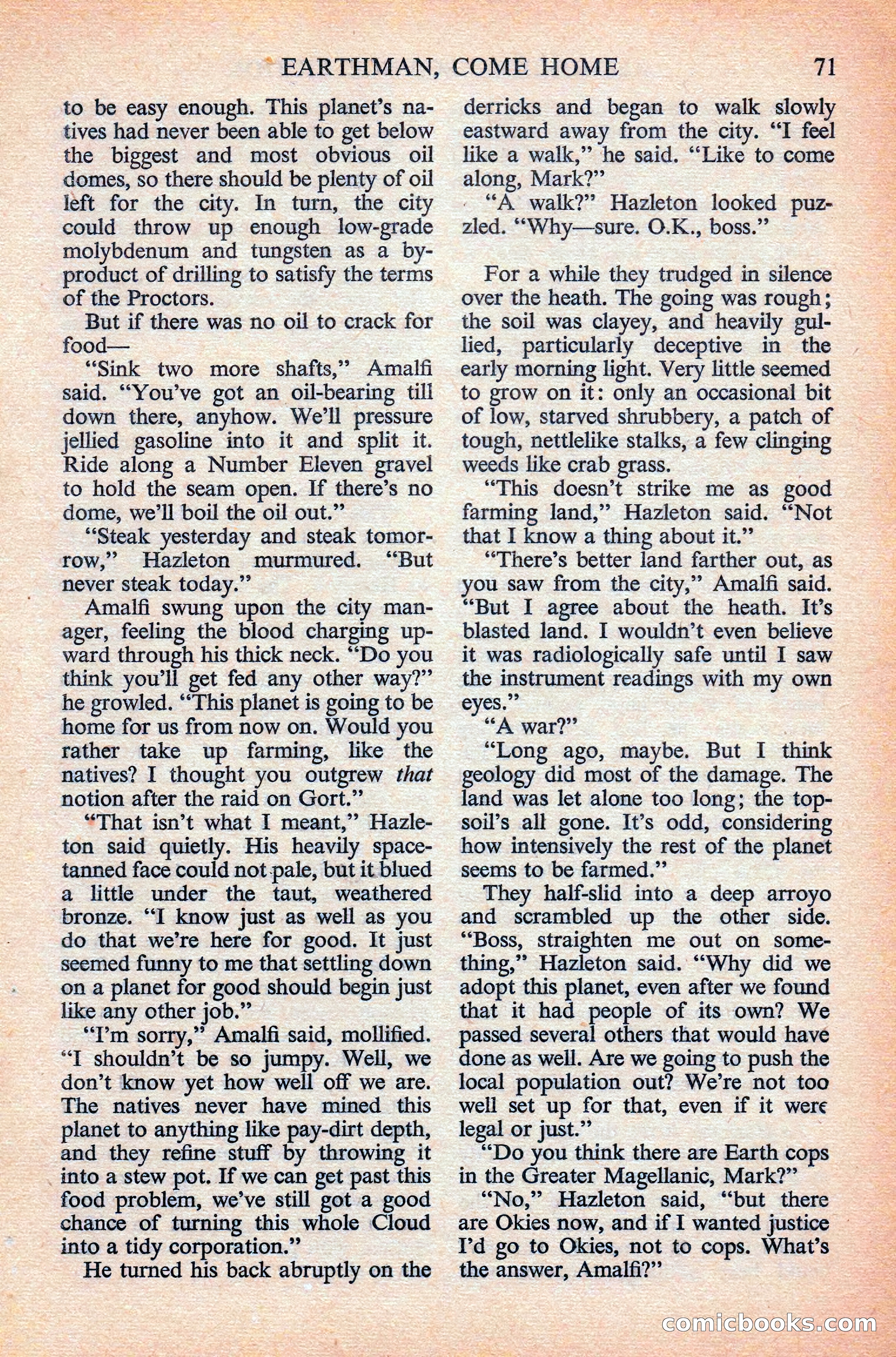
A restored page from Pulp Fiction, 1954. Page through the whole issue in the reader above.
📄 Transcribed text from this page (OCR, searchable)
Machine-transcribed from the original scan — historical spelling and the odd misread are preserved.
' EARTHMAN, COME HOME 71 to be easy enough. This planet’s na- tives had never been able to get below the biggest and most obvious oil domes, so there should be plenty of oil left for the city. In turn, the city could throw up enough low-grade molybdenum and tungsten as a by- product of drilling to satisfy the terms of the Proctors. But if there was no oil to crack for food— ‘Sink two more shafts,” Amalfi said. “You’ve got an oil-bearing till down there, anyhow. We'll pressure jellied gasoline into it and split it. Ride along a Number Eleven gravel to hold the seam open. If there’s no dome, we'll boil the oil out.” “Steak yesterday and steak tomor- row,” Hazleton murmured. “But never steak today.” Amalfi swung upon the city man- ager, feeling the blood charging up- ward through his thick neck. ““Do you think you'll get fed any other way?’ he growled. ““This planet is going to be home for us from now on. Would you rather take up farming, like the natives? I thought you outgrew that notion after the raid on Gort.” “That isn’t what I meant,” Hazle- ton said quietly. His heavily space- tanned face could not pale, but it blued a little under the taut, weathered bronze. “I know just as well as you do that we’re here for good. It just seemed funny to me that settling down on a planet for good should begin just like any other job.” “I’m sorry,” Amalfi said, mollified. “T shouldn’t be so jumpy. Well, we don’t know yet how well off we are. The natives never have mined this planet to anything like pay-dirt depth, and they refine stuff by throwing it into a stew pot. If we can get past this food problem, we’ve still got a good chance of turning this whole Cloud into a tidy corporation.” He turned his back abruptly on the derricks and began to walk slowly eastward away from the city. “I feel like a walk,” he said. ““Like to come along, Mark?” . “A walk?” Hazleton looked puz- zled. ““Why—sure. O.K., boss.” For a while they trudged in silence over the heath. The going was rough; the soil was clayey, and heavily gul- lied, particularly deceptive in the early morning light. Very little seemed to grow on it: only an occasional bit of low, starved shrubbery, a patch of tough, nettlelike stalks, a few clinging weeds like crab grass. : “This doesn’t strike me as good farming land,” Hazleton said. “Not that I know a thing about it.” “There’s better land farther out, as you saw from the city,” Amalfi said. “But I agree about the heath. It’s blasted land. I wouldn’t even believe it was radiologically safe until I saw the instrument readings with my own eyes.” “A war?” “Long ago, maybe. But I think geology did most of the damage. The land was let alone too long; the top- soil’s all gone. It’s odd, considering how intensively the rest of the planet seems to be farmed.” They half-slid into a deep arroyo and scrambled up the other side. “Boss, straighten me out on some- thing,”” Hazleton said. ““Why did we adopt this planet, even after we found that it had people of its own? We passed several others that would have done as well. Are we going to push the local population out? We’re not too well set up for that, even if it were legal or just.” | “Do you think there are Earth cops in the Greater Magellanic, Mark?” “No,” Hazleton said, “‘but there are Okies now, and if I wanted justice — I’d go to Okies, not to cops. What’s the answer, Amalfi?’ COMME OOK nEO)