
Pulp Fiction, 1954 · page 72 of 132
Astounding Science Fiction, British Edition — page 72: what you’re looking at
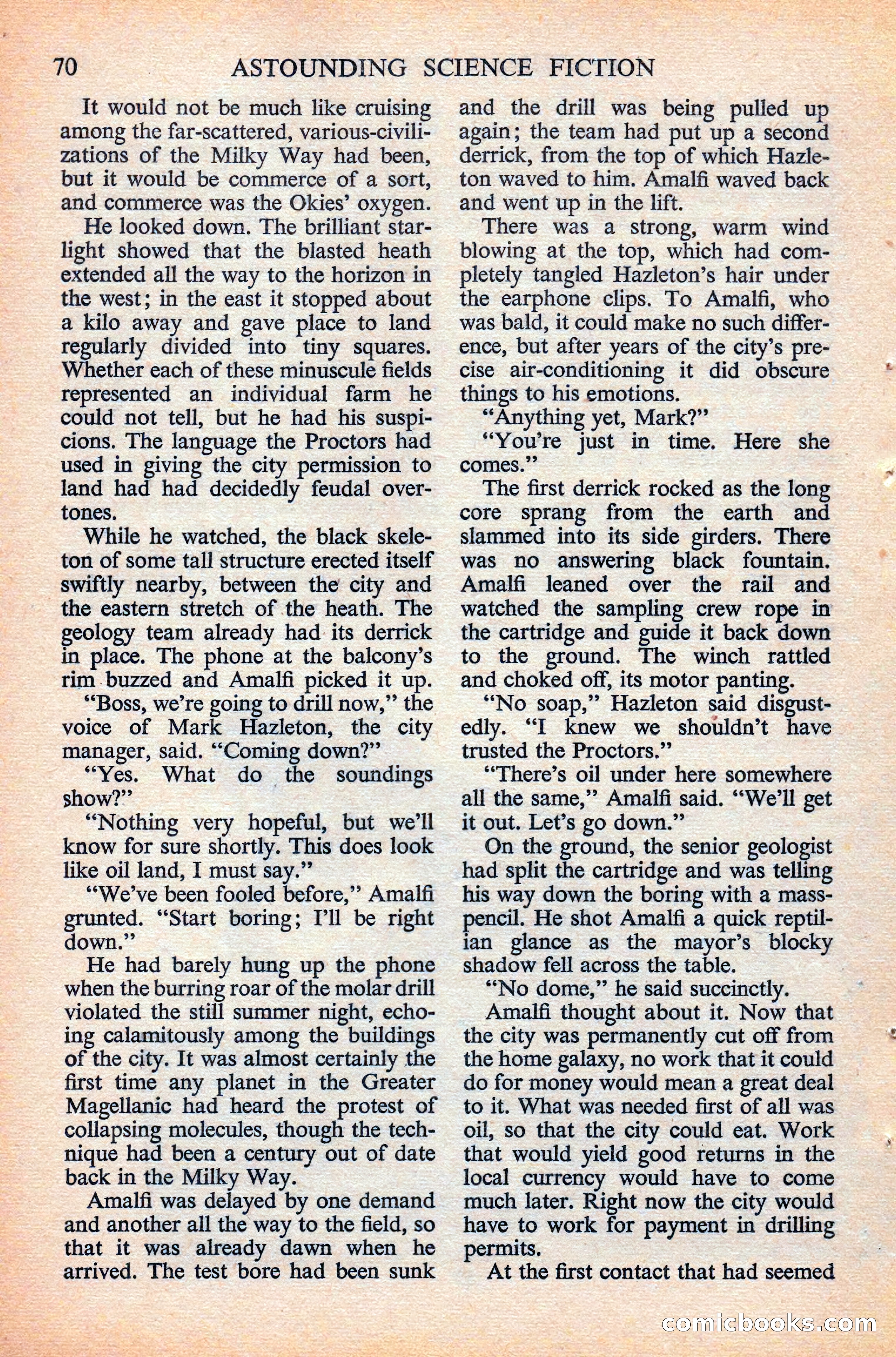
A restored page from Pulp Fiction, 1954. Page through the whole issue in the reader above.
📄 Transcribed text from this page (OCR, searchable)
Machine-transcribed from the original scan — historical spelling and the odd misread are preserved.
70 It would not be much like cruising among the far-scattered, various-civili- zations of the Milky Way had been, but it would be commerce of a sort, and commerce was the Okies’ oxygen. He looked down. The brilliant star- light showed that the blasted heath extended all the way to the horizon in the west; in the east it stopped about a kilo away and gave place to land regularly divided into tiny squares. Whether each of these minuscule fields represented an individual farm he could not tell, but he had his suspi- cions. The language the Proctors had used in giving the city permission to land had had decidedly feudal over- tones. While he watched, the black skele- ton of some tall structure erected itself swiftly nearby, between the city and the eastern stretch of the heath. The geology team already had its derrick in place. The phone at the balcony’s rim buzzed and Amalfi picked it up. “Boss, we’re going to drill now,” the voice of Mark Hazleton, the city manager, said. “Coming down?”’ “Yes. What do the soundings show?” “Nothing very hopeful, but we'll know for sure shortly. This does look like oil land, I must say.” ‘**We’ve been fooled before,’’ Amalfi grunted. “Start boring; Pll be right down.” He had barely hung up the phone when the burring roar of the molar drill violated the still summer night, echo- ing calamitously among the buildings of the city. It was almost certainly the first time any planet in the Greater Magellanic had heard the protest of collapsing molecules, though the tech- nique had been a century out of date back in the Milky Way. Amalfi was delayed by one demand and another all the way to the field, so that it was already dawn when he arrived. The test bore had been sunk ASTOUNDING SCIENCE FICTION and the drill was being pulled up again; the team had put up a second derrick, from the top of which Hazle- ton waved to him. Amalfi waved back and went up in the lift. There was a strong, warm wind blowing at the top, which had com- pletely tangled Hazleton’s hair under the earphone clips. To Amalfi, who was bald, it could make no such differ- ence, but after years of the city’s pre- cise air-conditioning it did obscure things to his emotions. “Anything yet, Mark?” “You're just in time. Here she comes.” The first derrick rocked as the long core sprang from the earth and slammed into its side girders. There was no answering black fountain. Amalfi leaned over the rail and watched the sampling crew rope in the cartridge and guide it back down to the ground. The winch rattled and choked off, its motor panting. “No soap,” Hazleton said disgust- edly. “I knew we shouldn’t have trusted the Proctors.” “There’s oil under here somewhere all the same,” Amalfi said. “We'll get it out. Let’s go down.” On the ground, the senior geologist had split the cartridge and was telling his way down the boring with a mass- pencil. He shot Amalfi a quick reptil- ian glance as the mayor’s blocky shadow fell across the table. *““No dome,” he said succinctly. Amalfi thought about it. Now that the city was permanently cut off from the home galaxy, no work that it could do for money would mean a great deal to it. What was needed first of all was oil, so that the city could eat. Work that would yield good returns in the local currency would have to come much later. Right now the city would have to work for payment in drilling ermits, At the first contact that had seemed Al EComichookssco