
Pulp Fiction, 1954 · page 74 of 132
Astounding Science Fiction, British Edition — page 74: what you’re looking at
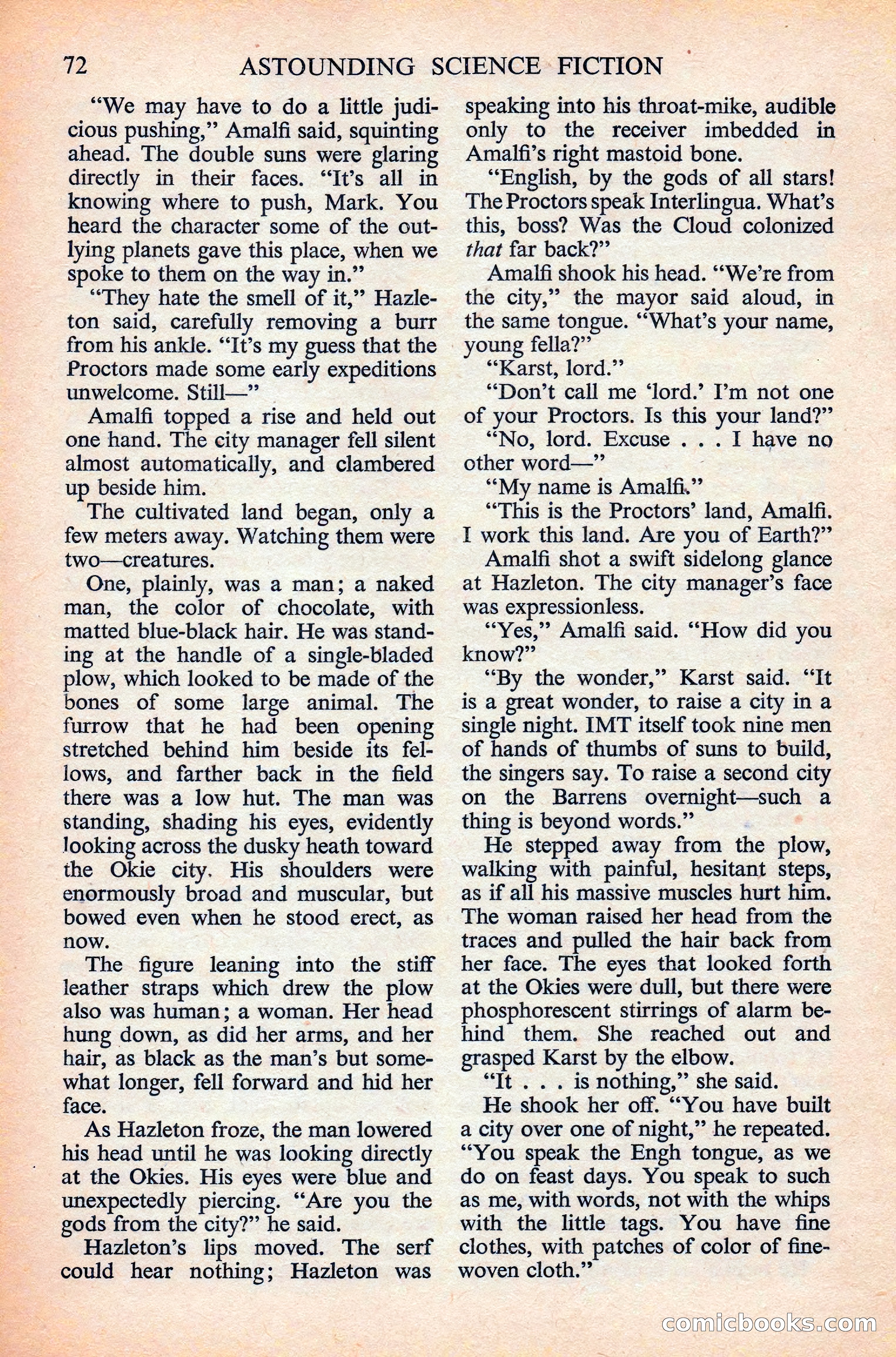
A restored page from Pulp Fiction, 1954. Page through the whole issue in the reader above.
📄 Transcribed text from this page (OCR, searchable)
Machine-transcribed from the original scan — historical spelling and the odd misread are preserved.
72 ASTOUNDING SCIENCE FICTION “We may have to do a little judi- cious pushing,” Amalfi said, squinting ahead. The double suns were glaring directly in their faces. “It’s all in knowing where to push, Mark. You heard the character some of the out- lying planets gave this place, when we spoke to them on the way in.” “They hate the smell of it,” Hazle- ton said, carefully removing a burr from his ankle. “It’s my guess that the Proctors made some early expeditions unwelcome. Still—” Amalfi topped a rise and held out one hand. The city manager fell silent almost automatically, and clambered up beside him. The cultivated land began, only a few meters away. Watching them were two—creatures. One, plainly, was a man; a naked man, the color of chocolate, with matted blue-black hair. He was stand- ing at the handle of a single-bladed plow, which looked to be made of the bones of some large animal. The furrow that he had been opening stretched behind him beside its fel- lows, and farther back in the field there was a low hut. The man was standing, shading his eyes, evidently looking across the dusky heath toward the Okie city. His shoulders were enormously broad and muscular, but bowed even when he stood erect, as now. The figure leaning into the stiff leather straps which drew the plow also was human; a woman. Her head hung down, as did her arms, and her hair, as black as the man’s but some- what longer, fell forward and hid her face. As Hazleton froze, the man lowered his head until he was looking directly at the Okies. His eyes were blue and unexpectedly piercing. “Are you the gods from the city?” he said. Hazleton’s lips moved. The serf could hear nothing; Hazleton was speaking into his throat-mike, audible only to the receiver imbedded in Amalfi’s right mastoid bone. “English, by the gods of all stars! The Proctors speak Interlingua. What’s this, boss? Was the Cloud colonized that far back?’ Amalfi shook his head. ‘‘We’re from the city,” the mayor said aloud, in the same tongue. ““What’s your name, young fella?’’ **Karst, lord.” “Don’t call me ‘lord.’ I’m not one of your Proctors. Is this your land?” ““No, lord. Excuse ...I have no other word—” “My name is Amalfi” “This is the Proctors’ land, Amalfi. I work this land. Are you of Earth?” Amalfi shot a swift sidelong glance at Hazleton. The city manager’s face was expressionless. “Yes,” Amalfi said. ““How did you know?” “By the wonder,” Karst said. “It is a great wonder, to raise a city in a single night. IMT itself took nine men of hands of thumbs of suns to build, the singers say. To raise a second city on the Barrens overnight—such a thing is beyond words.” He stepped away from the plow, walking with painful, hesitant steps, as if all his massive muscles hurt him. The woman raised her head from the traces and pulled the hair back from her face. The eyes that looked forth at the Okies were dull, but there were phosphorescent stirrings of alarm be- hind them. She reached out and grasped Karst by the elbow. “It... is nothing,” she said. He shook her off. “You have built a city over one of night,” he repeated. “You speak the Engh tongue, as we do on feast days. You speak to such as me, with words, not with the whips with the little tags. You have fine clothes, with patches of color of fine- woven cloth.” Connie oookks.c© im