
Pulp Fiction, 1954 · page 63 of 132
Astounding Science Fiction, British Edition — page 63: what you’re looking at
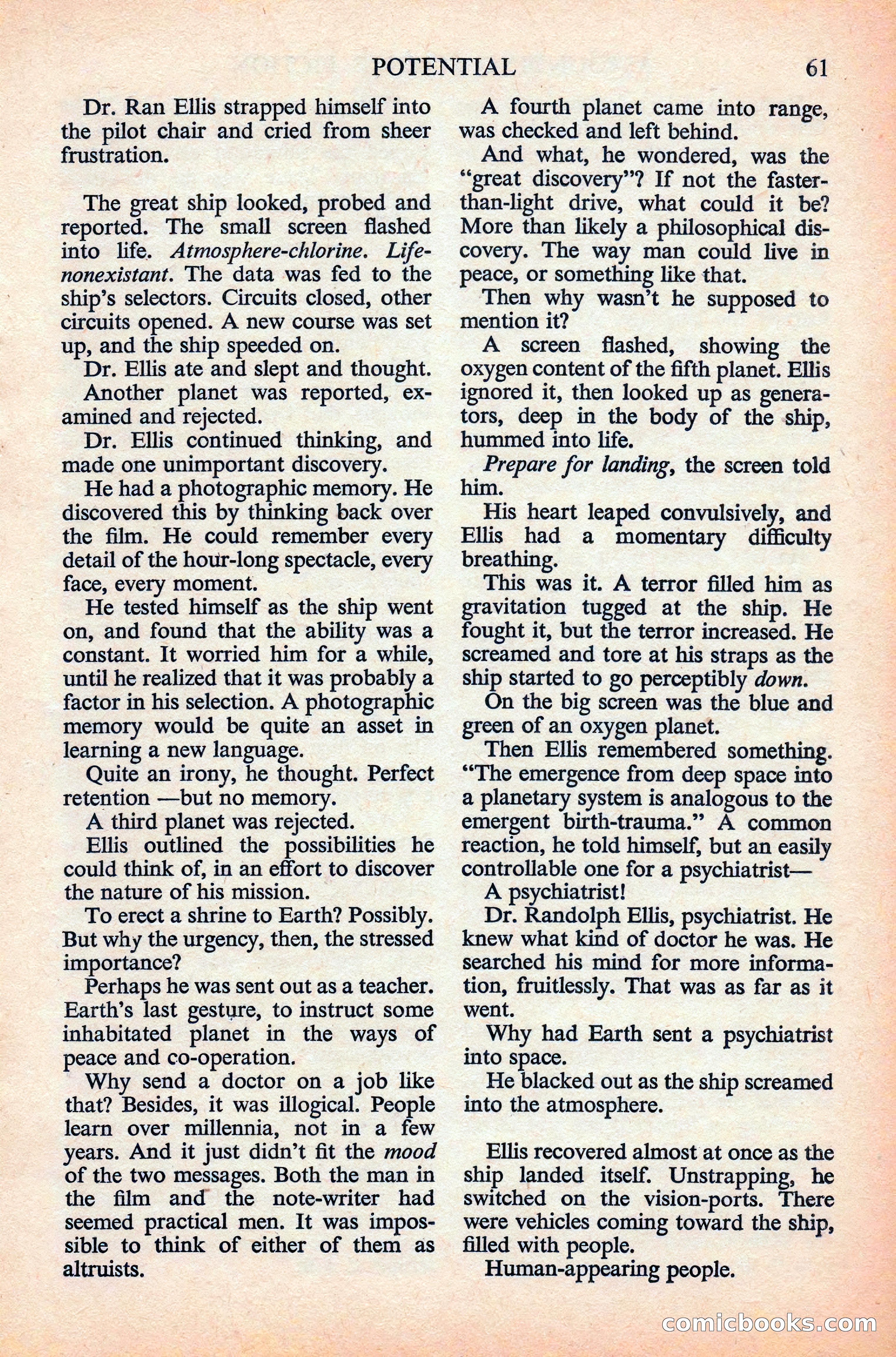
A restored page from Pulp Fiction, 1954. Page through the whole issue in the reader above.
📄 Transcribed text from this page (OCR, searchable)
Machine-transcribed from the original scan — historical spelling and the odd misread are preserved.
POTENTIAL 61 Dr. Ran Ellis strapped himself into the pilot chair and cried from sheer frustration. The great ship looked, probed and reported. The small screen flashed into life. Atmosphere-chlorine. Life- nonexistant. The data was fed to the ship’s selectors. Circuits closed, other circuits opened. A new course was set up, and the ship speeded on. Dr. Ellis ate and slept and thought. Another planet was reported, ex- amined and rejected. Dr. Ellis continued thinking, and made one unimportant discovery. He had a photographic memory. He discovered this by thinking back over the film. He could remember every detail of the hour-long spectacle, every face, every moment. He tested himself as the ship went on, and found that the ability was a constant. It worried him for a while, until he realized that it was probably a factor in his selection. A photographic memory would be quite an asset in learning a new language. Quite an irony, he thought. Perfect retention —but no memory. A third planet was rejected. Ellis outlined the possibilities he could think of, in an effort to discover the nature of his mission. To erect a shrine to Earth? Possibly. But why the urgency, then, the stressed importance? : Perhaps he was sent out as a teacher. Earth’s last gesture, to instruct some inhabitated planet in the ways of peace and co-operation. Why send a doctor on a job like that? Besides, it was illogical. People learn over millennia, not in a few years. And it just didn’t fit the mood of the two messages. Both the man in the film and the note-writer had seemed practical men. It was impos- sible to think of either of them as altruists. A fourth planet came into range, was checked and left behind. And what, he wondered, was the “great discovery”? If not the faster- than-light drive, what could it be? More than likely a philosophical dis- covery. The way man could live in peace, or something like that. Then why wasn’t he supposed to mention it? A screen flashed, showing the oxygen content of the fifth planet. Ellis ignored it, then looked up as genera- tors, deep in the body of the ship, hummed into life. _Prepare for landing, the screen told His heart leaped convulsively, and Ellis had a momentary difficulty breathing. This was it. A terror filled him as gravitation tugged at the ship. He fought it, but the terror increased. He screamed and tore at his straps as the ship started to go perceptibly down. On the big screen was the blue and green of an oxygen planet. Then Ellis remembered something. “The emergence from deep space into a planetary system is analogous to the emergent birth-trauma.” A common reaction, he told himself, but an easily controllable one for a psychiatrist— A psychiatrist! Dr. Randolph Ellis, psychiatrist. He knew what kind of doctor he was. He searched his mind for more informa- tion, fruitlessly. That was as far as it went. Why had Earth sent a psychiatrist into space. He blacked out as the ship screamed into the atmosphere. Ellis recovered almost at once as the ship landed itself. Unstrapping, he switched on the vision-ports. There were vehicles coming toward the ship, filled with people. Human-appearing people. Comichooksnco im