
Pulp Fiction, 1954 · page 64 of 132
Astounding Science Fiction, British Edition — page 64: what you’re looking at
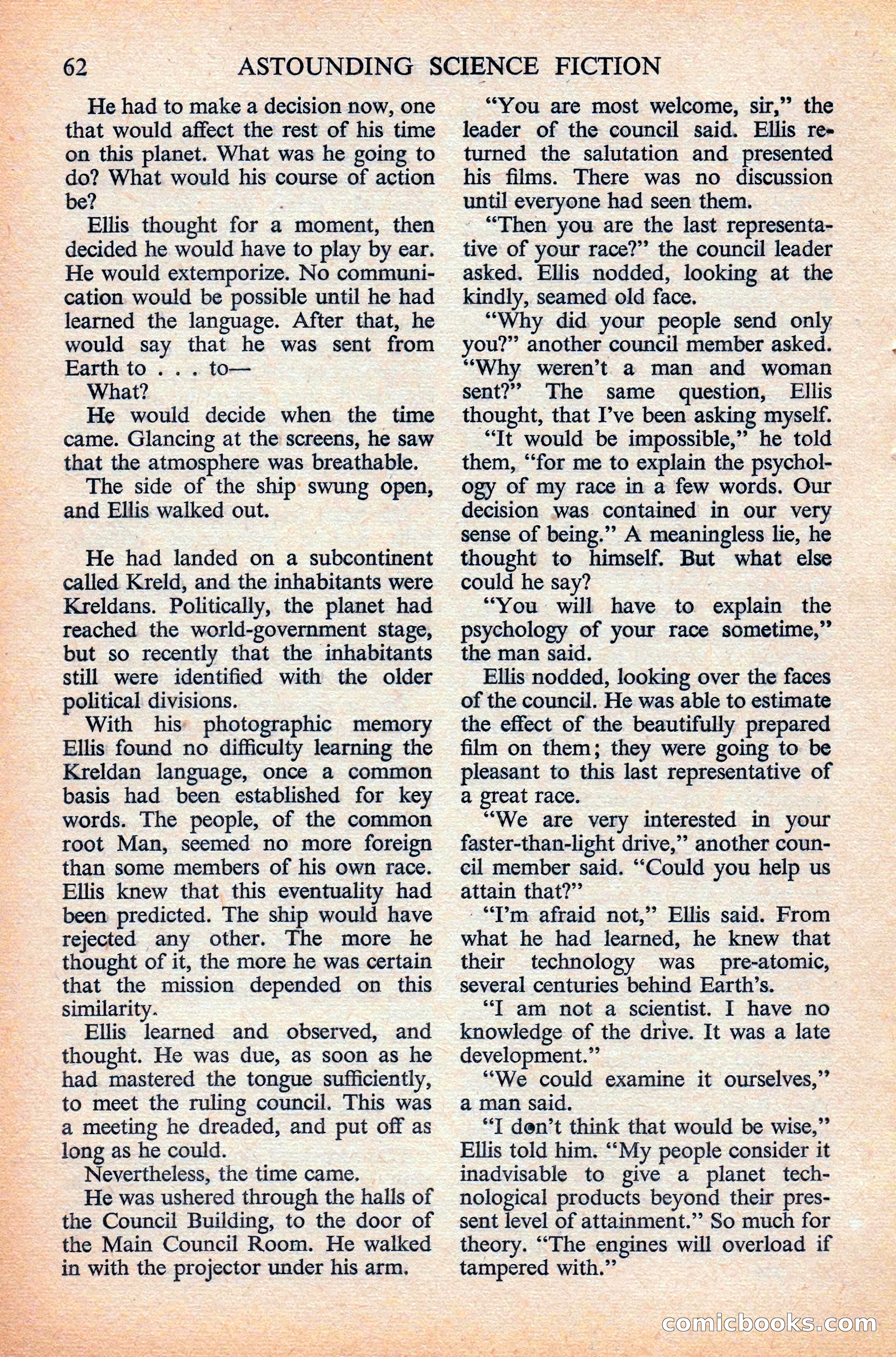
A restored page from Pulp Fiction, 1954. Page through the whole issue in the reader above.
📄 Transcribed text from this page (OCR, searchable)
Machine-transcribed from the original scan — historical spelling and the odd misread are preserved.
62 He had to make a decision now, one that would affect the rest of his time on this planet. What was he going to do? What would his course of action be? Ellis thought for a | moment, then decided he would have to play by ear. He would extemporize. No communi- cation would be possible until he had learned the language. After that, he would say that he was sent from Earth to... to— What? He would decide when the time came. Glancing at the screens, he saw that the atmosphere was breathable. The side of the ship swung open, and Ellis walked out. He had landed on a subcontinent called Kreld, and the inhabitants were Kreldans. Politically, the planet had reached the world-government stage, but so recently that the inhabitants still were identified with the older political divisions, With his’ photographic memory Ellis found no difficulty learning the Kreldan language, once a common basis had been established for key words. The people, of the common root Man, seemed no more foreign than some members of his own race. Ellis knew that this eventuality had been predicted. The ship would have rejected any other. The more he thought of it, the more he was certain that the mission depended on this similarity. Ellis learned and observed, and thought. He was due, as soon as he had mastered the tongue sufficiently, to meet the ruling council. This was a meeting he dreaded, and put off as long as he could. Nevertheless, the time came. He was ushered through the halls of the Council Building, to the door of the Main Council Room. He walked in with the projector under his arm. ASTOUNDING SCIENCE FICTION “You are most welcome, sir,” the leader of the council said. Ellis re» turned the salutation and presented his films. There was no discussion until everyone had seen them. ' “Then you are the last representa- tive of your race?” the council leader asked. Ellis nodded, looking at the kindly, seamed old face. “Why did your people send only you?” another council member asked. “Why weren’t a man and woman sent?” The same question, Ellis thought, that I’ve been asking myself. “It would be impossible,” he told them, “for me to explain the psychol- ogy of my race in a few words. Our decision was contained in our very sense of being.” A meaningless lie, he thought to himself. But what else could he say? “You will have to explain the psychology of your race sometime,” the man said. Ellis nodded, looking over the faces of the council. He was able to estimate the effect of the beautifully prepared film on them; they were going to be pleasant to this last representative of a great race. “We are very interested in your faster-than-light drive,” another coun- cil member said. “Could you help us attain that?” ~ “I’m afraid not,” Ellis said. From what he had learned, he knew that their technology was _ pre-atomic, several centuries behind Earth’s. “IT am not a scientist. I have no knowledge of the drive. It was a late development.” ‘“‘We could examine it ourselves,” a man said. “I den’t think that would be wise,” Ellis told him. ““My people consider it inadvisable to give a planet tech- nological products beyond their pres- sent level of attainment.” So much for theory. “The engines will overload if tampered with.” im EComichooksnco