
Pulp Fiction, 1954 · page 62 of 132
Astounding Science Fiction, British Edition — page 62: what you’re looking at
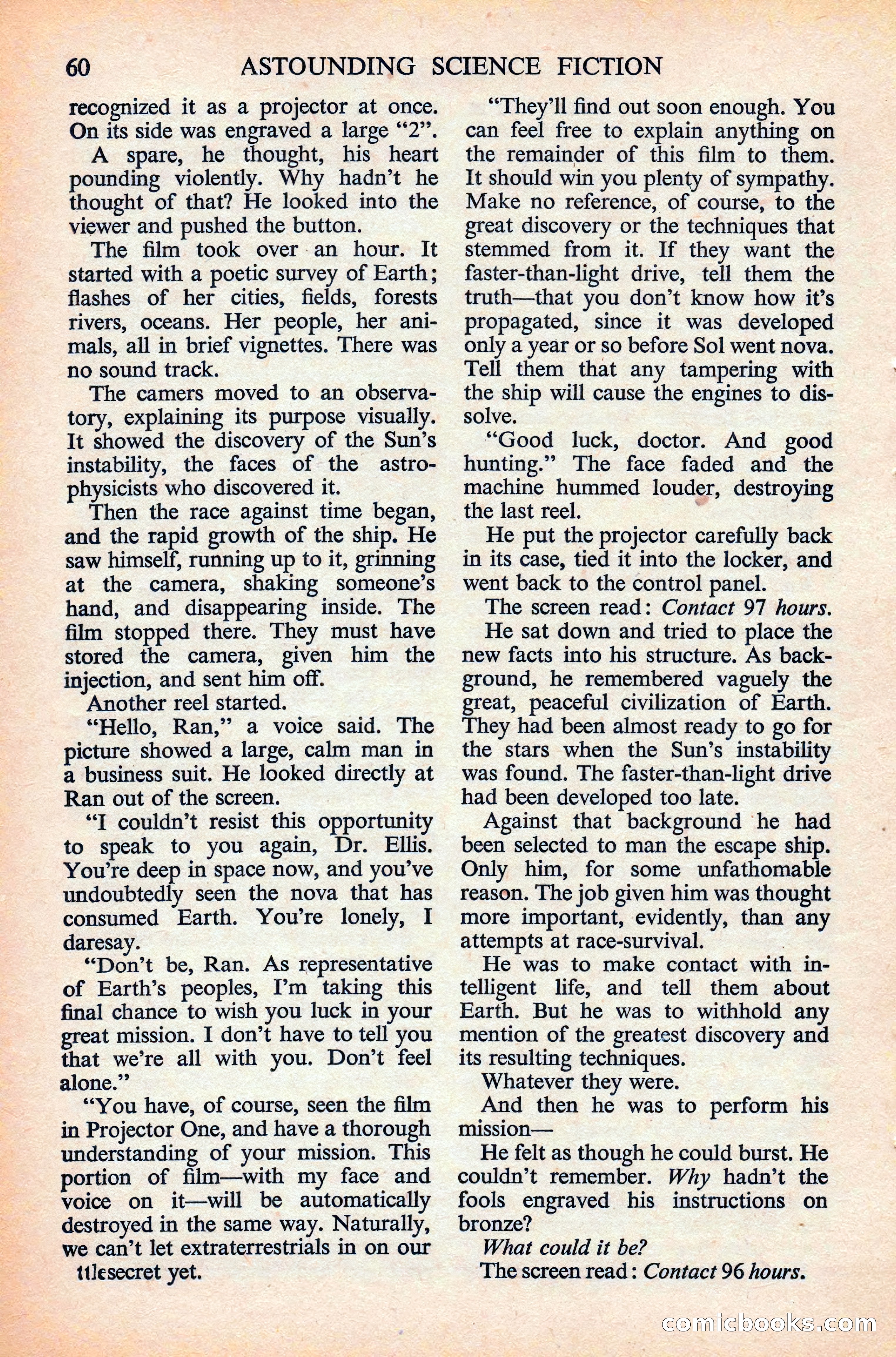
A restored page from Pulp Fiction, 1954. Page through the whole issue in the reader above.
📄 Transcribed text from this page (OCR, searchable)
Machine-transcribed from the original scan — historical spelling and the odd misread are preserved.
60 ASTOUNDING SCIENCE FICTION recognized it as a projector at once. On its side was engraved a large “2”. A spare, he thought, his heart pounding violently. Why hadn’t he thought of that? He looked into the viewer and pushed the button. The film took over-an hour. It started with a poetic survey of Earth; flashes of her cities, fields, forests rivers, oceans. Her people, her ani- mals, all in brief vignettes. There was no sound track. The camers moved to an observa- tory, explaining its purpose visually. It showed the discovery of the Sun’s instability, the faces of the astro- physicists who discovered it. Then the race against time began, and the rapid growth of the ship. He saw himself, running up to it, grinning at the camera, shaking someone’s hand, and disappearing inside. The film stopped there. They must have stored the camera, given him the injection, and sent him off. Another reel started. “Hello, Ran,’ a voice said. The picture showed a large, calm man in a business suit. He looked directly at Ran out of the screen. “T couldn’t resist this opportunity to speak to you again, Dr. Ellis. You're deep in space now, and you’ve undoubtedly seen the nova that has consumed Earth. You're lonely, I daresay. “Don’t be, Ran. As representative of Earth’s peoples, I’m taking this final chance to wish you luck in your great mission. I don’t have to tell you that we’re all with you. Don’t feel alone.” ‘““You have, of course, seen the film in Projector One, and have a thorough understanding of your mission. This portion of film—with my face and voice on it—will be automatically destroyed in the same way. Naturally, we can’t let extraterrestrials in on our ttlesecret yet. “They'll find out soon enough. You can feel free to explain anything on the remainder of this film to them. It should win you plenty of sympathy. Make no reference, of course, to the great discovery or the techniques that stemmed from it. If they want the faster-than-light drive, tell them the truth—that you don’t know how it’s propagated, since it was developed only a year or so before Sol went nova. Tell them that any tampering with the ship will cause the engines to dis- solve. “Good luck, doctor. And good hunting.” The face faded and the machine hummed louder, destroying the last reel. : He put the projector carefully back in its case, tied it into the locker, and went back to the control panel. The screen read: Contact 97 hours. He sat down and tried to place the new facts into his structure. As back- ground, he remembered vaguely the great, peaceful civilization of Earth. They had been almost ready to go for the stars when the Sun’s instability was found. The faster-than-light drive had been developed too late. Against that background he had been selected to man the escape ship. Only him, for some unfathomable reason. The job given him was thought more important, evidently, than any attempts at race-survival. : He was to make contact with in- telligent life, and tell them about Earth. But he was to withhold any mention of the greatest discovery and its resulting techniques. Whatever they were. And then he was to perform his mission— He felt as though he could burst. He couldn’t remember. Why hadn’t the fools engraved his instructions on bronze? What could it be? The screen read : Contact 96 hours. Conniclooolks.Cc© iin