
Pulp Fiction, 1954 · page 5 of 132
Astounding Science Fiction, British Edition — page 5: what you’re looking at
A restored page from Pulp Fiction, 1954. Page through the whole issue in the reader above.
📄 Transcribed text from this page (OCR, searchable)
Machine-transcribed from the original scan — historical spelling and the odd misread are preserved.
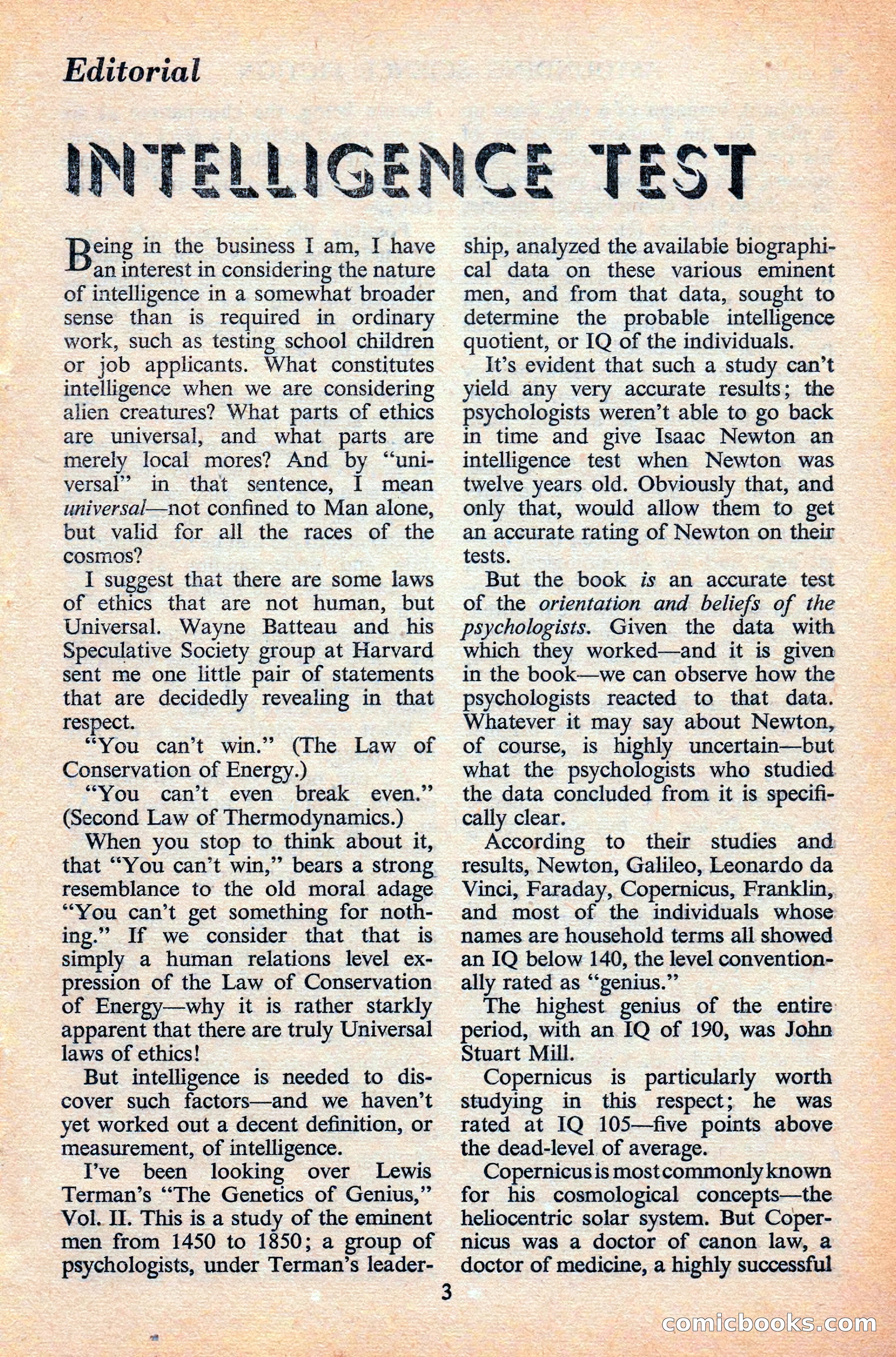
Editorial INTELLIG Bots in the business I am, I have an interest in considering the nature of intelligence in a somewhat broader sense than is required in ordina work, such as testing school children : or job applicants. What constitutes intelligence when we are considering alien creatures? What parts of ethics are universal, and what parts are merely local mores? And by “uni- versal” in that sentence, I mean universal—not confined to Man alone, but valid for all the races of the cosmos? I suggest that there are some laws of ethics that are not human, but Universal. Wayne Batteau and __his Speculative Society group at Harvard sent me one little pair of statements that are decidedly revealing in that respect. “You can’t win.’ (The Law of Conservation of Energy.) “You can’t even break even.” (Second Law of Thermodynamics.) When you stop to think about it, that “You can’t win,” bears a strong resemblance to the old moral adage “You can’t get something for noth- ing.” If we consider that that is simply a human relations level ex- pression of the Law of Conservation of Energy—why it is rather starkly apparent that there are truly Universal laws of ethics! But intelligence is needed to dis- cover such factors—and we haven't yet worked out a decent definition, or measurement, of intelligence. I’ve been looking over Lewis Terman’s ‘“‘The Genetics of Genius,” Vol. II. This is a study of the eminent men from 1450 to 1850; a group of psychologists, under Terman’s leader- ENCE TEST ship, analyzed the available biographi- cal data on these various eminent men, and from that data, sought to determine the probable intelligence quotient, or IQ of the individuals. It’s evident that such a study can’t yield any very accurate results; the psychologists weren’t able to go back in time and give Isaac Newton an intelligence test when Newton was twelve years old. Obviously that, and only that, would allow them to get an accurate rating of Newton on their tests. But the book is an accurate test of the orientation and beliefs of the psychologists. Given the data with which they worked—and it is given in the book—we can observe how the psychologists reacted to that data. Whatever it may say about Newton, of course, is highly uncertain—but what the psychologists who studied the data concluded from it is specifi- cally clear. According to their studies and results, Newton, Galileo, Leonardo da Vinci, Faraday, Copernicus, Franklin, and most of the individuals whose names are household terms all showed an IQ below 140, the level convention- ally rated as “genius.” The highest genius of the entire period, with an IQ of 190, was John Stuart Mill. Copernicus is particularly worth studying in this respect; he was rated at IQ 105—five points above the dead-level of average. Copernicus is mostcommonly known for his cosmological concepts—the heliocentric solar system. But Coper- nicus was a doctor of canon law, a doctor of medicine, a highly successful Qg EComichbooks.co im "