
Pulp Fiction, 1954 · page 6 of 132
Astounding Science Fiction, British Edition — page 6: what you’re looking at
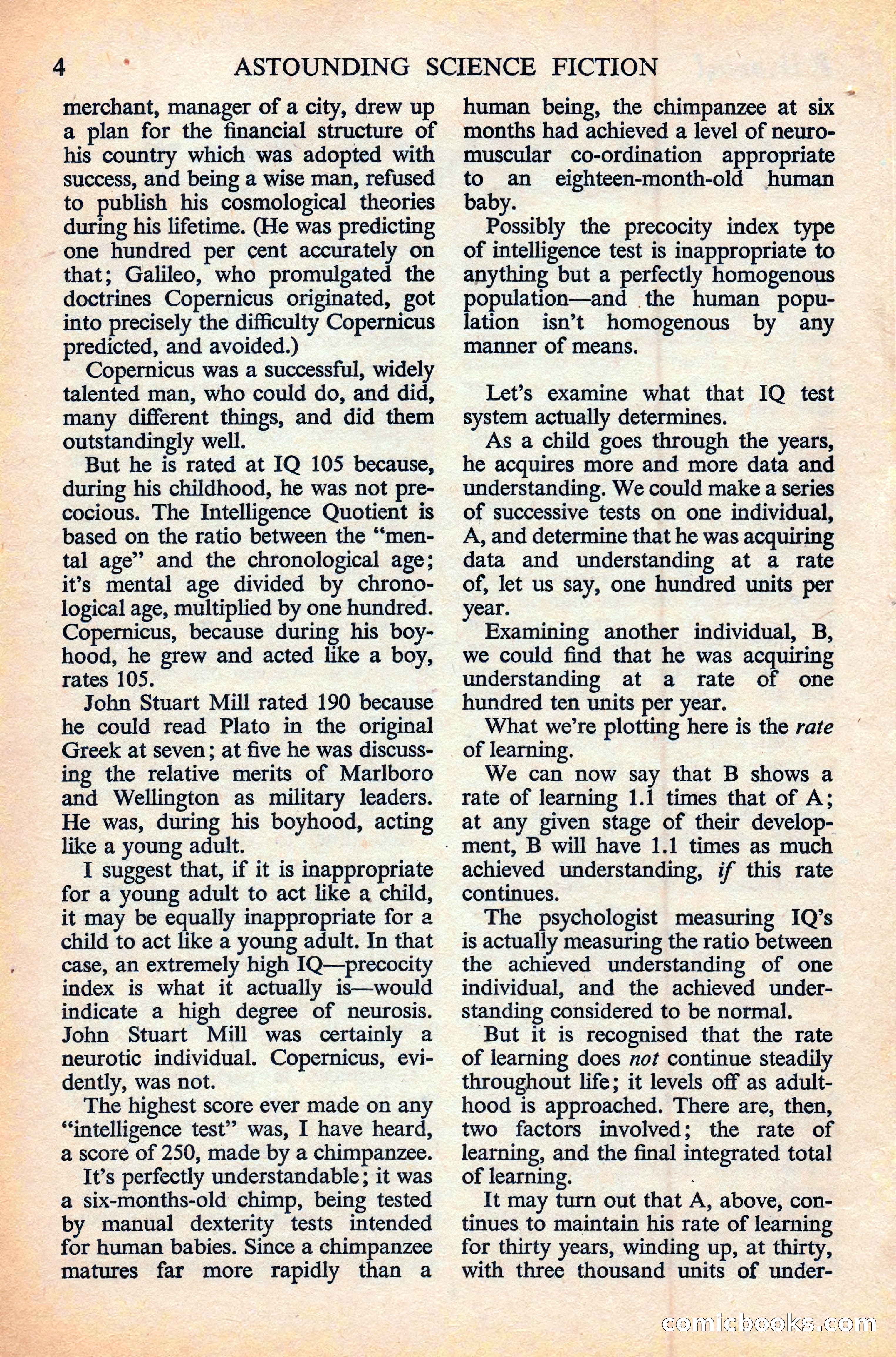
A restored page from Pulp Fiction, 1954. Page through the whole issue in the reader above.
📄 Transcribed text from this page (OCR, searchable)
Machine-transcribed from the original scan — historical spelling and the odd misread are preserved.
4 merchant, manager of a city, drew up a plan for the financial structure of his country which was adopted with success, and being a wise man, refused to publish his cosmological theories during his lifetime. (He was predicting one hundred per cent accurately on that; Galileo, who promulgated the doctrines Copernicus originated, got into precisely the difficulty Copernicus predicted, and avoided.) Copernicus was a successful, widely talented man, who could do, and did, many different things, and did them outstandingly well. But he is rated at IQ 105 because, during his childhood, he was not pre- cocious. The Intelligence Quotient is based on the ratio between the “‘men- tal age’? and the chronological age; it’s mental age divided by chrono- logical age, multiplied by one hundred. Copernicus, because during his boy- hood, he grew and acted like a boy, rates 105. John Stuart Mill rated 190 because he could read Plato in the original Greek at seven; at five he was discuss- ing the relative merits of Marlboro and Wellington as military leaders. He was, during his boyhood, acting like a young adult. I suggest that, if it is inappropriate for a young adult to act like a child, it may be equally inappropriate for a child to act like a young adult. In that case, an extremely high IQ—precocity index is what it actually is—would indicate a high degree of neurosis. John Stuart Mill was certainly a neurotic individual. Copernicus, evi- dently, was not. The highest score ever made on any “intelligence test” was, I have heard, a score of 250, made by a chimpanzee. It’s perfectly understandable; it was a six-months-old chimp, being tested by manual dexterity tests intended for human babies. Since a chimpanzee matures far more rapidly than a ASTOUNDING SCIENCE FICTION human being, the chimpanzee at six months had achieved a level of neuro- muscular co-ordination appropriate to an _ eighteen-month-old human baby. Possibly the precocity index type of intelligence test is inappropriate to anything but a perfectly homogenous population—and the human popu- lation isn’t homogenous by any manner of means. Let’s examine what that IQ test system actually determines. As a child goes through the years, he acquires more and more data and understanding. We could make a series of successive tests on one individual, A, and determine that he was acquiring data and understanding at a rate of, let us say, one hundred units per year. Examining another individual, B, we could find that he was acquiring understanding at a rate of one hundred ten units per year. What we’re plotting here is the rate of learning. We can now say that B shows a rate of learning 1.1 times that of A; at any given stage of their develop- - ment, B will have 1.1 times as much achieved understanding, if this rate continues. The psychologist measuring IQ’s is actually measuring the ratio between the achieved understanding of one individual, and the achieved under- standing considered to be normal. But it is recognised that the rate of learning does not continue steadily throughout life; it levels off as adult- hood is approached. There are, then, two factors involved; the rate of learning, and the final integrated total of learning. It may turn out that A, above, con- tinues to maintain his rate of learning for thirty years, winding up, at thirty, with three thousand units of under- = Cconmileloooks.c© im