
Pulp Fiction, 1954 · page 4 of 132
Astounding Science Fiction, British Edition — page 4: what you’re looking at
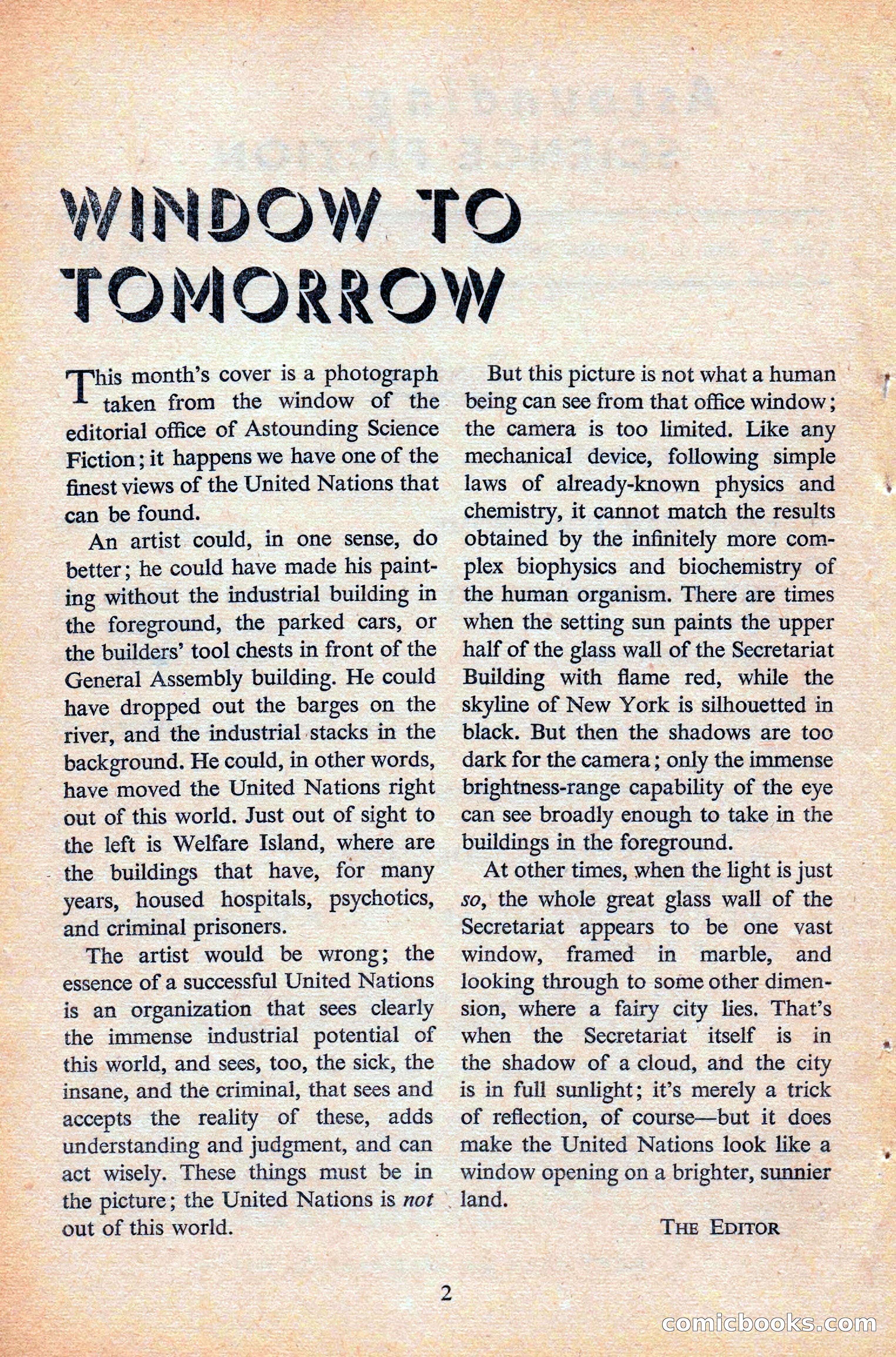
A restored page from Pulp Fiction, 1954. Page through the whole issue in the reader above.
📄 Transcribed text from this page (OCR, searchable)
Machine-transcribed from the original scan — historical spelling and the odd misread are preserved.
WINDOW TO TOMORROW oo month’s cover is a photograph taken from the window of the editorial office of Astounding Science Fiction; it happens we have one of the finest views of the United Nations that can be found. An artist could, in one sense, do better; he could have made his paint- ing without the industrial building in the foreground, the parked cars, or the builders’ tool chests in front of the General Assembly building. He could have dropped out the barges on the river, and the industrial stacks in the background. He could, in other words, have moved the United Nations right out of this world. Just out of sight to the left is Welfare Island, where are _ the buildings that have, for many years, housed hospitals, psychotics, and criminal prisoners. : The artist would be wrong; the essence of a successful United Nations is an organization that sees clearly the immense industrial potential of this world, and sees, too, the sick, the insane, and the criminal, that sees and accepts the reality of these, adds understanding and judgment, and can act wisely. These things must be in the picture; the United Nations is not out of this world. But this picture is not what a human © being can see from that office window ; the camera is too limited. Like any mechanical device, following simple laws of already-known physics and chemistry, it cannot match the results obtained by the infinitely more com- plex biophysics and biochemistry of the human organism. There are times when the setting sun paints the upper half of the glass wall of the Secretariat Building with flame red, while the skyline of New York is silhouetted in black. But then the shadows are too dark for the camera; only the immense brightness-range capability of the eye can see broadly enough to take in the buildings in the foreground. At other times, when the light is just so, the whole great glass wall of the Secretariat appears to be one vast window, framed in marble, and looking through to some other dimen- sion, where a fairy city lies, That’s when the Secretariat itself is in the shadow of a cloud, and the city is in full sunlight; it’s merely a trick of reflection, of course—but it does make the United Nations look like a window opening on a brighter, sunnier land. THE EDITOR ECoOmichooksaco im