
Pulp Fiction, 1954 · page 36 of 132
Astounding Science Fiction, British Edition — page 36: what you’re looking at
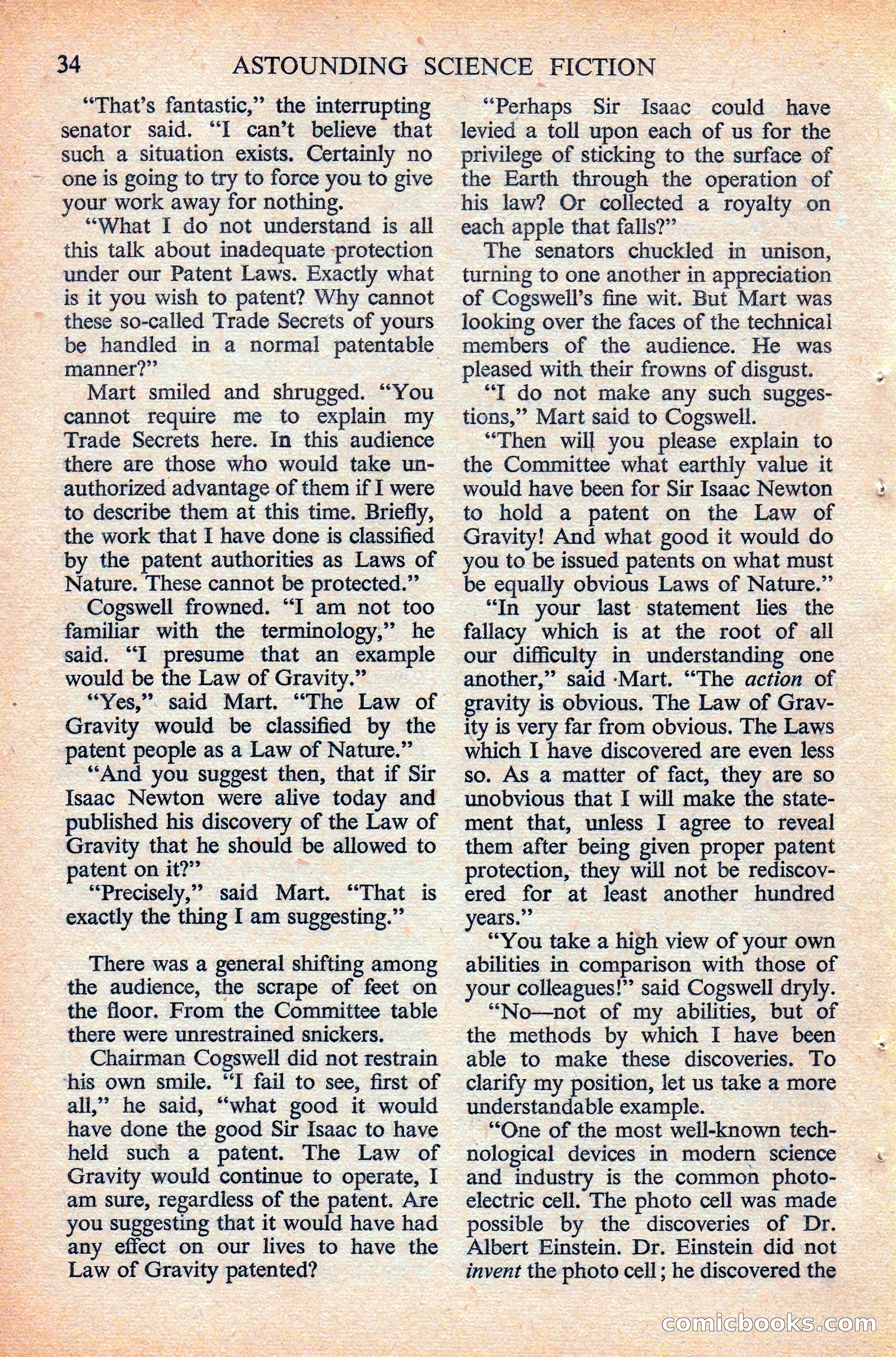
A restored page from Pulp Fiction, 1954. Page through the whole issue in the reader above.
📄 Transcribed text from this page (OCR, searchable)
Machine-transcribed from the original scan — historical spelling and the odd misread are preserved.
34 “That’s fantastic,” the interrupting senator said. “I can’t believe that such a situation exists. Certainly no one is going to try to force you to give your work away for nothing. “What I do not understand is all this talk about inadequate -protection under our Patent Laws. Exactly what is it you wish to patent? Why cannot these so-called Trade Secrets of yours be handled in a normal patentable manner?”’ Mart smiled and shrugged. “You cannot require me to explain my Trade Secrets here. In this audience there are those who would take un- authorized advantage of them if I were to describe them at this time. Briefly, the work that I have done is classified by the patent authorities as Laws of Nature. These cannot be protected.” Cogswell frowned. “I am not too familiar with the terminology,” he said. “I presume that an example would be the Law of Gravity.” “Yes,” said Mart. “The Law of Gravity would be classified by the patent people as a Law of Nature.” “And you suggest then, that if Sir Isaac Newton were alive today and published his discovery of the Law of Gravity that he should be allowed to patent on it?” “Precisely,” said Mart. “That is exactly the thing I am suggesting.” There was a general shifting among the audience, the scrape of feet on the floor. From the Committee table there were unrestrained snickers. Chairman Cogswell did not restrain ‘his own smile. “I fail to see, first of all,” he said, “what good it would have done the good Sir Isaac to have held such a patent. The Law of Gravity would continue to operate, I am sure, regardless of the patent. Are you suggesting that it would have had any effect on our lives to have the Law of Gravity patented? ASTOUNDING SCIENCE FICTION “Perhaps Sir Isaac could have levied a toll upon each of us for the privilege of sticking to the surface of the Earth through the operation of his law? Or collected a royalty on each apple that falls?” The senators chuckled in unison, turning to one another in appreciation of Cogswell’s fine wit. But Mart was looking over the faces of the technical members of the audience. He was pleased with their frowns of disgust. “I do not make any such sugges- tions,’ Mart said to Cogswell. “Then will you please explain to the Committee what earthly value it would have been for Sir Isaac Newton to hold a patent on the Law of Gravity! And what good it would do you to be issued patents on what must be equally obvious Laws of Nature.” “In your last statement lies the fallacy which is at the root of all our difficulty in understanding one another,” said -Mart. ““The action of gravity is obvious. The Law of Grav- ity is very far from obvious. The Laws which I have discovered are even less so. As a matter of fact, they are so unobvious that I will make the state- ment that, unless I agree to reveal them after being given proper patent protection, they will not be rediscoy- ered for at least another hundred ears.” “You take a high view of your own abilities in comparison with those of your colleagues!”’ said Cogswell dryly. “‘No—not of my abilities, but of the methods by which I have been able to make these discoveries. To clarify my position, let us take a more understandable example. “One of the most well-known tech- nological devices in modern science and industry is the common photo- electric cell. The photo cell was made possible by the discoveries of Dr. Albert Einstein. Dr. Einstein did not invent the photo cell; he discovered the Comichooksico in ie Al