
Pulp Fiction, 1954 · page 37 of 132
Astounding Science Fiction, British Edition — page 37: what you’re looking at
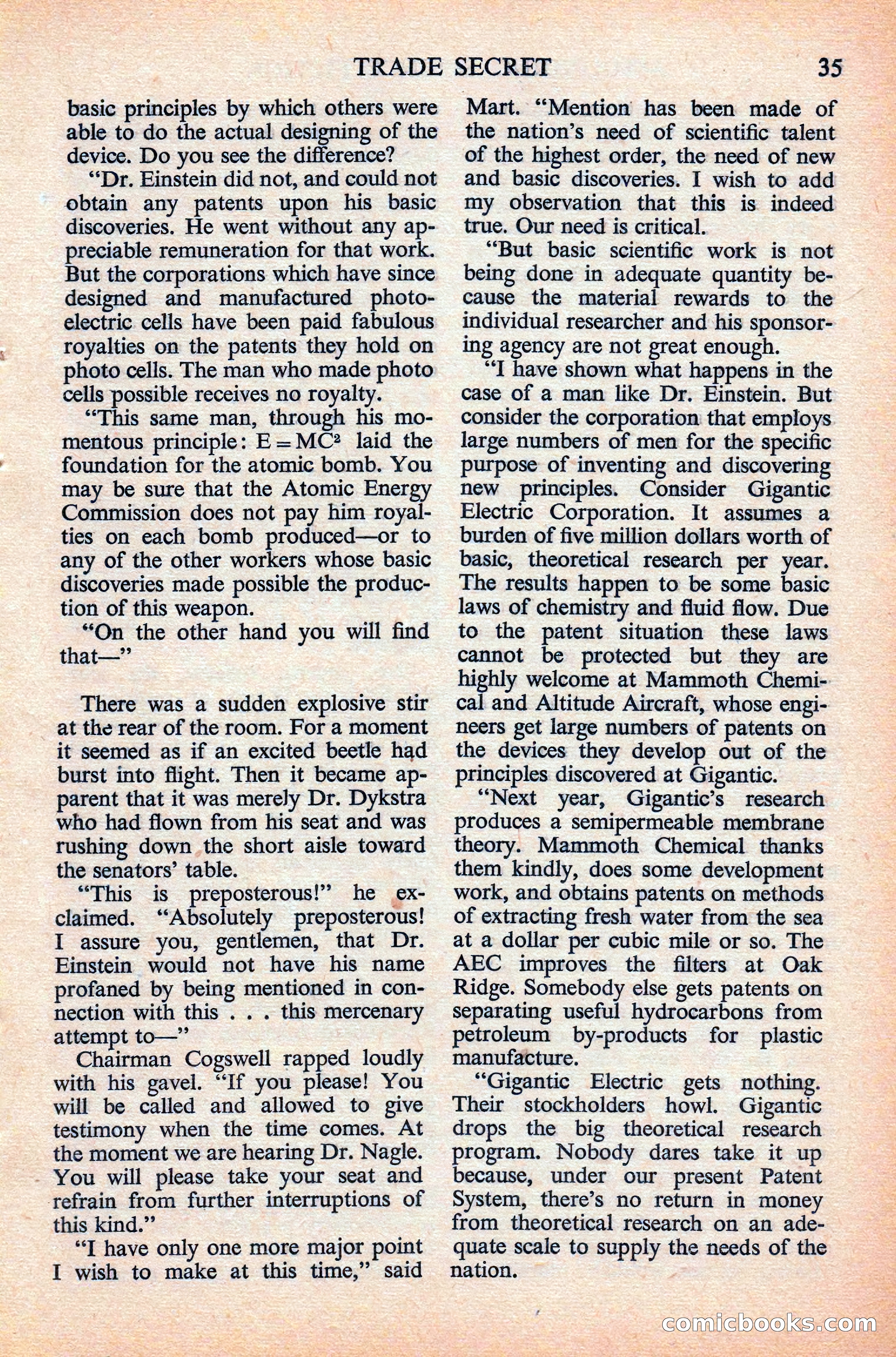
A restored page from Pulp Fiction, 1954. Page through the whole issue in the reader above.
📄 Transcribed text from this page (OCR, searchable)
Machine-transcribed from the original scan — historical spelling and the odd misread are preserved.
TRADE SECRET . 35 basic principles by which others were able to do the actual designing of the device. Do you see the difference? ‘“‘Dr. Einstein did not, and could not obtain any patents upon his basic discoveries. He went without any ap- preciable remuneration for that work. But the corporations which have since designed and manufactured photo- electric cells have been paid fabulous royalties on the patents they hold on photo cells. The man who made photo cells possible receives no royalty. “This same man, through his mo- mentous principle: E=MC? laid the foundation for the atomic bomb. You may be sure that the Atomic Energy Commission does not pay him royal- ties on each bomb produced—or to any of the other workers whose basic discoveries made possible the produc- tion of this weapon. “On the other hand you will find that—” There was a sudden explosive stir at the rear of the room. For a moment it seemed as if an excited beetle had burst into flight. Then it became ap- parent that it was merely Dr. Dykstra who had flown from his seat and was rushing down the short aisle toward the senators’ table. “This is preposterous!’ he ex- claimed. “Absolutely preposterous! I assure you, gentlemen, that Dr. Einstein would not have his name profaned by being mentioned in con- nection with this . . . this mercenary attempt to—” Chairman Cogswell rapped loudly with his gavel. “If you please! You will be called and allowed to give testimony when the time comes. At the moment we are hearing Dr. Nagle. - You will please take your seat and refrain from further interruptions of this kind.” “T have only one more major point I wish to make at this time,” said Mart. “Mention has been made of the nation’s need of scientific talent of the highest order, the need of new and basic discoveries. I wish to add my observation that this is indeed true. Our need is critical. “But basic scientific work is not being done in adequate quantity be- cause the material rewards to the individual researcher and his sponsor- ing agency are not great enough. ‘I have shown what happens in the case of a man like Dr. Einstein. But consider the corporation that employs large numbers of men for the specific purpose of inventing and discovering new principles. Consider Gigantic Electric Corporation. It assumes a burden of five million dollars worth of basic, theoretical research per year. The results happen to be some basic laws of chemistry and fluid flow. Due to the patent situation these laws cannot be protected but they are highly welcome at Mammoth Chemi- cal and Altitude Aircraft, whose engi- neers get large numbers of patents on the devices they develop out of the principles discovered at Gigantic. “Next year, Gigantic’s research produces a semipermeable membrane theory. Mammoth Chemical thanks them kindly, does some development work, and obtains patents on methods of extracting fresh water from the sea at a dollar per cubic mile or so. The AEC improves the filters at Oak Ridge. Somebody else gets patents on separating useful hydrocarbons from petroleum by-products for plastic manufacture. “Gigantic Electric gets nothing. Their stockholders howl. Gigantic drops the big theoretical research program. Nobody dares take it up because, under our present Patent System, there’s no return in money from theoretical research on an ade- quate scale to supply the needs of the nation. Comichbooks.co ae