
Pulp Fiction, 1954 · page 35 of 132
Astounding Science Fiction, British Edition — page 35: what you’re looking at
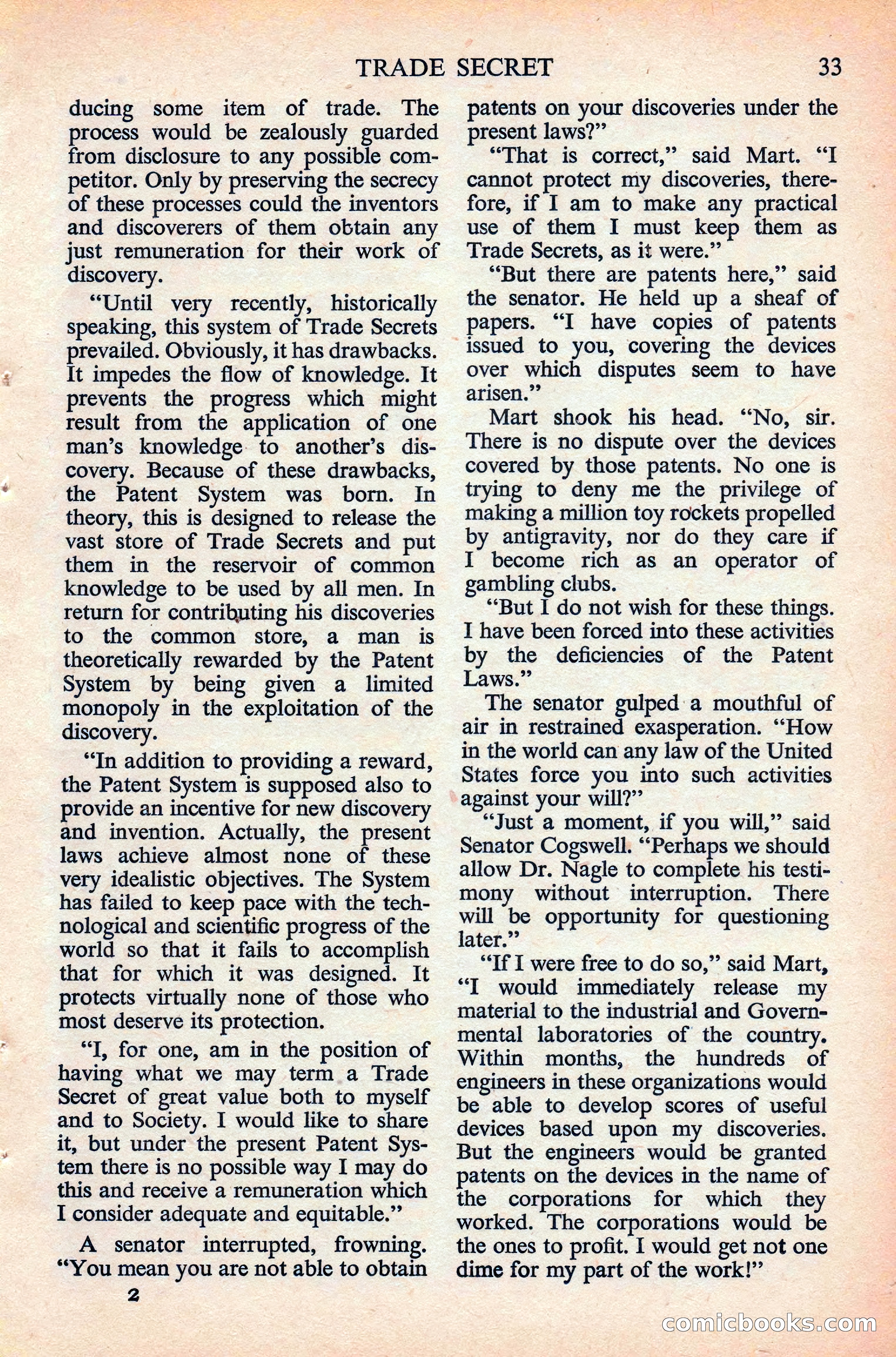
A restored page from Pulp Fiction, 1954. Page through the whole issue in the reader above.
📄 Transcribed text from this page (OCR, searchable)
Machine-transcribed from the original scan — historical spelling and the odd misread are preserved.
TRADE SECRET | 33 ducing some item of trade. The process would be zealously guarded from disclosure to any possible com- petitor. Only by preserving the secrecy of these processes could the inventors and discoverers of them obtain any just remuneration for their work of discovery. “Until very recently, historically speaking, this system of Trade Secrets prevailed. Obviously, it has drawbacks. It impedes the flow of knowledge. It prevents the progress which might result from the application of one man’s knowledge to another’s dis- covery. Because of these drawbacks, the Patent System was born. In theory, this is designed to release the vast store of Trade Secrets and put them in the reservoir of common knowledge to be used by all men. In return for contributing his discoveries to the common store, a man is theoretically rewarded by the Patent System by being given a limited monopoly in the exploitation of the discovery. “In addition to providing a reward, the Patent System is supposed also to provide an incentive for new discovery and invention. Actually, the present laws achieve almost none of these very idealistic objectives. The System has failed to keep pace with the tech- nological and scientific progress of the world so that it fails to accomplish that for which it was designed. It protects virtually none of those who most deserve its protection. “I, for one, am in the position of having what we may term a Trade Secret of great value both to myself and to Society. I would like to share it, but under the present Patent Sys- tem there is no possible way I may do this and receive a remuneration which I consider adequate and equitable.” A senator interrupted, frowning. “You mean you are not able to obtain 2 patents on your discoveries under the present laws?” “That is correct,” said Mart. “I cannot protect my discoveries, there- fore, if I am to make any practical use of them I must keep them as Trade Secrets, as it were.” “But there are patents here,” said the senator. He held up a sheaf of papers. “I have copies of patents issued to you, covering the devices over which disputes seem to have arisen.” Mart shook his head. ‘‘No, sir. There is no dispute over the devices covered by those patents. No one is trying to deny me the privilege of making a million toy rockets propelled by antigravity, nor do they care if I become rich as an operator of gambling clubs. “But I do not wish for these things. I have been forced into these activities by the deficiencies of the Patent Laws.” The senator gulped a mouthful of air in restrained exasperation. ““How in the world can any law of the United States force you into such activities against your will?” “Just a moment, if you will,” said Senator Cogswell. ““Perhaps we should allow Dr. Nagle to complete his testi- mony without interruption. There will be opportunity for questioning later.” “If I were free to do so,” said Mart, “I would immediately release my material to the industrial and Govern- mental laboratories of the country. Within months, the hundreds of engineers in these organizations would be able to develop scores of useful devices based upon my discoveries. But the engineers would be granted patents on the devices in the name of the corporations for which they worked. The corporations would be the ones to profit. I would get not one dime for my part of the work!” CoOmichooksico im