
Pulp Fiction, 1954 · page 34 of 132
Astounding Science Fiction, British Edition — page 34: what you’re looking at
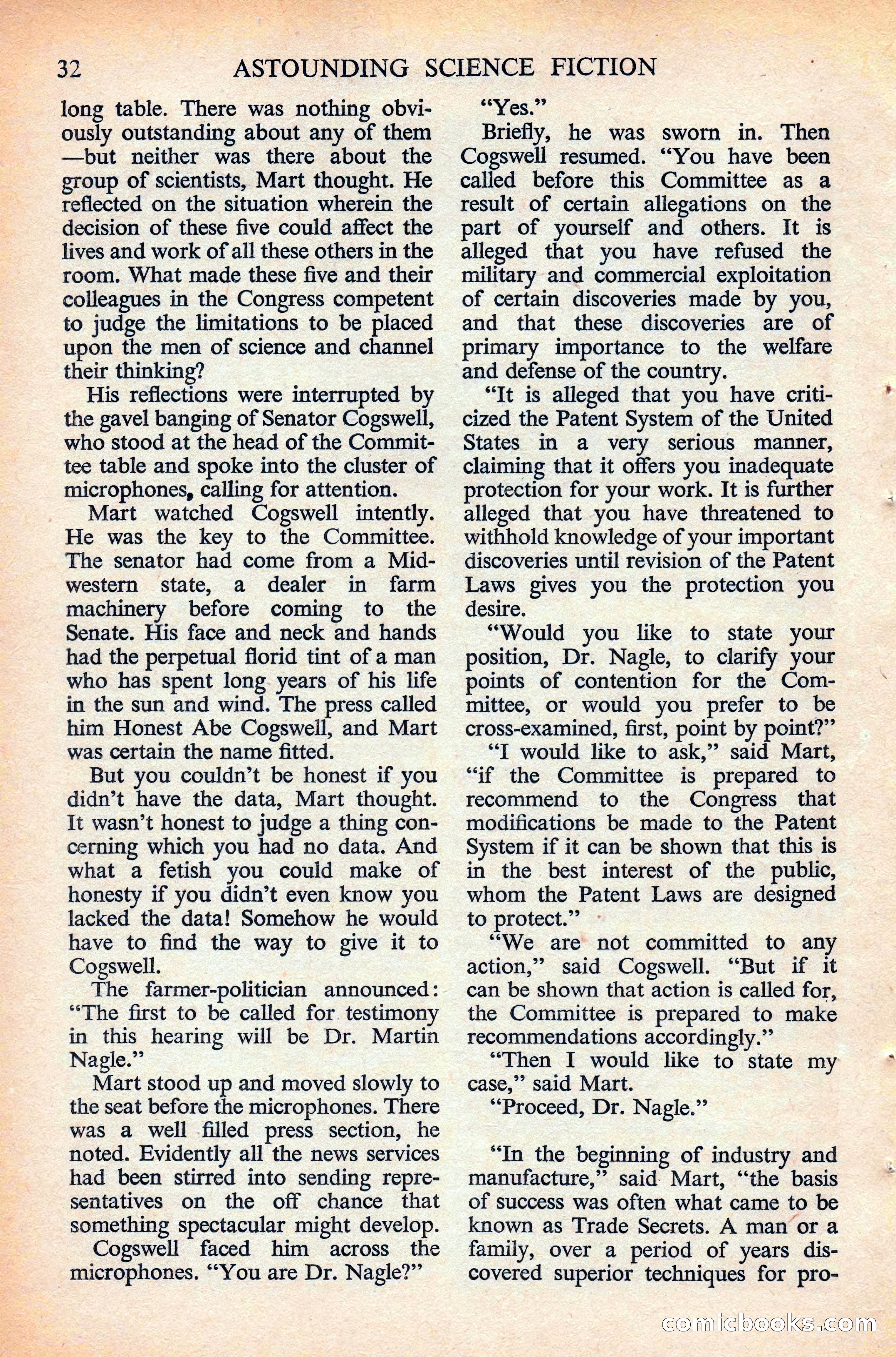
A restored page from Pulp Fiction, 1954. Page through the whole issue in the reader above.
📄 Transcribed text from this page (OCR, searchable)
Machine-transcribed from the original scan — historical spelling and the odd misread are preserved.
32 long table. There was nothing obvi- ously outstanding about any of them —but neither was there about the group of scientists, Mart thought. He reflected on the situation wherein the decision of these five could affect the lives and work of all these others in the room. What made these five and their colleagues in the Congress competent to judge the limitations to be placed upon the men of science and channel their thinking? His reflections were interrupted by the gavel banging of Senator Cogswell, who stood at the head of the Commit- tee table and spoke into the cluster of microphones, calling for attention. Mart watched Cogswell intently. He was the key to the Committee. The senator had come from a Mid- western state, a dealer in farm machinery before coming to the Senate. His face and neck and hands had the perpetual florid tint of a man who has spent long years of his life in the sun and wind. The press called him Honest Abe Cogsweil, and Mart was certain the name fitted. But you couldn’t be honest if you didn’t have the data, Mart thought. It wasn’t honest to judge a thing con- cerning which you had no data. And what a fetish you could make of honesty if you didn’t even know you lacked the data! Somehow he would have to find the way to give it to Cogswell. The farmer-politician announced: “The first to be called for. testimony in this hearing will be Dr. Martin Nagle.” Mart stood up and moved slowly to the seat before the microphones. There was a well filled press section, he noted. Evidently all the news services had been stirred into sending repre- sentatives on the off chance that something spectacular might develop. Cogswell faced him across the microphones. ““You are Dr. Nagle?’’ ASTOUNDING SCIENCE FICTION *“Yes,”’ Briefly, he was sworn in. Then Cogswell resumed. “You have been called before this Committee as a result of certain allegations on the part of yourself and others. It is alleged that you have refused the military and commercial exploitation of certain discoveries made by you, and that these discoveries are of primary importance to the welfare and defense of the country. “It is alleged that you have criti- cized the Patent System of the United States in a very serious manner, claiming that it offers you inadequate protection for your work. It is further alleged that you have threatened to withhold knowledge of your important discoveries until revision of the Patent Laws gives you the protection you desire. “Would you like to state your position, Dr. Nagle, to clarify your points of contention for the Com- mittee, or would you prefer to be cross-examined, first, point by point?” “I would like to ask,’ said Mart, “if the Committee is prepared to recommend to the Congress that modifications be made to the Patent System if it can be shown that this is in the best interest of the public, whom the Patent Laws are designed to protect.” — “We are not committed to any action,” said Cogswell. “But if it can be shown that action is called for, the Committee is prepared to make recommendations accordingly.” “Then I would like to state my case,”’ said Mart. “Proceed, Dr. Nagle.” “In the beginning of industry and manufacture,” said: Mart, ‘‘the basis of success was often what came to be known as Trade Secrets. A man or a family, over a period of years dis- covered superior techniques for pro- Conniclooolkks.<c© nl