
Pulp Fiction, 1954 · page 121 of 132
Astounding Science Fiction, British Edition — page 121: what you’re looking at
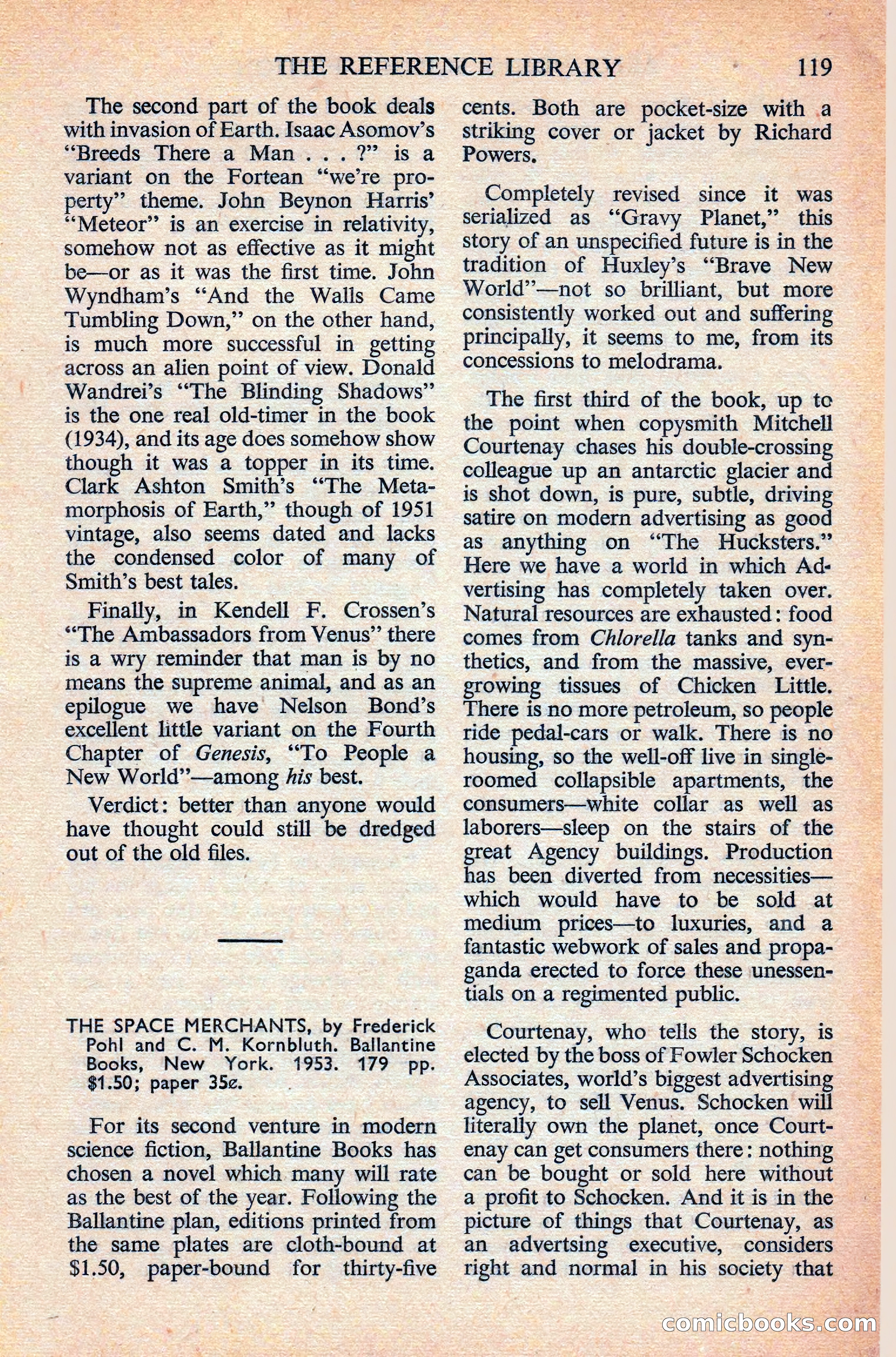
A restored page from Pulp Fiction, 1954. Page through the whole issue in the reader above.
📄 Transcribed text from this page (OCR, searchable)
Machine-transcribed from the original scan — historical spelling and the odd misread are preserved.
THE REFERENCE LIBRARY The second part of the book deals with invasion of Earth. Isaac Asomov’s “Breeds There a Man... ?” is a variant on the Fortean “we’re pro- perty” theme. John Beynon Harris’ ““Meteor”’ is an exercise in relativity, somehow not as effective as it might be—or as it was the first time. John Wyndham’s “And the Walls Came Tumbling Down,” on the other hand, is much more successful in getting across an alien point of view. Donald Wandrei’s “The Blinding Shadows” is the one real old-timer in the book (1934), and its age does somehow show though it was a topper in its time. Clark Ashton Smith’s “The Meta- morphosis of Earth,” though of 1951 vintage, also seems dated and lacks the condensed color of many of Smith’s best tales. Finally, in Kendell F. Crossen’s “The Ambassadors from Venus”’ there is a wry reminder that man is by no means the supreme animal, and as an epilogue we have Nelson Bond’s excellent little variant on the Fourth Chapter of Genesis, “To People a New World”’—among his best. Verdict: better than anyone would have thought could still be dredged out of the old files. THE SPACE MERCHANTS, by Frederick Pohl and C. M. Kornbluth. Ballantine Books, New York. 1953. 179 pp. $1.50; paper 35. For its second venture in modern science fiction, Ballantine Books has chosen a novel which many will rate as the best of the year. Following the Ballantine plan, editions printed from the same plates are cloth-bound at $1.50, paper-bound for thirty-five 119 cents. Both are pocket-size with a striking cover or jacket by Richard Powers, Completely revised since it was serialized as “Gravy Planet,” this story of an unspecified future is in the tradition of Huxley’s “Brave New World’’—not so brilliant, but more consistently worked out and suffering principally, it seems to me, from its concessions to melodrama. The first third of the book, up te the point when copysmith Mitchell Courtenay chases his double-crossing colleague up an antarctic glacier and is shot down, is pure, subtle, driving satire on modern advertising as good as anything on “The Hucksters.” Here we have a world in which Ad: vertising has completely taken over. Natural resources are exhausted : food comes from Chlorella tanks and syn- thetics, and from the massive, ever- growing tissues of Chicken Little. There is no more petroleum, so people ride pedal-cars or walk. There is no housing, so the well-off live in single- roomed collapsible apartments, the consumers—white collar as well as laborers—sleep on the stairs of the great Agency buildings. Production has been diverted from necessities— which would have to be sold at medium prices—to luxuries, and a fantastic webwork of sales and propa- ganda erected to force these unessen- tials on a regimented public. Courtenay, who tells the story, is elected by the boss of Fowler Schocken Associates, world’s biggest advertising agency, to sell Venus. Schocken will literally own the planet, once Court- enay can get consumers there: nothing can be bought or sold here without a profit to Schocken. And it is in the picture of things that Courtenay, as an advertsing executive, considers right and normal in his society that Eomichbooksco m