
Pulp Fiction, 1954 · page 122 of 132
Astounding Science Fiction, British Edition — page 122: what you’re looking at
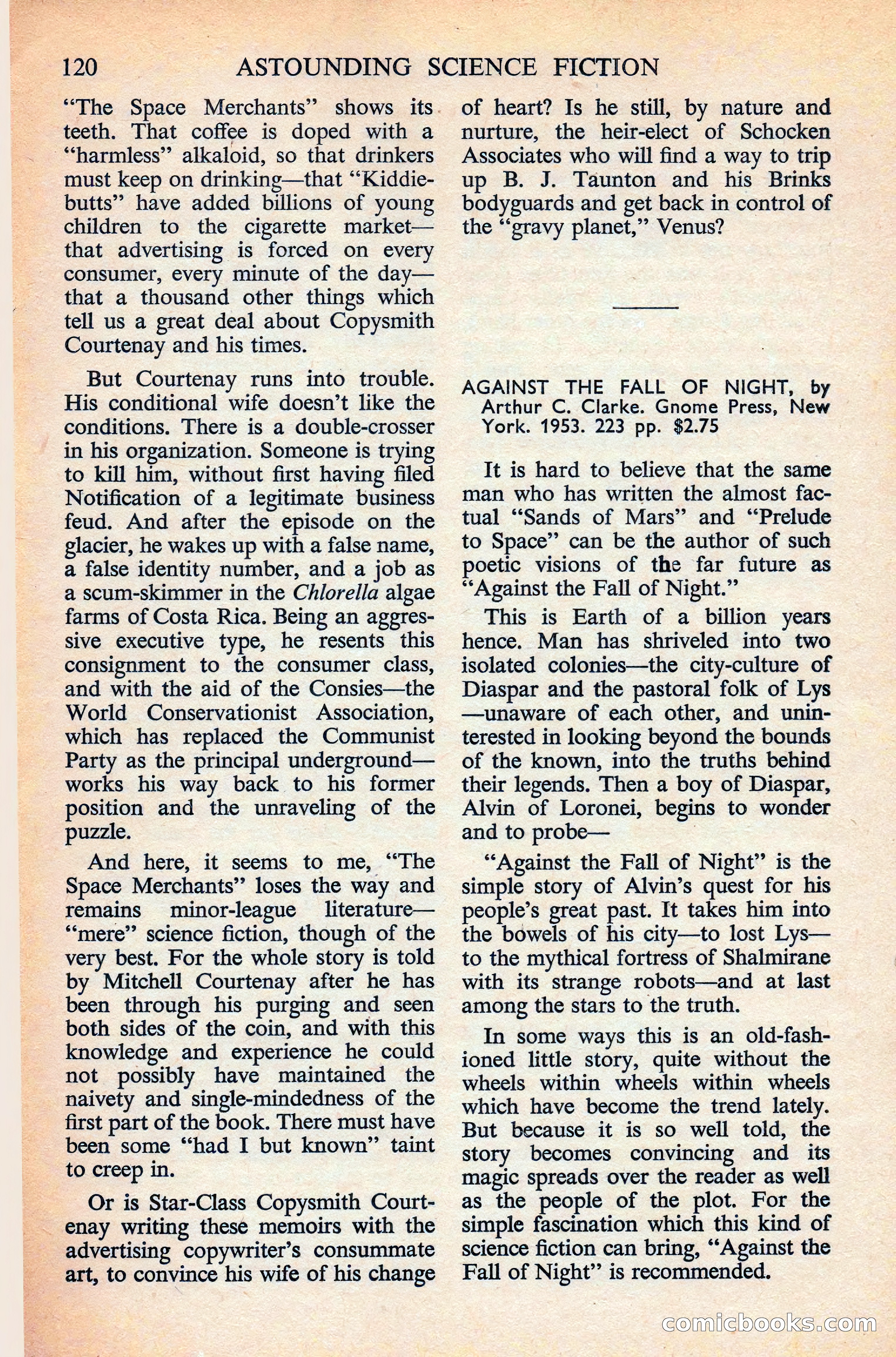
A restored page from Pulp Fiction, 1954. Page through the whole issue in the reader above.
📄 Transcribed text from this page (OCR, searchable)
Machine-transcribed from the original scan — historical spelling and the odd misread are preserved.
120 “The Space Merchants” teeth. That coffee is doped with a “harmless” alkaloid, so that drinkers must keep on drinking—that “‘Kiddie- butts” have added billions of young children to the cigarette market— that advertising is forced on every consumer, every minute of the day— that a thousand other things which tell us a great deal about Copysmith Courtenay and his times. But Courtenay runs into trouble. His conditional wife doesn’t like the conditions. There is a double-crosser in his organization. Someone is trying to kill him, without first having filed Notification of a legitimate business feud. And after the episode on the glacier, he wakes up with a false name, a false identity number, and a job as a scum-skimmer in the Chlorella algae farms of Costa Rica. Being an aggres- sive executive type, he resents this consignment to the consumer class, and with the aid of the Consies—the World Conservationist Association, which has replaced the Communist Party as the principal underground— works his way back to his former position and the unraveling of the puzzle. And here, it seems to me, “The Space Merchants” loses the way and remains minor-league literature— ‘“‘mere” science fiction, though of the very best. For the whole story is told by Mitchell Courtenay after he has been through his purging and seen both sides of the coin, and with this knowledge and experience he could not possibly have maintained the naivety and single-mindedness of the first part of the book. There must have been some “had I but known’’ taint to creep in. Or is Star-Class Copysmith Court- enay writing these memoirs with the advertising copywriter’s consummate art, to convince his wife of his change shows its. ASTOUNDING SCIENCE FICTION of heart? Is he still, by nature and nurture, the heir-elect of Schocken Associates who will find a way to trip up B. J. Taunton and his Brinks bodyguards and get back in control of the “‘gravy planet,” Venus? AGAINST THE FALL OF NIGHT, by Arthur C. Clarke. Gnome Press, New York. 1953. 223 pp. $2.75 It is hard to believe that the same man who has written the almost fac- tual ‘Sands of Mars” and ‘Prelude to Space” can be the author of such poetic visions of the far future as ‘Against the Fall of Night.” This is Earth of a billion years hence. Man has shriveled into two isolated colonies—the city-culture of Diaspar and the pastoral folk of Lys —unaware of each other, and unin- terested in looking beyond the bounds of the known, into the truths behind their legends. Then a boy of Diaspar, Alvin of Loronei, begins to wonder and to probe— “Against the Fall of Night’’ is the simple story of Alvin’s quest for his people’s great past. It takes him into the bowels of his city—to lost Lys— to the mythical fortress of Shalmirane with its strange robots—and at last among the stars to the truth. In some ways this is an old-fash- ioned little story, quite without the wheels within wheels within wheels which have become the trend lately. But because it is so well told, the story becomes convincing and its magic spreads over the reader as well as the people of the plot. For the simple fascination which this kind of science fiction can bring, “Against the Fall of Night” is recommended. Cconniclooolkks. corn