
Pulp Fiction, 1954 · page 120 of 132
Astounding Science Fiction, British Edition — page 120: what you’re looking at
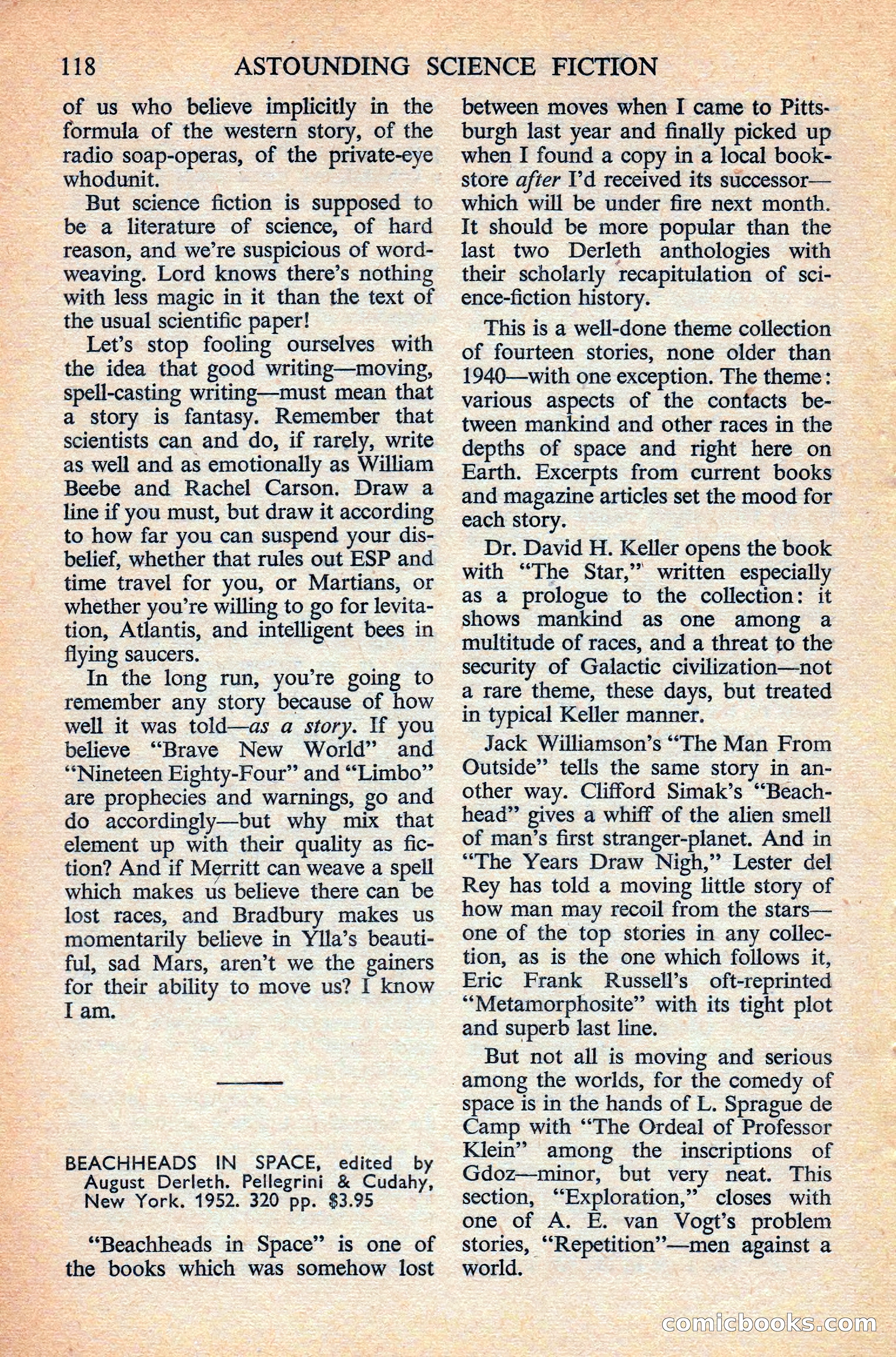
A restored page from Pulp Fiction, 1954. Page through the whole issue in the reader above.
📄 Transcribed text from this page (OCR, searchable)
Machine-transcribed from the original scan — historical spelling and the odd misread are preserved.
118 ASTOUNDING SCIENCE FICTION of us who believe implicitly in the formula of the western story, of the radio soap-operas, of the private-eye whodunit. But science fiction is supposed to be a literature of science, of hard reason, and we’re suspicious of word- weaving. Lord knows there’s nothing with less magic in it than the text of the usual scientific paper! Let’s stop fooling ourselves with the idea that good writing—moving, spell-casting writing—must mean that a story is fantasy. Remember that scientists can and do, if rarely, write as well and as emotionally as William Beebe and Rachel Carson. Draw a line if you must, but draw it according to how far you can suspend your dis- belief, whether that rules out ESP and time travel for you, or Martians, or whether you’re willing to go for levita- tion, Atlantis, and intelligent bees in flying saucers. In the long run, you’re going to remember any story because of how well it was told—as a story. If you believe “Brave New World” and ‘Nineteen Eighty-Four” and “Limbo”’ are prophecies and warnings, go and do accordingly—but why mix that element up with their quality as fic- tion? And if Merritt can weave a spell which makes us believe there can be lost races, and Bradbury makes us momentarily believe in Ylla’s beauti- ful, sad Mars, aren’t we the gainers for their ability to move us? I know I am. BEACHHEADS IN SPACE, edited by August Derleth. Pellegrini & Cudahy, New York. 1952. 320 pp. $3.95 ‘““Beachheads in Space’’ is one of the books which was somehow lost between moves when I came to Pitts- burgh last year and finally picked up when I found a copy in a local book- store after I’d received its successor— which will be under fire next month. It should be more popular than the last two Derleth anthologies with their scholarly recapitulation of sci- ence-fiction history. This is a well-done theme collection of fourteen stories, none older than 1940—with one exception. The theme: various aspects of the contacts be- tween mankind and other races in the depths of space and right here on Earth. Excerpts from current books and magazine articles set the mood for each story. Dr. David H. Keller opens the book with “The Star,” written especially as a prologue to the collection: it shows mankind as one among a multitude of races, and a threat to the security of Galactic civilization—not a rare theme, these days, but treated in typical Keller manner. Jack Williamson’s “The Man From Outside” tells the same story in an- other way. Clifford Simak’s “Beach- head” gives a whiff of the alien smell of man’s first stranger-planet. And in “The Years Draw Nigh,” Lester del Rey has told a moving little story of how man may recoil from the stars— one of the top stories in any collec- tion, as is the one which follows it, Eric Frank Russell’s oft-reprinted ‘““Metamorphosite” with its tight plot and superb last line. But not all is moving and serious -among the worlds, for the comedy of space is in the hands of L. Sprague de Camp with “The Ordeal of Professor Klein’ among the inscriptions of Gdoz—minor, but very neat. This section, “Exploration,” closes with one of A. E. van Vogt’s problem stories, ““Repetition”—men against a world. Connie ooolks.e@ Al