
Pulp Fiction, 1954 · page 119 of 132
Astounding Science Fiction, British Edition — page 119: what you’re looking at
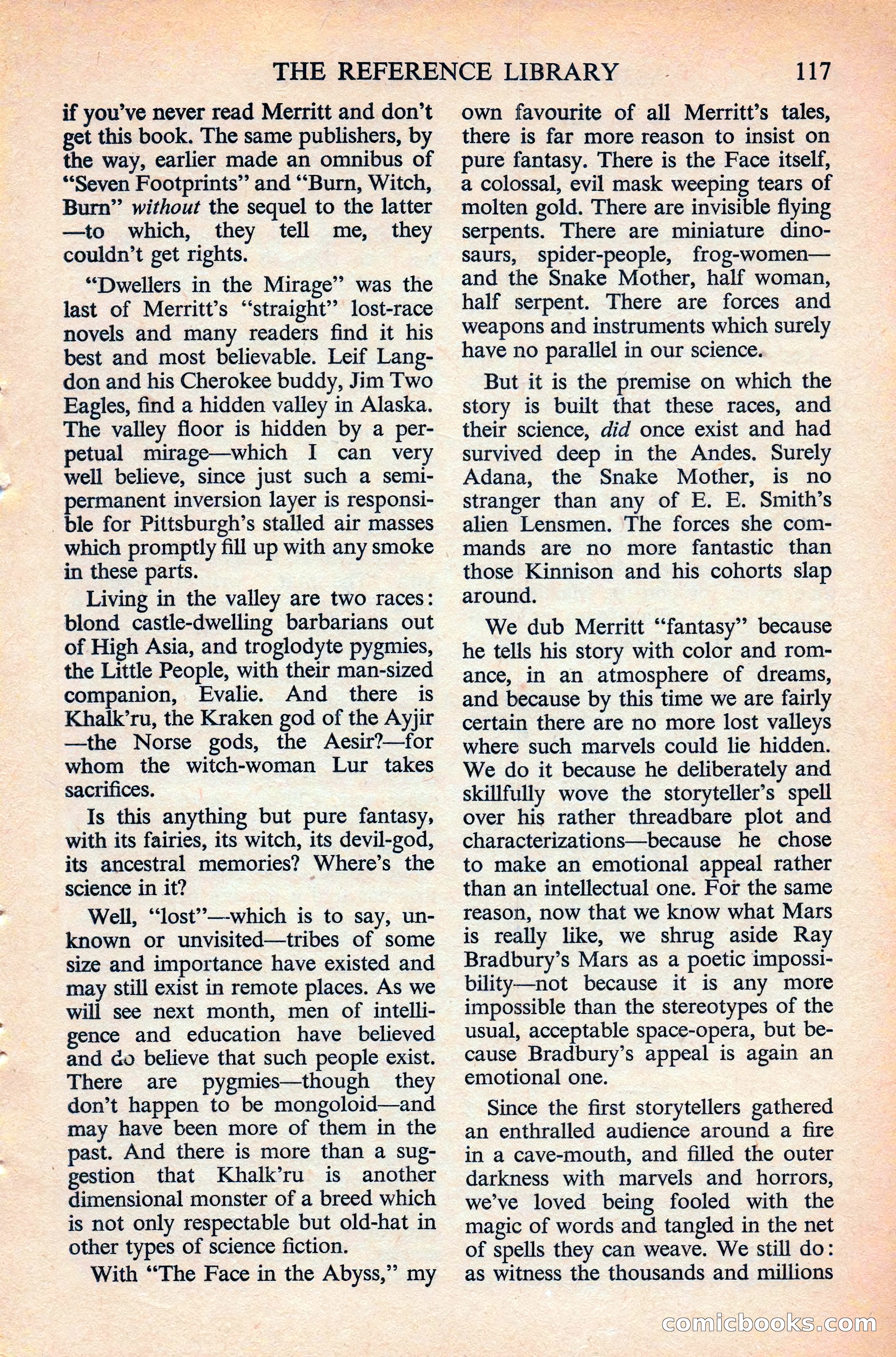
A restored page from Pulp Fiction, 1954. Page through the whole issue in the reader above.
📄 Transcribed text from this page (OCR, searchable)
Machine-transcribed from the original scan — historical spelling and the odd misread are preserved.
THE REFERENCE LIBRARY 117 if you’ve never read Merritt and don’t get this book. The same publishers, by the way, earlier made an omnibus of ‘Seven Footprints” and “Burn, Witch, Burn” without the sequel to the latter —to which, they tell me, they couldn’t get rights. “Dwellers in the Mirage’’ was the last of Merritt’s “‘straight’’ lost-race novels and many readers find it his best and most believable. Leif Lang- don and his Cherokee buddy, Jim Two Eagles, find a hidden valley in Alaska. The valley floor is hidden by a per- petual mirage—which I can very well believe, since just such a semi- ermanent inversion layer is responsi- _ble for Pittsburgh’s stalled air masses which promptly fill up with any smoke in these parts. Living in the valley are two races: blond castle-dwelling barbarians out of High Asia, and troglodyte pygmies, the Little People, with their man-sized companion, Evalie. And there is Khalk’ru, the Kraken god of the Ayjir —the Norse gods, the Aesir?—for whom the witch-woman Lur takes sacrifices. Is this anything but pure fantasy, with its fairies, its witch, its devil-god, its ancestral memories? Where’s the science in it? Well, ‘“‘lost”—-which is to say, un- known or unvisited—tribes of some size and importance have existed and may still exist in remote places. As we will see next month, men of intelli- gence and education have believed and Go believe that such people exist. There are pygmies—though they don’t happen to be mongoloid—and may have been more of them in the past. And there is more than a sug- gestion that Khalk’ru is another dimensional monster of a breed which is not only respectable but old-hat in other types of science fiction. With “‘The Face in the Abyss,”’ my own favourite of all Merritt’s tales, there is far more reason to insist on pure fantasy. There is the Face itself, a colossal, evil mask weeping tears of molten gold. There are invisible flying serpents. There are miniature dino- saurs, spider-people, frog-women— and the Snake Mother, half woman, half serpent. There are forces and weapons and instruments which surely have no parallel in our science. But it is the premise on which the story is built that these races, and their science, did once exist and had survived deep in the Andes. Surely Adana, the Snake Mother, is no stranger than any of E. E. Smith’s alien Lensmen. The forces she com- mands are no more fantastic than those Kinnison and his cohorts slap around. We dub Merritt “fantasy”? because he tells his story with color and rom- ance, in an atmosphere of dreams, and because by this time we are fairly certain there are no more lost valleys where such marvels could lie hidden. We do it because he deliberately and skillfully wove the storyteller’s spell over his rather threadbare plot and characterizations—because he chose to make an emotional appeal rather than an intellectual one. For the same reason, now that we know what Mars is really like, we shrug aside Ray Bradbury’s Mars as a poetic impossi- bility—not because it is any more impossible than the stereotypes of the usual, acceptable space-opera, but be- cause Bradbury’s appeal is again an emotional one. Since the first storytellers gathered an enthralled audience around a fire in a cave-mouth, and filled the outer darkness with marvels and horrors, we’ve loved being fooled with the magic of words and tangled in the net of spells they can weave. We still do: as witness the thousands and millions Comicdooksnico m