
Pulp Fiction, 1954 · page 105 of 132
Astounding Science Fiction, British Edition — page 105: what you’re looking at
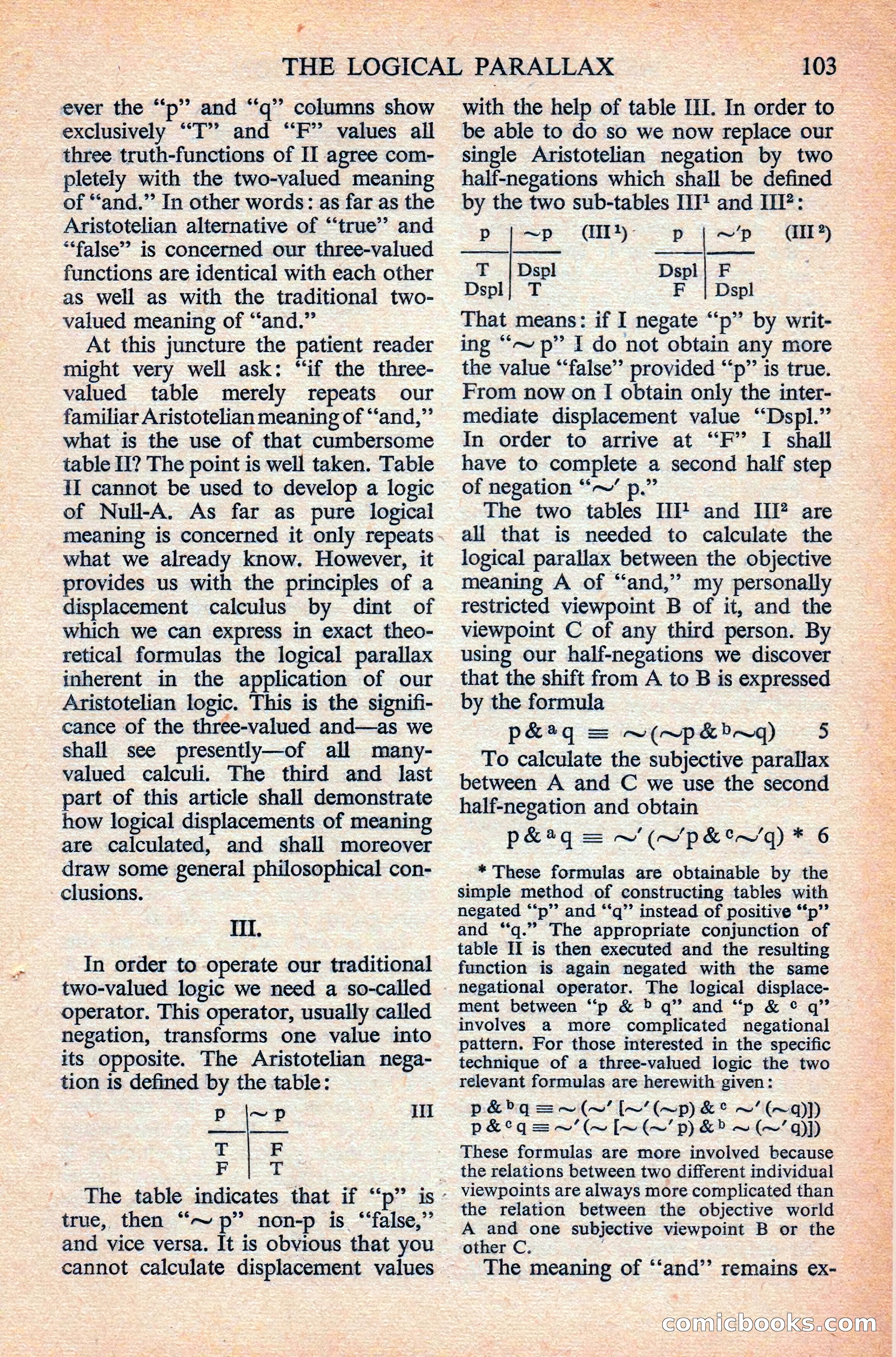
A restored page from Pulp Fiction, 1954. Page through the whole issue in the reader above.
📄 Transcribed text from this page (OCR, searchable)
Machine-transcribed from the original scan — historical spelling and the odd misread are preserved.
r THE LOGICAL PARALLAX ever the “‘p’’ and “‘q” columns show exclusively ““T”? and “F” values all three truth-functions of II agree com- pletely with the two-valued meaning of “and.” In other words: as far as the Aristotelian alternative of “true’’ and “false” is concerned our three-valued functions are identical with each other as well as with the traditional two- valued meaning of “and.” At this juncture the patient reader might very well ask: “if the three- valued table merely repeats our familiar Aristotelian meaning of “and,” what is the use of that cumbersome table II? The point is well taken. Table iI cannot be used to develop a logic of Null-A. As far as pure logical meaning is concerned it only repeats what we already know. However, it provides us with the principles of a displacement calculus by dint of which we can express in exact theo- retical formulas the logical parallax inherent in the application of our Aristotelian logic. This is the signifi- cance of the three-valued and—as we shall see presently—of all many- valued calculi. The third and last part of this article shall demonstrate how logical displacements of meaning are calculated, and shall moreover draw some general philosophical con- clusions. Til. In order to operate our traditional two-valued logic we need a so-called operator. This operator, usually called negation, transforms one value into its opposite. The Aristotelian nega- tion is defined by the table: T F F a The table indicates that if “‘p” is : true, then “~p” non-p is “false,” and vice versa. It is obvious that you cannot calculate displacement values 103 with the help of table II. In order to be able to do so we now replace our single Aristotelian negation by two half-negations which shall be defined by the two sub-tables III? and III?: p j~p (4) p |p dr T |Dspl Dspl| F Dspl| T F | Dspl That means: if I negate “p” by writ- ing “~ p” I do not obtain any more the value “‘false’’ provided “‘p”’ is true. From now on I obtain only the inter- mediate displacement value “‘Dspl.” In order to arrive at “F’” I shall have to complete a second half step of negation “‘-~’ p.” The two tables III’ and III? are all that is needed to calculate the logical parallax between the objective meaning A of “and,’’ my personally restricted viewpoint B of it, and the viewpoint C of any third person. By using our half-negations we discover that the shift from A to B is expressed by the formula spas eee Sie ete To calculate the subjective parallax between A and C we use the second half-negation and obtain pels ~ (Spee os * These formulas are obtainable by the simple method of constructing tables with negated “‘p” and “‘q”’ instead of positive ‘‘p”’ and ‘*‘q.” The appropriate conjunction of table II is then executed and the resulting function is again negated with the same negational operator. The logical displace- ment between “p & » q” and “‘p & © q” involves a more complicated negational pattern. For those interested in the specific technique of a three-valued logic the two relevant formulas are herewith given: p&’q=~’(~ [~ (~’p) &» ~ (~’g))) These formulas are more involved because the relations between two different individual viewpoints are always more complicated than the relation between the objective world A and one subjective viewpoint B or the other C. The meaning of ‘‘and’’ remains ex- CONIC OOOLESaCO) a