
Pulp Fiction, 1954 · page 104 of 132
Astounding Science Fiction, British Edition — page 104: what you’re looking at
A restored page from Pulp Fiction, 1954. Page through the whole issue in the reader above.
📄 Transcribed text from this page (OCR, searchable)
Machine-transcribed from the original scan — historical spelling and the odd misread are preserved.
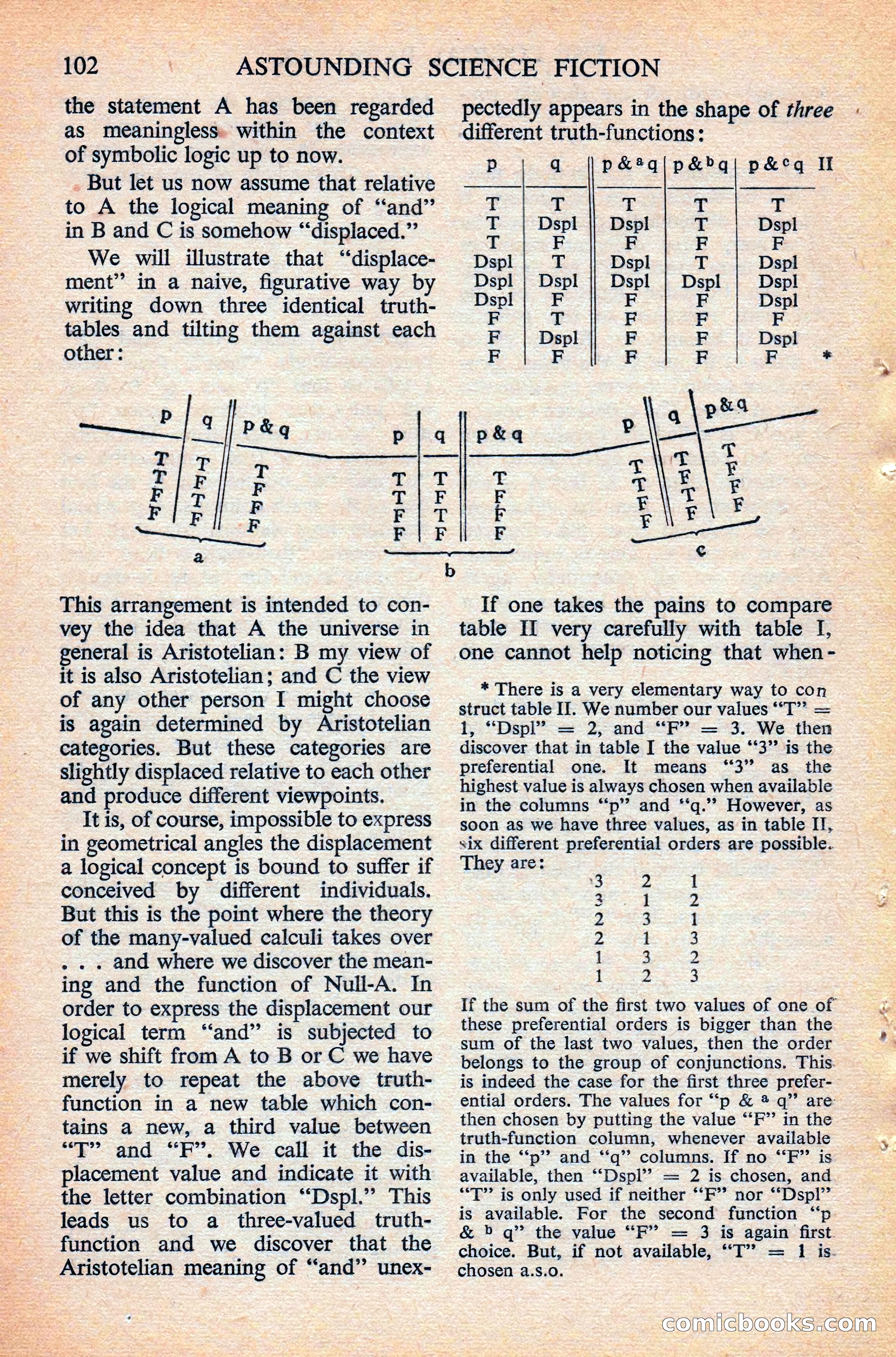
102 the statement A has been regarded as meaningless. within the context of symbolic logic up to now. ASTOUNDING SCIENCE FICTION pectedly appears in the shape of three different truth-functions: p q | p&*q{p&q| p&*q Il . But let us now assume that relative §£——j——||—_j_|___ to A the logical meaning of “and” qT T T T T in B and C is somehow “displaced.” ss — ae - A We will illustrate that ““displace- Dspl| T Dspl T Dspl ment” in a naive, figurative way by Dspl| Dspl || Dspl | Dspl | Dspl writing down three identical truth- PsP!) F = oe tables and tilting them against each 6) Daptt <8 FE Dspl other: F F F F F + &q P q \ PY JS sl F/T} F ENF a ee eee ¢ This arrangement is intended to con- vey the idea that A the universe in general is Aristotelian: B my view of it is also Aristotelian; and C the view of any other person I might choose is again determined by Aristotelian categories. But these categories are slightly displaced relative to each other and produce different viewpoints. It is, of course, impossible to express in geometrical angles the displacement a logical concept is bound to suffer if conceived by different individuals. But this is the point where the theory of the many-valued calculi takes over . . . and where we discover the mean- ing and the function of Null-A. In order to express the displacement our logical term “and” is subjected to if we shift from A to B or C we have merely to repeat the above truth- function in a new table which con- tains a new, a third value between “T” and “F”. We call it the dis- placement value and indicate it with the letter combination “Dspl.” This leads us to a three-valued truth- function and we discover that the Aristotelian meaning of “‘and” unex- If one takes the pains to compare table II very carefully with table I, one cannot help noticing that when- * There is a very elementary way to con struct table IT. We number our values ““T”? = 1; “Dspi?- =: 2, and “F’™ — "3. We. then discover that in table I the value ‘‘3” is the preferential one. It means “3” as the highest value is always chosen when available in the columns “p’”’ and ‘‘q.’? However, as soon as we have three values, as in table IT, six different preferential orders are possible. They are: ht it KD WW DD NW eRe Ww be WN We Ne If the sum of the first two values of one of these preferential orders is bigger than the sum of the last two values, then the order belongs to the group of conjunctions. This. is indeed the case for the first three prefer- ential orders. The values for “‘p & # q”’ are: then chosen by putting the value “‘F’”’ in the truth-function column, whenever available in the “‘p’’ and ‘‘q”’ columns. If no ‘“‘F”’ is available, then ‘‘Dspl’? = 2 is chosen, and “*T”? is only used if neither ‘‘F” nor ‘“‘Dspl’’ is available. For the second function ‘‘p & » gq” the value “F’? = 3 is again first. choice. But, if not available, “T’? = 1 is. chosen a.s.o. EComichookssco ‘ im