
Pulp Fiction, 1954 · page 106 of 132
Astounding Science Fiction, British Edition — page 106: what you’re looking at
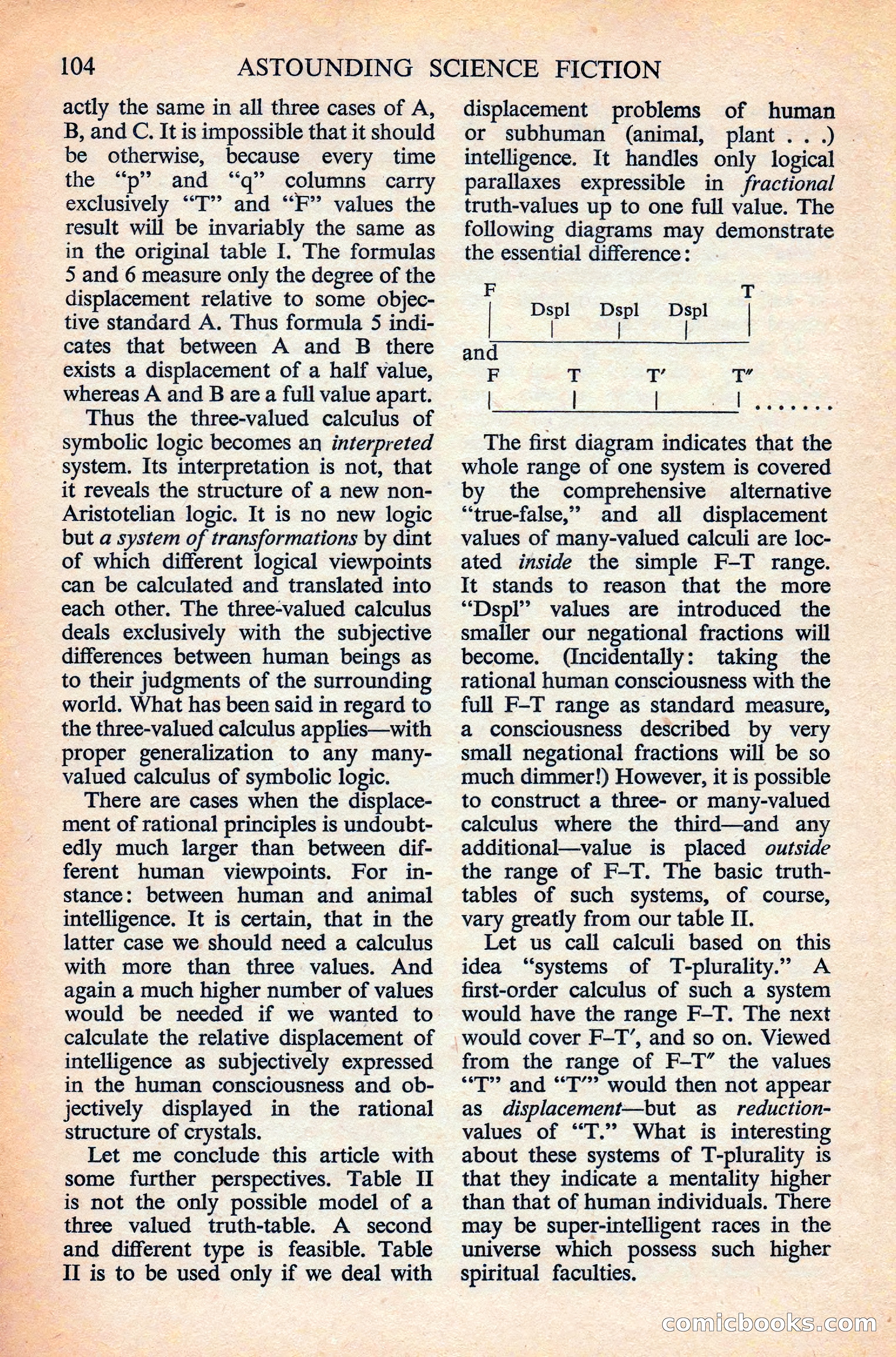
A restored page from Pulp Fiction, 1954. Page through the whole issue in the reader above.
📄 Transcribed text from this page (OCR, searchable)
Machine-transcribed from the original scan — historical spelling and the odd misread are preserved.
104 actly the same in all three cases of A, B, and C. It is impossible that it should be otherwise, because every time the “p” and “gq” columns carry exclusively “IT”? and “‘F’ values the result will be invariably the same as in the original table I. The formulas 5 and 6 measure only the degree of the displacement relative to some objec- tive standard A. Thus formula 5 indi- cates that between A and B there exists a displacement of a half value, whereas A and B are a full value apart. Thus the three-valued calculus of _ symbolic logic becomes an interpreted system. Its interpretation is not, that it reveals the structure of a new non- Aristotelian logic. It is no new logic but a system of transformations by dint of which different logical viewpoints can be calculated and translated into each other. The three-valued calculus deals exclusively with the subjective differences between human beings as to their judgments of the surrounding world. What has been said in regard to the three-valued calculus applies—with proper generalization to any many- valued calculus of symbolic logic. There are cases when the displace- ment of rational principles is undoubt- edly much larger than between dif- ferent human viewpoints. For in- stance: between human and animal intelligence. It is certain, that in the latter case we should need a calculus with more than three values. And again a much higher number of values would be needed if we wanted to calculate the relative displacement of intelligence as subjectively expressed in the human consciousness and ob- jectively displayed in the rational structure of crystals. Let me conclude this article with some further perspectives. Table II is not the only possible model of a three valued truth-table. A second and different type is feasible. Table II is to be used only if we deal with ASTOUNDING SCIENCE FICTION displacement problems of human or subhuman (animal, plant...) | intelligence. It handles only logical parallaxes expressible in fractional truth-values up to one full value. The following diagrams may demonstrate the essential difference: F T a Dspl ee | | and F T fd Be fas The first diagram indicates that the whole range of one system is covered by the comprehensive alternative “true-false,” and all displacement values of many-valued calculi are loc- ated inside the simple F-T range. It stands to reason that the more “Dspl’” values are introduced the smaller our negational fractions will become. (Incidentally: taking the rational human consciousness with the full F-T range as standard measure, a consciousness described by very small negational fractions will be so much dimmer!) However, it is possible to construct a three- or many-valued calculus where the third—and any additional—value is placed outside the range of F-T. The basic truth- tables of such systems, of course, vary greatly from our table II. Let us call calculi based on this idea “systems of T-plurality.” A first-order calculus of such a system would have the range F-T. The next would cover F—T’, and so on. Viewed from the range of F—T” the values “T” and “T’’ would then not appear as displacement—but as_ reduction- values of “‘T.” What is interesting about these systems of T-plurality is that they indicate a mentality higher than that of human individuals. There may be super-intelligent races in the universe which possess such higher spiritual faculties. Cconmicloooks.c© Im é