
Pulp Fiction, 1954 · page 103 of 132
Astounding Science Fiction, British Edition — page 103: what you’re looking at
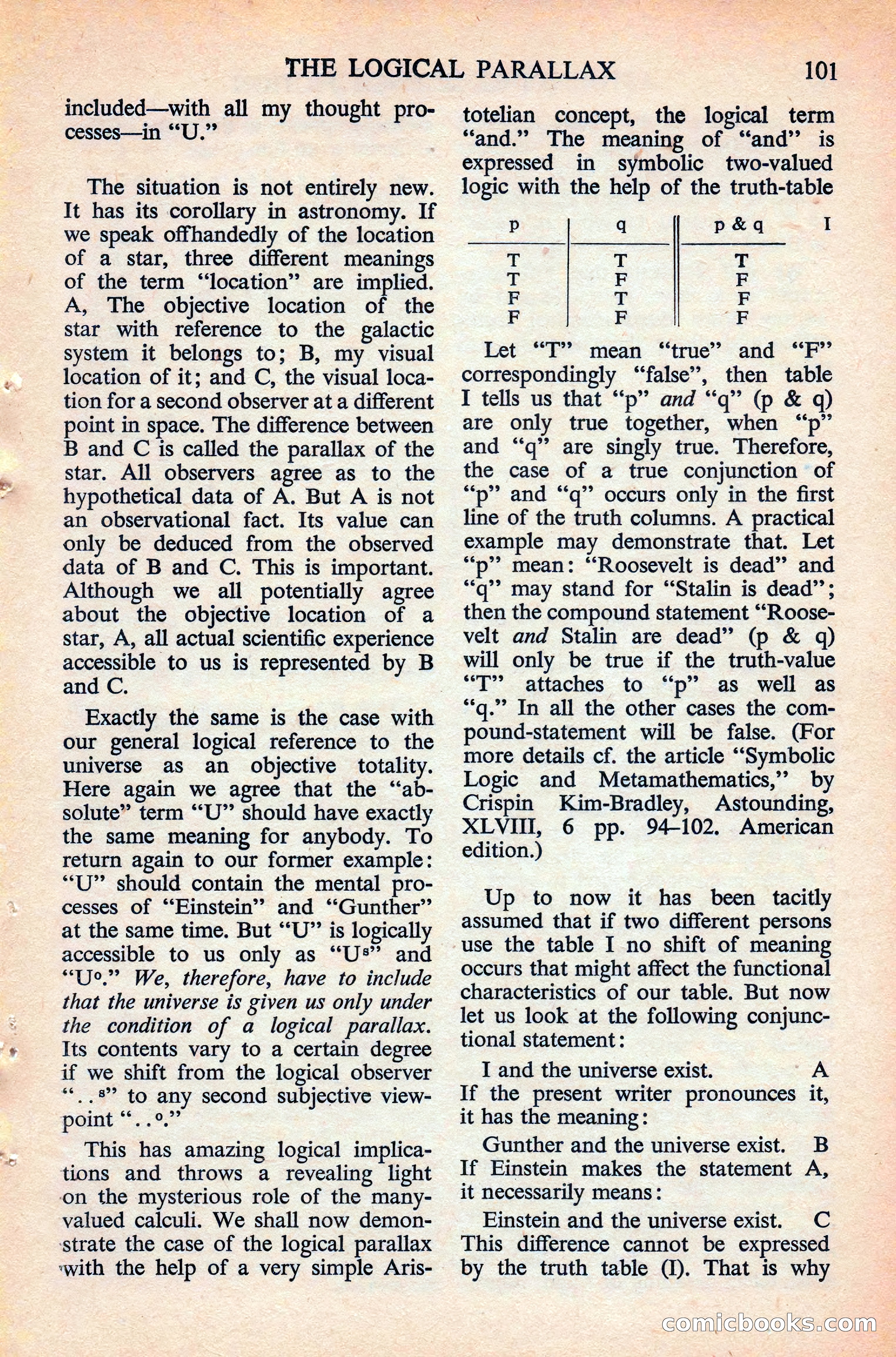
A restored page from Pulp Fiction, 1954. Page through the whole issue in the reader above.
📄 Transcribed text from this page (OCR, searchable)
Machine-transcribed from the original scan — historical spelling and the odd misread are preserved.
THE LOGICAL PARALLAX 101 included—with all my thought pro- cesses—in “U.” totelian concept, the logical term “and.” The meaning of “and’’ is expressed in symbolic two-valued The situation is not entirely new. logic with the help of the truth-table It has its corollary in astronomy. If we speak offhandedly of the location of a star, three different meanings of the term “location” are implied. A, The objective location of the star with reference to the galactic system it belongs to; B, my visual location of it; and C, the visual loca- tion for a second observer at a different point in space. The difference between B and C is called the parallax of the star. All observers agree as to the hypothetical data of A. But A is not an observational fact. Its value can only be deduced from the observed data of B and C. This is important. Although we all potentially agree about the objective location of a star, A, all actual scientific experience accessible to us is represented by B and C. Exactly the same is the case with our general logical reference to the universe as an objective totality. Here again we agree that the “ab- solute” term “‘U” should have exactly the same meaning for anybody. To return again to our former example: “U” should contain the mental pro- cesses Of “Einstein” and “‘Gunther”’ at the same time. But “U” is logically accessible to us only as “U®*” and “Ue.” We, therefore, have to include that the universe is given us only under the condition of a logical parallax. Its contents vary to a certain degree if we shift from the logical observer **..®” to any second subjective view- point *..°.” This has amazing logical implica- tions and throws a revealing light on the mysterious role of the many- valued calculi. We shall now demon- strate the case of the logical parallax ‘with the help of a very simple Aris- p q p&aq I T T T T F F F T F F F F Let “T” mean “true” and “FP” correspondingly “false”, then table I tells us that “‘p” and “q” (p & q) are only true together, when “p” and “q” are singly true. Therefore, the case of a true conjunction of ““p” and “q’’ occurs only in the first line of the truth columns. A practical example may demonstrate that. Let ““p”’ mean: “Roosevelt is dead’? and ““q’? may stand for “Stalin is dead’; then the compound statement “‘Roose- velt and Stalin are dead” (p & q) will only be true if the truth-value “T” attaches to “p” as well as **q.”’ In all the other cases the com- pound-statement will be false. (For more details cf. the article ““Symbolic Logic and Metamathematics,’’ by Crispin Kim-Bradley, Astounding, XLVI, 6 pp. 94-102. American edition.) Up to now it has been tacitly assumed that if two different persons use the table I no shift of meaning occurs that might affect the functional characteristics of our table. But now let us look at the following conjunc- tional statement: I and the universe exist. A If the present writer pronounces it, it has the meaning: Gunther and the universe exist. B If Einstein makes the statement A, it necessarily means: Einstein and the universe exist. C This difference cannot be expressed by the truth table (I). That is why [email protected]© im