
Pulp Fiction, 1954 · page 102 of 132
Astounding Science Fiction, British Edition — page 102: what you’re looking at
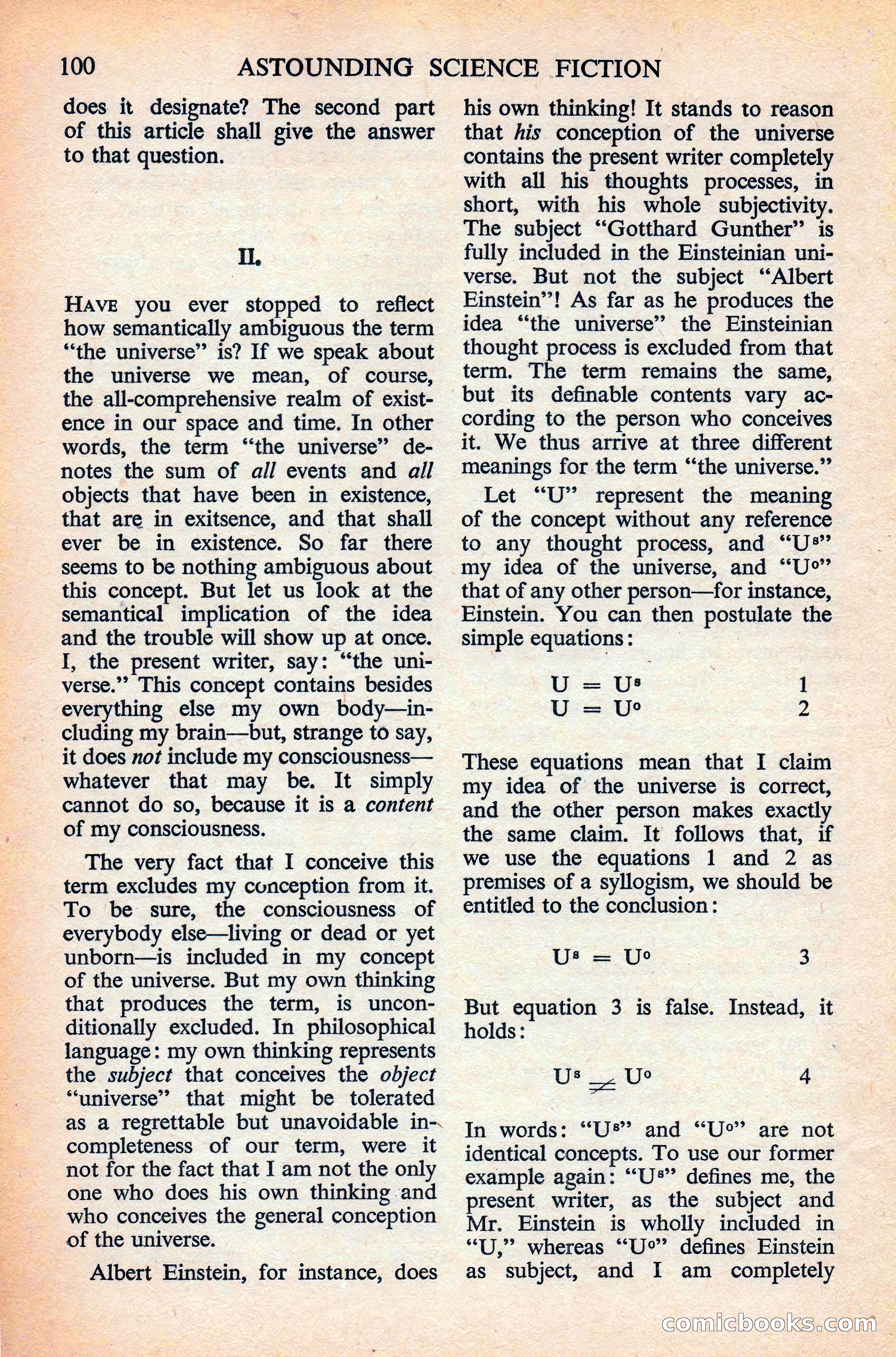
A restored page from Pulp Fiction, 1954. Page through the whole issue in the reader above.
📄 Transcribed text from this page (OCR, searchable)
Machine-transcribed from the original scan — historical spelling and the odd misread are preserved.
100 ASTOUNDING SCIENCE FICTION does it designate? The second part of this article shall give the answer to that question. I HAVE you ever stopped to reflect how semantically ambiguous the term “the universe” is? If we speak about the universe we mean, of course, the all-comprehensive realm of exist- ence in our space and time. In other words, the term ‘“‘the universe” de- notes the sum of all events and all objects that have been in existence, that are in exitsence, and that shall ever be in existence. So far there seems to be nothing ambiguous about this concept. But let us look at the semantical implication of the idea and the trouble will show up at once. I, the present writer, say: “the uni- verse.”” This concept contains besides everything else my own body—in- cluding my brain—but, strange to say, it does not include my consciousness— whatever that may be. It simply cannot do so, because it is a content of my consciousness. The very fact that I conceive this term excludes my conception from it. To be sure, the consciousness of everybody else—living or dead or yet unborn—is included in my concept of the universe. But my own thinking that produces the term, is uncon- ditionally excluded. In philosophical language: my own thinking represents the subject that conceives the object “universe’’ that might be tolerated as a regrettable but unavoidable in-. completeness of our term, were it not for the fact that I am not the only one who does his own thinking and who conceives the general conception of the universe. Albert Einstein, for instance, does his own thinking! It stands to reason that his conception of the universe contains the present writer completely with all his thoughts processes, in short, with his whole subjectivity. The subject “Gotthard Gunther’ is fully included in the Einsteinian uni- verse. But not the subject “Albert Einstein’! As far as he produces the idea “the universe’ the Einsteinian thought process is excluded from that term. The term remains the same, but its definable contents vary ac- cording to the person who conceives it. We thus arrive at three different meanings for the term “the universe.” Let “‘U” represent the meaning of the concept without any reference to any thought process, and “U®*”’ my idea of the universe, and “U°” that of any other person—for instance, Einstein. You can then postulate the simple equations : Us | 1 Ue 2 U U These equations mean that I claim my idea of the universe is correct, and the other person makes exactly the same claim. It follows that, if we use the equations 1 and 2 as premises of a syllogism, we should be entitled to the conclusion : Ut = Ue 3 But equation 3 is false. Instead, it holds : Us _. U 4 In words: “U®*®’ and “U°” are not identical concepts. To use our former example again: “U*’’ defines me, the present writer, as the subject and Mr. Einstein is wholly included in “U,”” whereas “U°”’ defines Einstein as subject, and I am _ completely Cconniclooolkks.<© me