
Pulp Fiction, 1954 · page 101 of 132
Astounding Science Fiction, British Edition — page 101: what you’re looking at
A restored page from Pulp Fiction, 1954. Page through the whole issue in the reader above.
📄 Transcribed text from this page (OCR, searchable)
Machine-transcribed from the original scan — historical spelling and the odd misread are preserved.
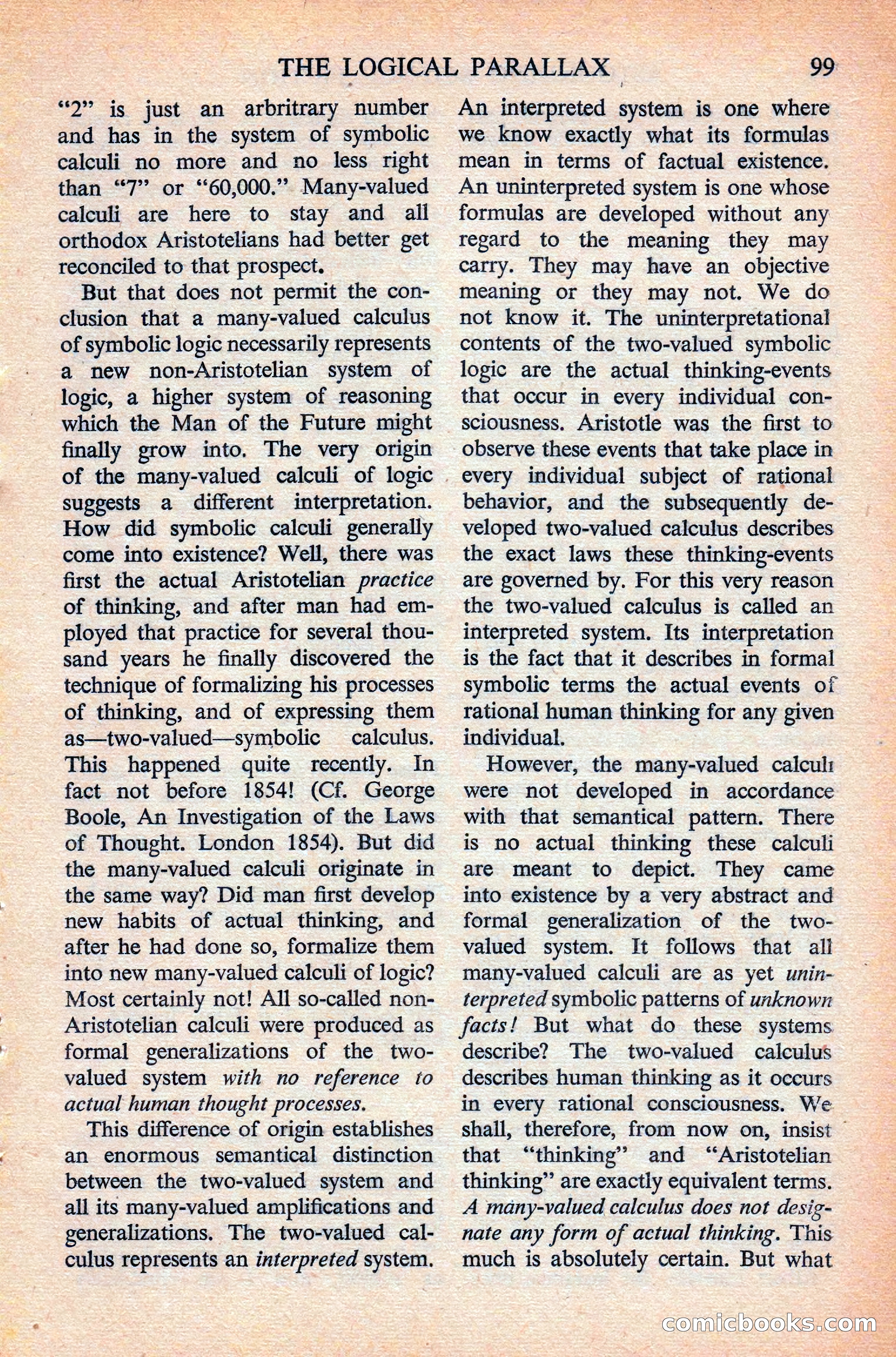
THE LOGICAL PARALLAX “2” is just an arbritrary number and has in the system of symbolic calculi no more and no less right than “7” or “60,000.” Many-valued calculi are here to stay and all orthodox Aristotelians had better get reconciled to that prospect. But that does not permit the con- clusion that a many-valued calculus of symbolic logic necessarily represents a new non-Aristotelian system of logic, a higher system of reasoning which the Man of the Future might finally grow into, The very origin of the many-valued calculi of logic | suggests a different interpretation. How did symbolic calculi generally come into existence? Well, there was first the actual Aristotelian practice of thinking, and after man had em- ployed that practice for several thou- sand years he finally discovered the technique of formalizing his processes of thinking, and of expressing them as—two-valued—symbolic calculus. This happened quite recently. In fact not before 1854! (Cf. George Boole, An Investigation of the Laws of Thought. London 1854). But did the many-valued calculi originate in the same way? Did man first develop new habits of actual thinking, and after he had done so, formalize them into new many-valued calculi of logic? Most certainly not! All so-called non- Aristotelian calculi were produced as formal generalizations of the two- valued system with no reference to actual human thought processes. This difference of origin establishes an enormous semantical distinction between the two-valued system and all its many-valued amplifications and generalizations. The two-valued cal- culus represents an interpreted system. An interpreted system is one where we know exactly what its formulas mean in terms of factual existence. An uninterpreted system is one whose formulas are developed without any regard to the meaning they may carry. They may have an objective meaning or they may not. We do not know it. The uninterpretational contents of the two-valued symbolic logic are the actual thinking-events that occur in every individual con- sciousness. Aristotle was the first to observe these events that take place in every individual subject of rational behavior, and the subsequently de- veloped two-valued calculus describes the exact laws these thinking-events are governed by. For this very reason the two-valued calculus is called an interpreted system. Its interpretation is the fact that it describes in formal symbolic terms the actual events of rational human thinking for any given individual. However, the many-valued calcult were not developed in accordance with that semantical pattern. There is no actual thinking these calculi are meant to depict. They came into existence by a very abstract and formal generalization of the two- valued system. It follows that all many-valued calculi are as yet wnin- terpreted symbolic patterns of unknown facts! But what do these systems describe? The two-valued calculus describes human thinking as it occurs in every rational consciousness. We shall, therefore, from now on, insist — that “thinking” and “Aristotelian thinking” are exactly equivalent terms. A many-valued calculus does not desig- nate any form of actual thinking. This much is absolutely certain. But what ECOMmMicdooks co 99 m ;