
Pulp Fiction, 1954 · page 87 of 133
Astounding Science Fiction (British Edition) — page 87: what you’re looking at
A restored page from Pulp Fiction, 1954. Page through the whole issue in the reader above.
📄 Transcribed text from this page (OCR, searchable)
Machine-transcribed from the original scan — historical spelling and the odd misread are preserved.
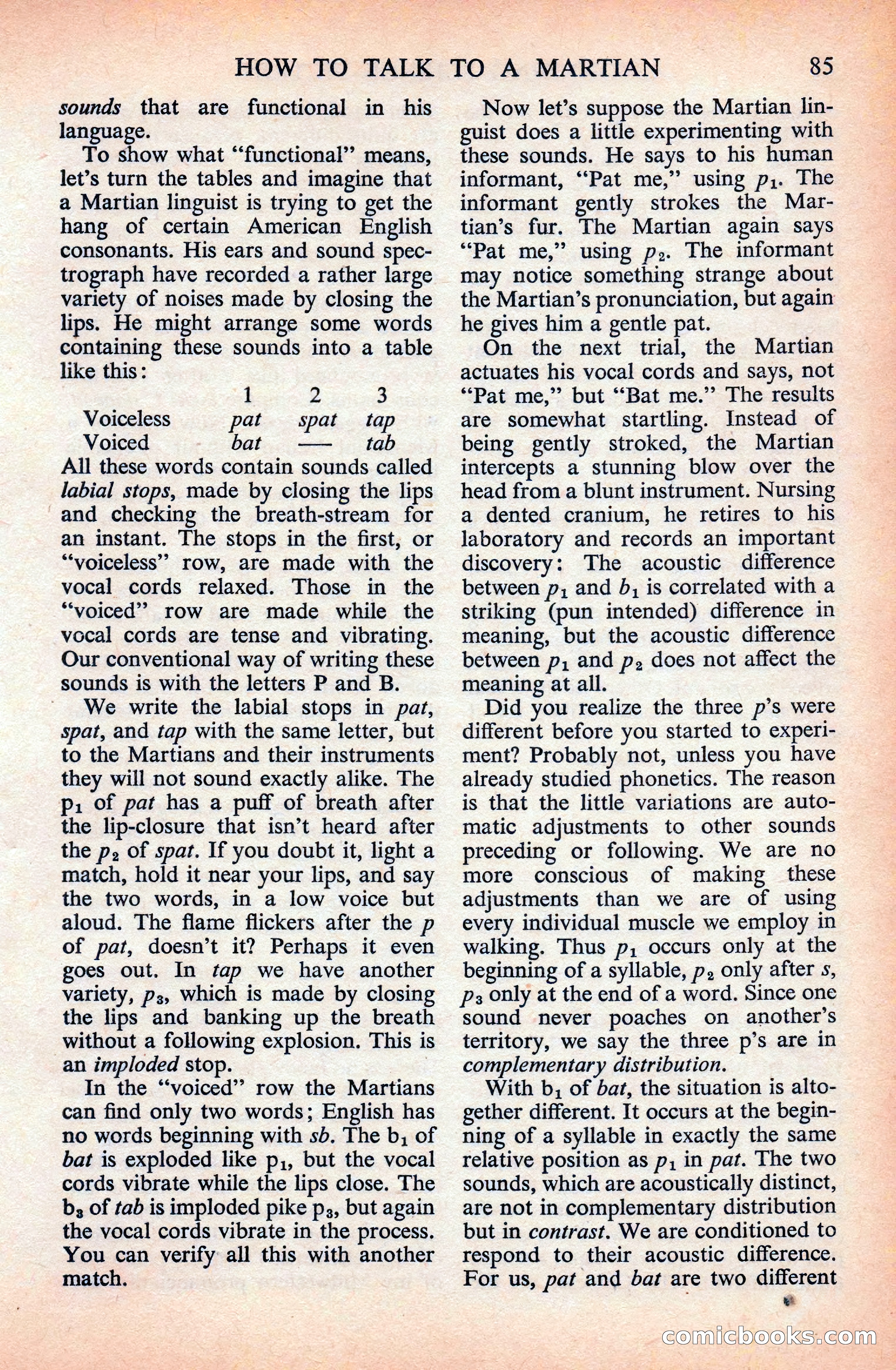
HOW TO TALK sounds that are functional in his language. To show what “‘functional’’ means, let’s turn the tables and imagine that a Martian linguist is trying to get the hang of certain American English consonants. His ears and sound spec- trograph have recorded a rather large variety of noises made by closing the lips. He might arrange some words containing these sounds into a table like this: 1 2 3 Voiceless pat spat tap Voiced bat... ——: tab All these words contain sounds called labial stops, made by closing the lips and checking the breath-stream for an instant. The stops in the first, or “voiceless” row, are made with the vocal cords relaxed. Those in the “voiced”? row are made while the vocal cords are tense and vibrating. Our conventional way of writing these sounds is with the letters P and B. We write the labial stops in pat, spat, and tap with the same letter, but to the Martians and their instruments they will not sound exactly alike. The Pi Of pat has a puff of breath after the lip-closure that isn’t heard after the p, of spat. If you doubt it, light a match, hold it near your lips, and say the two words, in a low voice but aloud. The flame flickers after the p of pat, doesn’t it? Perhaps it even goes out. In fap we have another variety, p3, which is made by closing the lips and banking up the breath without a following explosion. This is an imploded stop. : In the “voiced’’ row the Martians can find only two words; English has no words beginning with sb. The b, of bat is exploded like p,, but the vocal cords vibrate while the lips close. The b; of tab is imploded pike ps, but again the vocal cords vibrate in the process. You can verify all this with another match. TO A MARTIAN 85 Now let’s suppose the Martian lin- guist does a little experimenting with these sounds. He says to his human informant, ‘‘Pat me,” using p;. The informant gently strokes the Mar- tian’s fur. The Martian again says “Pat me,” using po. The informant may notice something strange about the Martian’s pronunciation, but again he gives him a gentle pat. On the next trial, the Martian actuates his vocal cords and says, not ‘‘Pat me,” but “Bat me.’’ The results are somewhat startling. Instead of being gently stroked, the Martian intercepts a stunning blow over the head from a blunt instrument. Nursing a dented cranium, he retires to his laboratory and records an important discovery: The acoustic difference between p, and 5, is correlated with a striking (pun intended) difference in meaning, but the acoustic difference between p, and pz does not affect the meaning at all. Did you realize the three p’s were different before you started to experi- ment? Probably not, unless you have already studied phonetics. The reason is that the little variations are auto- matic adjustments to other sounds preceding or following. We are no more conscious of making these adjustments than we are of using every individual muscle we employ in walking. Thus p; occurs only at the beginning of a syllable, p. only after s, Ps: Only at the end of a word. Since one sound never poaches on another’s territory, we say the three p’s are in complementary distribution. With b, of bat, the situation is alto- gether different. It occurs at the begin- ning of a syllable in exactly the same relative position as p; in pat. The two sounds, which are acoustically distinct, are not in complementary distribution but in contrast. We are conditioned to respond to their acoustic difference. For us, pat and bat are two different a EComichooksrco im