
Pulp Fiction, 1954 · page 86 of 133
Astounding Science Fiction (British Edition) — page 86: what you’re looking at
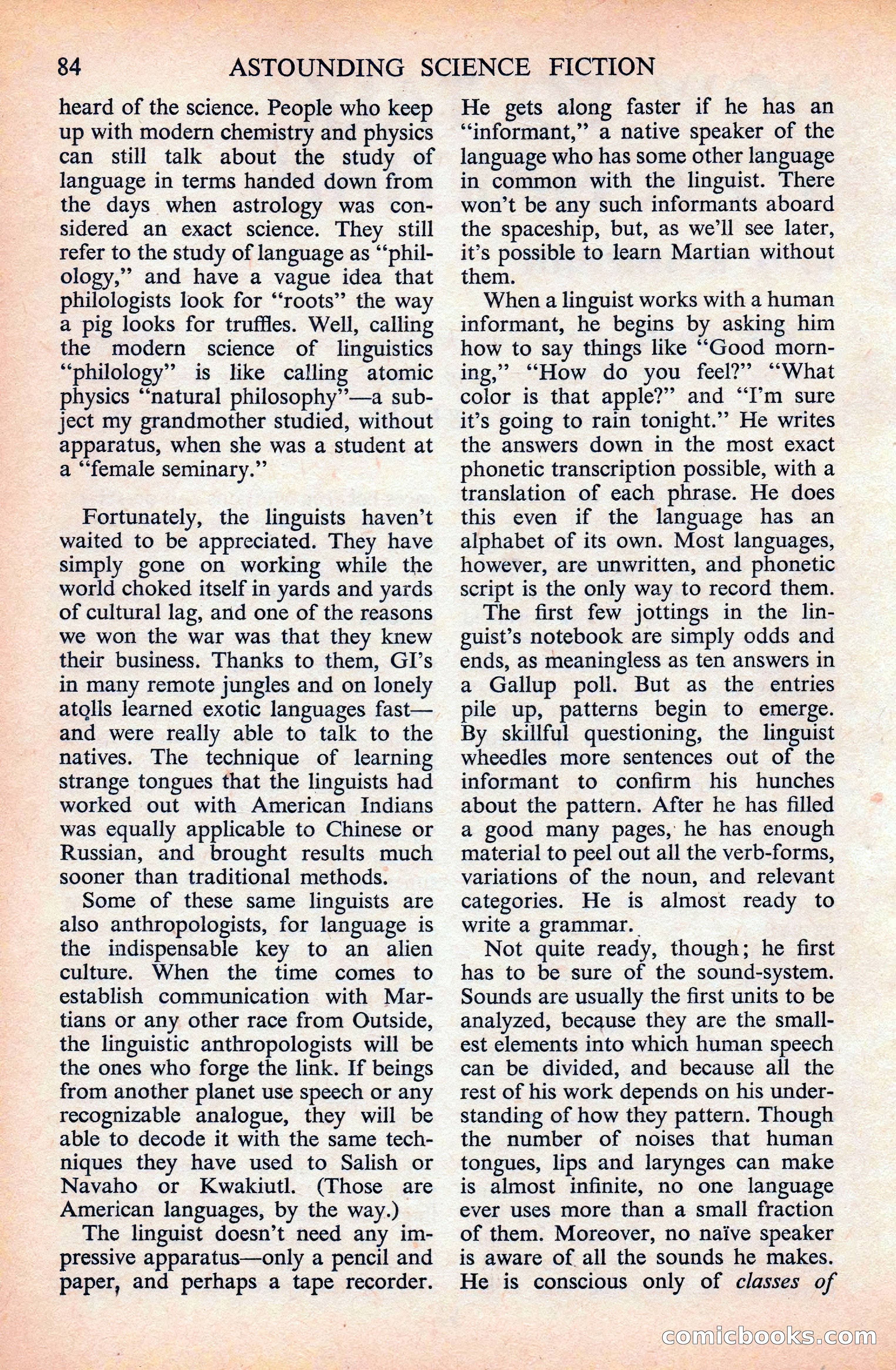
A restored page from Pulp Fiction, 1954. Page through the whole issue in the reader above.
📄 Transcribed text from this page (OCR, searchable)
Machine-transcribed from the original scan — historical spelling and the odd misread are preserved.
84 ASTOUNDING SCIENCE FICTION heard of the science. People who keep up with modern chemistry and physics can still talk about the study of language in terms handed down from the days when astrology was con- sidered an exact science. They still refer to the study of language as “‘phil- ology,” and have a vague idea that philologists look for “roots” the way a pig looks for truffles. Well, calling the modern science of linguistics “philology” is like calling atomic physics “natural philosophy”—a sub- ject my grandmother studied, without apparatus, when she was a student at a ‘female seminary.” Fortunately, the linguists haven’t waited to be appreciated. They have simply gone on working while the world choked itself in yards and yards of cultural lag, and one of the reasons we won the war was that they knew their business. Thanks to them, GI’s in many remote jungles and on lonely atglis learned exotic languages fast— and were really able to talk to the natives. The technique of learning strange tongues that the linguists had worked out with American Indians was equally applicable to Chinese or Russian, and brought results much sooner than traditional methods. Some of these same linguists are also anthropologists, for language is the indispensable key to an alien culture. When the time comes to establish communication with Mar- tians or any other race from Outside, the linguistic anthropologists will be the ones who forge the link. If beings from another planet use speech or any recognizable analogue, they will be able to decode it with the same tech- niques they have used to Salish or Navaho or Kwakiutl. (Those are American languages, by the way.) The linguist doesn’t need any im- pressive apparatus—only a pencil and paper, and perhaps a tape recorder. He gets along faster if he has an “informant,” a native speaker of the language who has some other language in common with the linguist. There won’t be any such informants aboard the spaceship, but, as we'll see later, it’s possible to learn Martian without them. When a linguist works with a human informant, he begins by asking him how to say things like “Good morn- ing,’ “How do you feel?” “What color is that apple?” and “I’m sure it’s going to rain tonight.” He writes the answers down in the most exact phonetic transcription possible, with a translation of each phrase. He does this even if the language has an alphabet of its own. Most languages, however, are unwritten, and phonetic script is the only way to record them. The first few jottings in the lin- guist’s notebook are simply odds and ends, as meaningless as ten answers in a Gallup poll. But as the entries pile up, patterns begin to emerge. By skillful questioning, the linguist wheedles more sentences out of the informant to confirm his hunches about the pattern. After he has filled a good many pages, he has enough material to peel out all the verb-forms, variations of the noun, and relevant categories. He is almost ready to write a grammar. Not quite ready, though; he first has to be sure of the sound-system. Sounds are usually the first units to be analyzed, because they are the small- est elements into which human speech can be divided, and because all the rest of his work depends on his under- standing of how they pattern. Though the number of noises that human tongues, lips and larynges can make is almost infinite, no one language ever uses more than a small fraction of them. Moreover, no naive speaker is aware of all the sounds he makes. He is conscious only of classes of Comicbooksnco im