
Pulp Fiction, 1954 · page 88 of 133
Astounding Science Fiction (British Edition) — page 88: what you’re looking at
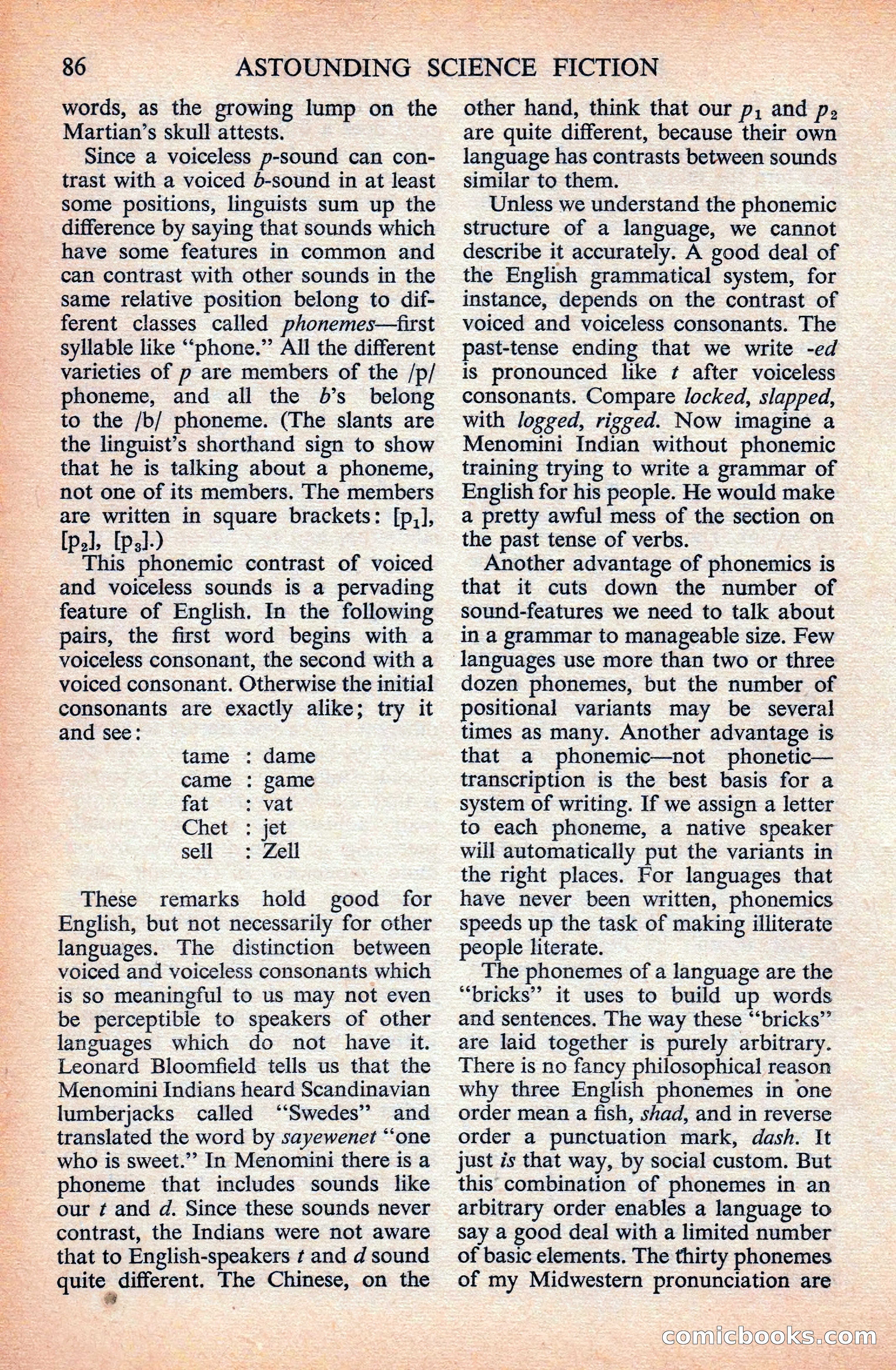
A restored page from Pulp Fiction, 1954. Page through the whole issue in the reader above.
📄 Transcribed text from this page (OCR, searchable)
Machine-transcribed from the original scan — historical spelling and the odd misread are preserved.
86 ASTOUNDING SCIENCE FICTION words, as the growing lump on the Martian’s skull attests. Since a voiceless p-sound can con- trast with a voiced b-sound in at least some positions, linguists sum up the difference by saying that sounds which have some features in common and can contrast with other sounds in the same relative position belong to dif- ferent classes called phonemes—first syllable like “phone.” All the different varieties of p are members of the /p/ phoneme, and all the b’s_ belong to the /b/ phoneme. (The slants are the linguist’s shorthand sign to show that he is talking about a phoneme, not one of its members. The members are written in square brackets: [p,], [pe], [ps]-) This phonemic contrast of voiced and voiceless sounds is a pervading feature of English. In the following pairs, the first word begins with a voiceless consonant, the second with a voiced consonant. Otherwise the initial consonants are exactly alike; try it and see: tame : dame came : game fat : vat Chet : jet sell =: Zell These remarks hold good for English, but not necessarily for other languages. The distinction between voiced and voiceless consonants which is so meaningful to us may not even be perceptible to speakers of other languages which do not have it. Leonard Bloomfield tells us that the Menomini Indians heard Scandinavian lumberjacks called “Swedes” and translated the word by sayewenet “‘one who is sweet.”’ In Menomini there is a phoneme that includes sounds like our ¢ and d. Since these sounds never contrast, the Indians were not aware that to English-speakers ¢ and d sound quite. different. The Chinese, on the other hand, think that our p, and p» are quite different, because their own language has contrasts between sounds similar to them. Unless we understand the phonemic structure of a language, we cannot describe it accurately. A good deal of the English grammatical system, for instance, depends on the contrast of voiced and voiceless consonants. The past-tense ending that we write -ed is pronounced like ¢ after voiceless consonants. Compare locked, slapped, with logged, rigged. Now imagine a Menomini Indian without phonemic training trying to write a grammar of English for his people. He would make a pretty awful mess of the section on the past tense of verbs. Another advantage of phonemics is that it cuts down the number of sound-features we need to talk about in a grammar to manageable size. Few languages use more than two or three dozen phonemes, but the number of positional variants may be several times as many. Another advantage is that a phonemic—not phonetic— transcription is the best basis for a system of writing. If we assign a letter to each phoneme, a native speaker will automatically put the variants in the right places. For languages that have never been written, phonemics speeds up the task of making illiterate people literate. The phonemes of a language are the “bricks” it uses to build up words and sentences. The way these “‘bricks”’ are laid together is purely arbitrary. There is no fancy philosophical reason why three English phonemes in one order mean a fish, shad, and in reverse order a punctuation mark, dash. It just is that way, by social custom. But this combination of phonemes in an arbitrary order enables a language to say a good deal with a limited number of basic elements. The thirty phonemes of my Midwestern pronunciation are EComichooks.co im