
Pulp Fiction, 1954 · page 85 of 133
Astounding Science Fiction (British Edition) — page 85: what you’re looking at
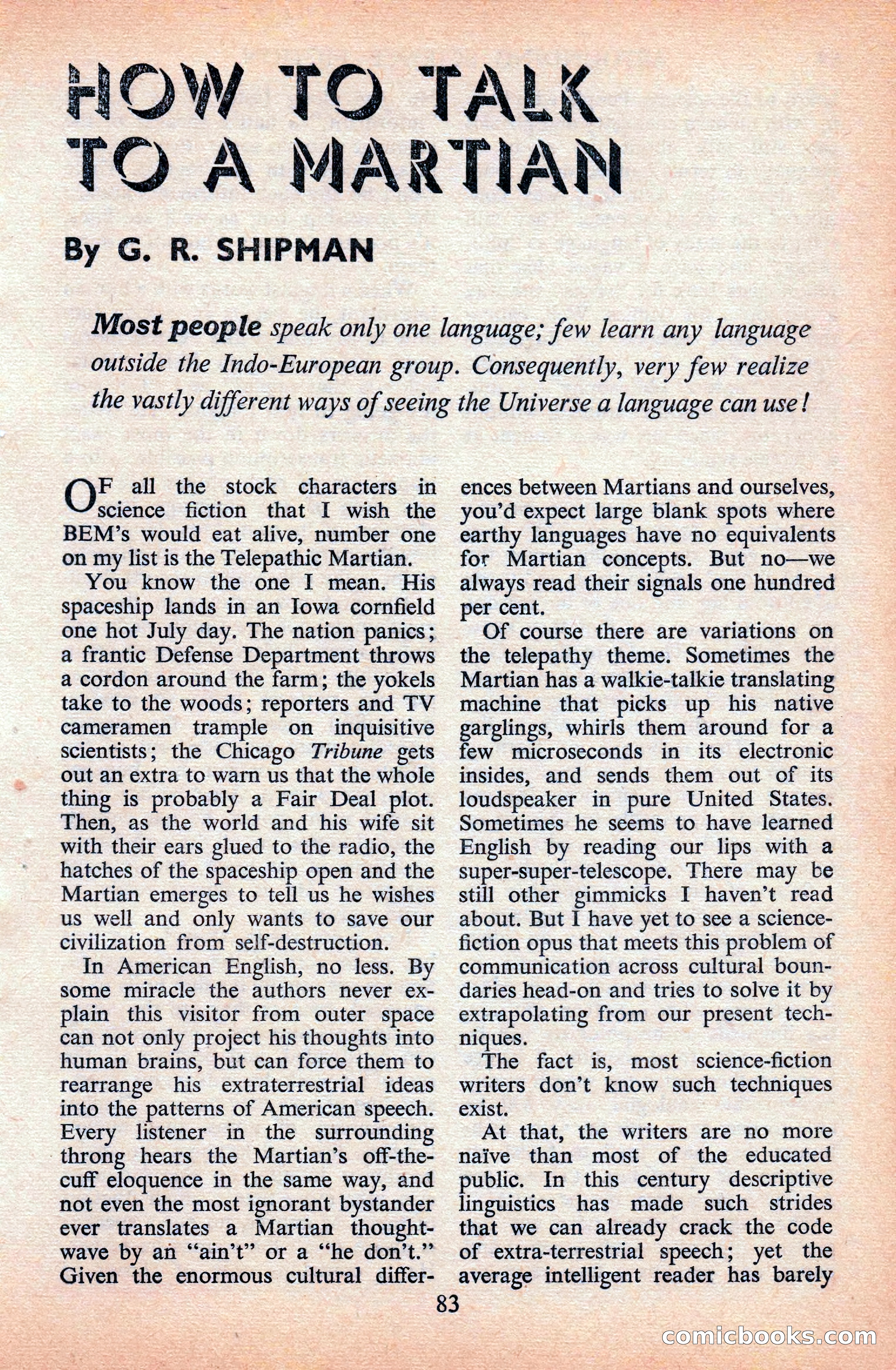
A restored page from Pulp Fiction, 1954. Page through the whole issue in the reader above.
📄 Transcribed text from this page (OCR, searchable)
Machine-transcribed from the original scan — historical spelling and the odd misread are preserved.
rlOW TO TALK TO A MARTIAN By G. R. SHIPMAN Most people speak only one language; few learn any language outside the Indo-European group. Consequently, very few realize the vastly different ways of seeing the Universe a language can use! F all the stock characters in science fiction that I wish the BEM’s would eat alive, number one on my list is the Telepathic Martian. You know the one I mean. His spaceship lands in an Iowa cornfield one hot July day. The nation panics; a frantic Defense Department throws a cordon around the farm; the yokels take to the woods; reporters and TV cameramen trample on inquisitive scientists; the Chicago Tribune gets out an extra to warn us that the whole thing is probably a Fair Deal plot. Then, as the world and his wife sit with their ears glued to the radio, the hatches of the spaceship open and the Martian emerges to tell us he wishes us well and only wants to save our civilization from self-destruction. In American English, no less. By some miracle the authors never ex- plain this visitor from outer space can not only project his thoughts into human brains, but can force them to rearrange his extraterrestrial ideas into the patterns of American speech. Every listener in the surrounding throng hears the Martian’s off-the- cuff eloquence in the same way, and not even the most ignorant bystander ever translates a Martian thought- wave by an “ain’t” or a “‘he don’t.” Given the enormous cultural differ- ences between Martians and ourselves, you’d expect large blank spots where earthy languages have no equivalents for Martian concepts. But no—we always read their signals one hundred per cent. Of course there are variations on the telepathy theme. Sometimes the Martian has a walkie-talkie translating machine that picks up his native garglings, whirls them around for a few microseconds in its electronic insides, and sends them out of its loudspeaker in pure United States. Sometimes he seems to have learned English by reading our lips with a super-super-telescope. There may be still other gimmicks I haven’t read about. But I have yet to see a science- fiction opus that meets this problem of communication across cultural boun- daries head-on and tries to solve it by extrapolating from our present tech- niques. The fact is, most science-fiction writers don’t know such techniques exist. At that, the writers are no more naive than most of the educated public. In this century descriptive linguistics has made such _ strides that we can already crack the code of extra-terrestrial speech; yet the average intelligent reader has barely 83 EComichbooks.co im