
Pulp Fiction, 1954 · page 121 of 133
Astounding Science Fiction (British Edition) — page 121: what you’re looking at
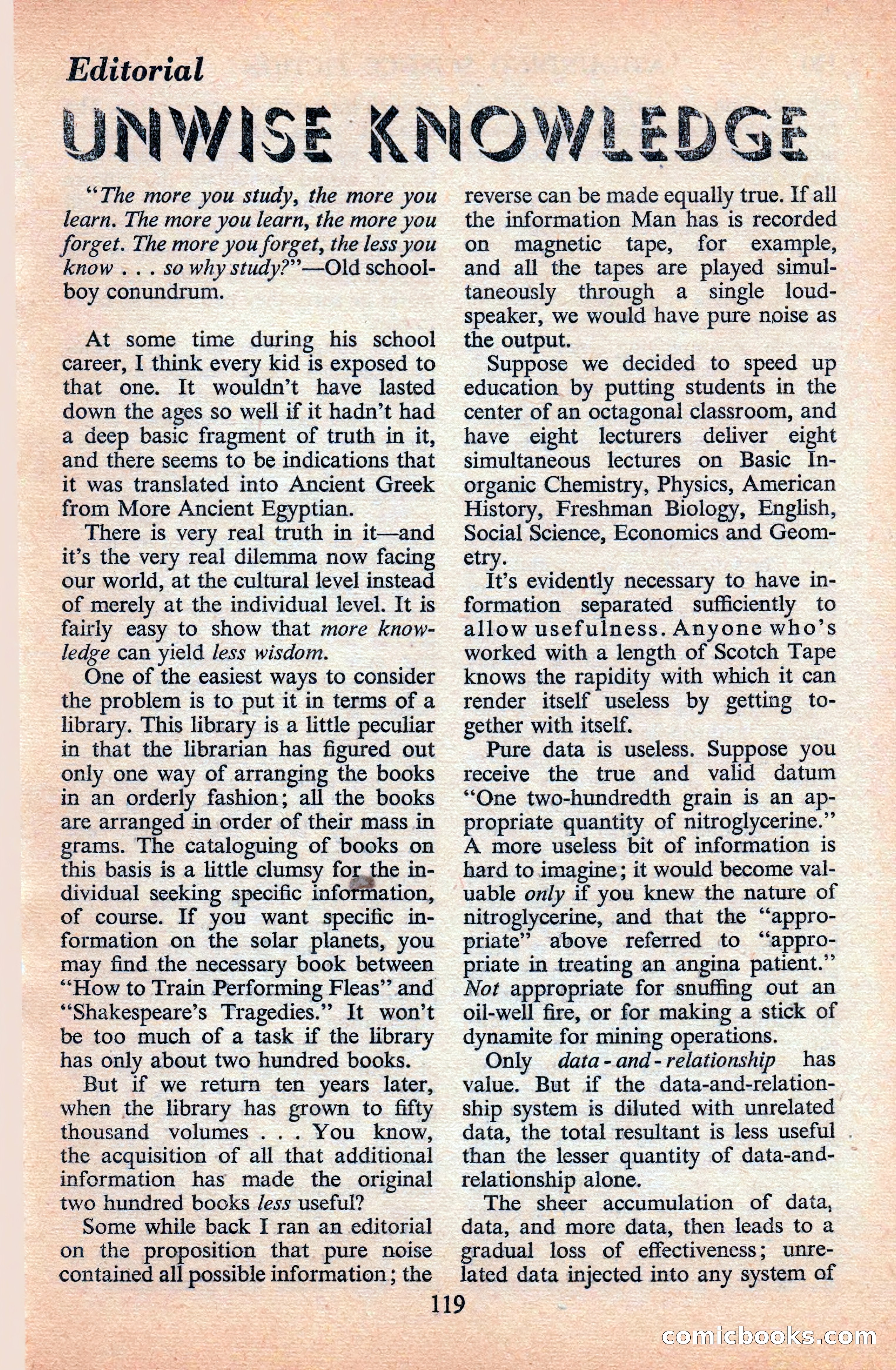
A restored page from Pulp Fiction, 1954. Page through the whole issue in the reader above.
📄 Transcribed text from this page (OCR, searchable)
Machine-transcribed from the original scan — historical spelling and the odd misread are preserved.
Editorial UNWISE KNOWLEDGE “The more you study, the more you learn. The more you learn, the more you forget. The more you forget, the less you know ... so why study?”’—Old school- boy conundrum. At some time during his school career, I think every kid is exposed to that one. It wouldn’t have lasted down the ages so well if it hadn’t had a deep basic fragment of truth in it, and there seems to be indications that it was translated into Ancient Greek from More Ancient Egyptian. There is very real truth in it—and it’s the very real dilemma now facing our world, at the cultural level instead of merely at the individual level. It is fairly easy to show that more know- ledge can yield less wisdom. One of the easiest ways to consider the problem is to put it in terms of a library. This library is a little peculiar in that the librarian has figured out only one way of arranging the books in an orderly fashion; all the books are arranged in order of their mass in grams. The cataloguing of books on this basis is a little clumsy ae in- dividual seeking specific information, of course. If you want specific in- formation on the solar planets, you may find the necessary book between “How to Train Performing Fleas’’ and ““Shakespeare’s Tragedies.” It won’t be too much of a task if the library has only about two hundred books. But if we return ten years later, when the library has grown to fifty thousand volumes ... You know, the acquisition of all that additional information has made the original two hundred books /ess useful? Some while back I ran an editorial on the proposition that pure noise contained all possible information ; the reverse can be made equally true. If all the information Man has is recorded on magnetic tape, for example, and all the tapes are played simul- taneously through a single loud- speaker, we would have pure noise as the output. Suppose we decided to speed up education by putting students in the center of an octagonal classroom, and have eight lecturers deliver eight simultaneous lectures on Basic In- organic Chemistry, Physics, American History, Freshman Biology, English, Social Science, Economics and Geom- etry. It’s evidently necessary to have in- formation separated sufficiently to allow usefulness. Anyone who’s worked with a length of Scotch Tape knows the rapidity with which it can render itself useless by getting to- gether with itself. Pure data is useless. Suppose you receive the true and valid datum “One two-hundredth grain is an ap- propriate quantity of nitroglycerine.” A more useless bit of information is hard to imagine; it would become val- uable only if you knew the nature of nitroglycerine, and that the “appro- priate” above referred to “appro- priate in treating an angina patient.” Not appropriate for snuffing out an oil-well fire, or for making a stick of dynamite for mining operations. Only data-and-relationship has value. But if the data-and-relation- ship system is diluted with unrelated data, the total resultant is less useful . than the lesser quantity of data-and- relationship alone. The sheer accumulation of data, data, and more data, then leads to a gradual loss of effectiveness; unre- lated data injected into any system of 119 im) EComichbooksico im