
Pulp Fiction, 1954 · page 120 of 133
Astounding Science Fiction (British Edition) — page 120: what you’re looking at
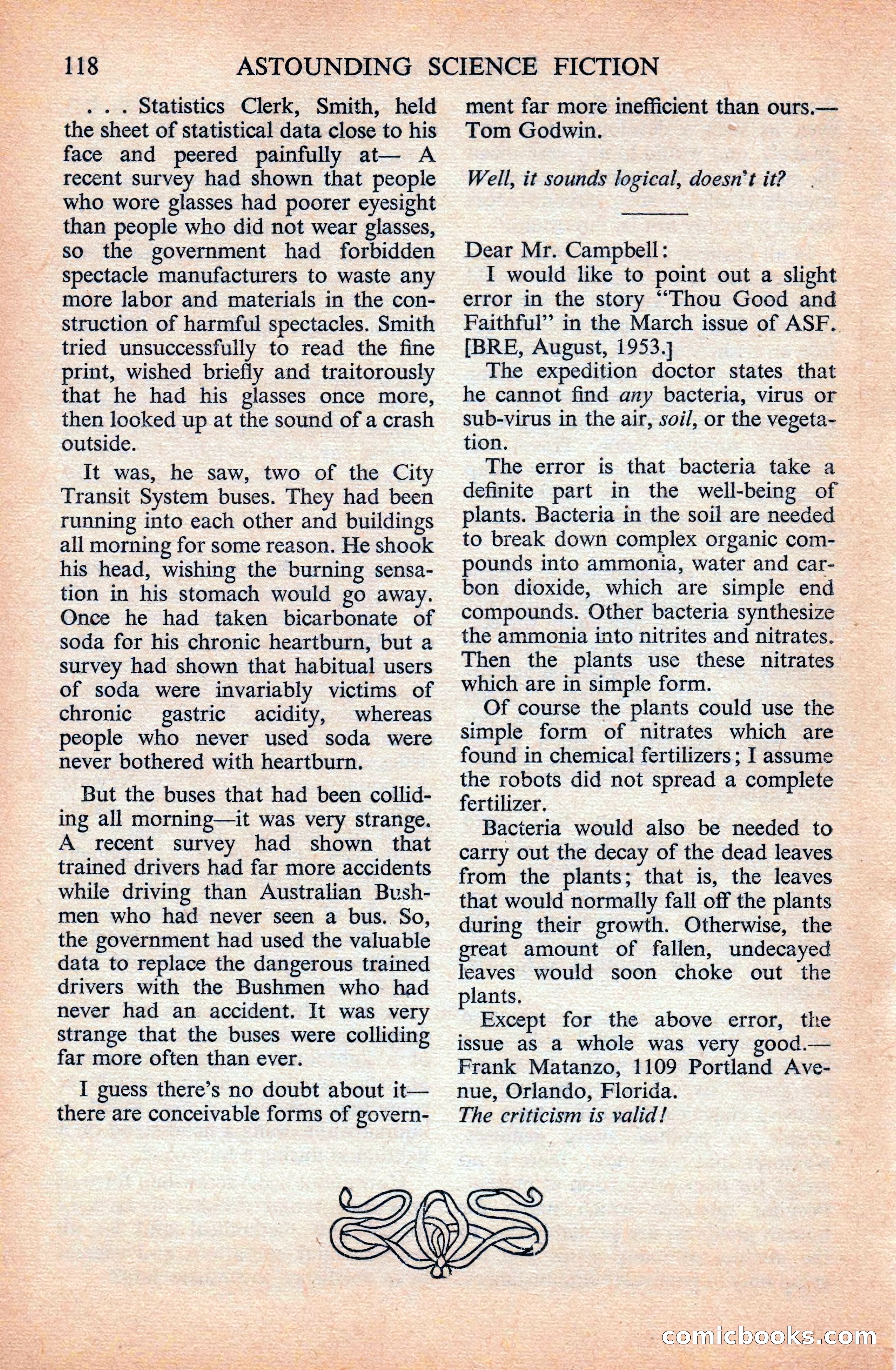
A restored page from Pulp Fiction, 1954. Page through the whole issue in the reader above.
📄 Transcribed text from this page (OCR, searchable)
Machine-transcribed from the original scan — historical spelling and the odd misread are preserved.
118 ASTOUNDING SCIENCE FICTION . . . Statistics Clerk, Smith, held the sheet of statistical data close to his face and peered painfully at— A recent survey had shown that people who wore glasses had poorer eyesight than people who did not wear glasses, so the government had forbidden spectacle manufacturers to waste any more labor and materials in the con- struction of harmful spectacles. Smith tried unsuccessfully to read the fine print, wished briefly and traitorously that he had his glasses once more, then looked up at the sound of a crash outside. It was, he saw, two of the City Transit System buses. They had been running into each other and buildings all morning for some reason. He shook his head, wishing the burning sensa- tion in his stomach would go away. Once he had taken bicarbonate of soda for his chronic heartburn, but a survey had shown that habitual users of soda were invariably victims of chronic gastric acidity, whereas people who never used soda were never bothered with heartburn. But the buses that had been collid- ing all morning—it was very strange. A recent survey had shown that trained drivers had far more accidents while driving than Australian Bush- men who had never seen a bus. So, the government had used the valuable data to replace the dangerous trained drivers with the Bushmen who had never had an accident. It was very strange that the buses were colliding far more often than ever. I guess there’s no doubt about it— there are conceivable forms of govern- ment far more inefficient than ours.— Tom Godwin. Well, it sounds logical, doesn’t it? Dear Mr. Campbell : I would like to point out a slight error in the story “Thou Good and Faithful” in the March issue of ASF. [BRE, August, 1953.) The expedition doctor states that he cannot find any bacteria, virus or sub-virus in the air, soil, or the vegeta- tion. The error is that bacteria take a definite part in the well-being of plants. Bacteria in the soil are needed to break down complex organic com- pounds into ammonia, water and car- bon dioxide, which are simple end compounds. Other bacteria synthesize _ the ammonia into nitrites and nitrates. Then the plants use these nitrates which are in simple form. Of course the plants could use the simple form of nitrates which are found in chemical fertilizers ; I assume the robots did not spread a complete fertilizer. Bacteria would also be needed to carry out the decay of the dead leaves from the plants; that is, the leaves that would normally fall off the plants during their growth. Otherwise, the great amount of fallen, undecayed leaves would soon choke out the plants. Except for the above error, the issue as a whole was very good.— Frank Matanzo, 1109 Portland Ave- nue, Orlando, Florida. The criticism is valid! im CONnniel yoo <SaColnn