
Pulp Fiction, 1954 · page 122 of 133
Astounding Science Fiction (British Edition) — page 122: what you’re looking at
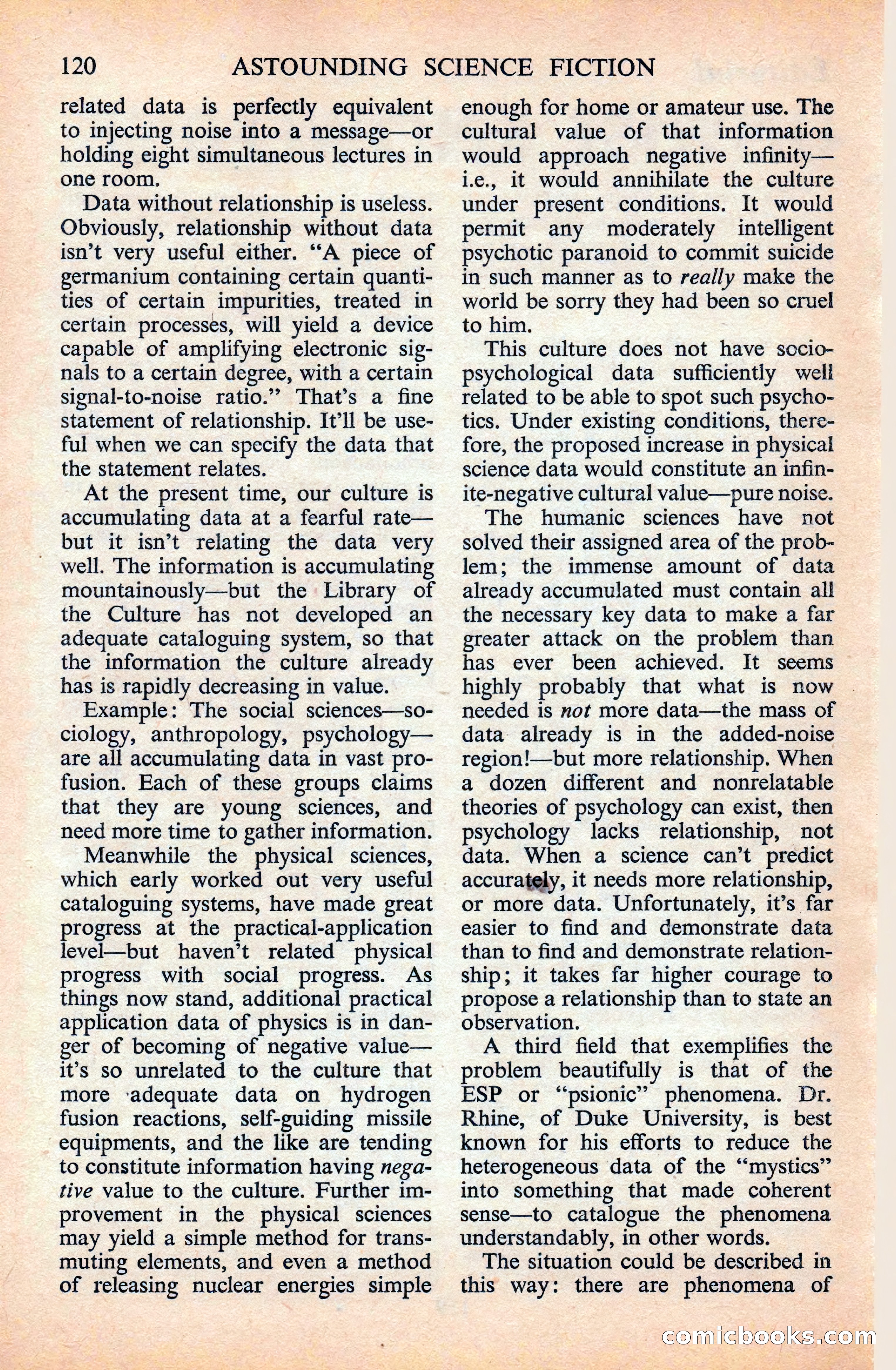
A restored page from Pulp Fiction, 1954. Page through the whole issue in the reader above.
📄 Transcribed text from this page (OCR, searchable)
Machine-transcribed from the original scan — historical spelling and the odd misread are preserved.
120 related data is perfectly equivalent to injecting noise into a message—or holding eight simultaneous lectures in one room. Data without relationship is useless. Obviously, relationship without data isn’t very useful either. “A piece of germanium containing certain quanti- ties of certain impurities, treated in certain processes, will yield a device capable of amplifying electronic sig- nals to a certain degree, with a certain signal-to-noise ratio.”” That’s a fine statement of relationship. It'll be use- ful when we can specify the data that the statement relates. At the present time, our culture is accumulating data at a fearful rate— but it isn’t relating the data very well. The information is accumulating mountainously—but the Library of the Culture has not developed an adequate cataloguing system, so that the information the culture already has is rapidly decreasing in value. Example: The social sciences—so- ciology, anthropology, psychology— are all accumulating data in vast pro- fusion. Each of these groups claims that they are young sciences, and need more time to gather information. Meanwhile the physical sciences, which early worked out very useful cataloguing systems, have made great progress at the practical-application level—but haven’t related physical progress with social progress. As things now stand, additional practical application data of physics is in dan- ger of becoming of negative value— it’s so unrelated to the culture that more ‘adequate data on hydrogen fusion reactions, self-guiding missile equipments, and the like are tending to constitute information having nega- tive value to the culture. Further im- provement in the physical sciences may yield a simple method for trans- muting elements, and even a method of releasing nuclear energies simple ASTOUNDING SCIENCE FICTION enough for home or amateur use. The cultural value of that information would approach negative infinity— i.e., it would annihilate the culture under present conditions. It would permit any moderately intelligent psychotic paranoid to commit suicide in such manner as to really make the world be sorry they had been so cruel to him. This culture does not have socio- psychological data sufficiently well related to be able to spot such psycho- tics. Under existing conditions, there- fore, the proposed increase in physical science data would constitute an infin- ite-negative cultural value—pure noise. The humanic sciences have not solved their assigned area of the prob- lem; the immense amount of data already accumulated must contain all the necessary key data to make a far greater attack on the problem than has ever been achieved. It seems highly probably that what is now needed is not more data—the mass of data already is in the added-noise region!—but more relationship. When a dozen different and nonrelatable theories of psychology can exist, then psychology lacks relationship, not data. When a science can’t predict accurately, it needs more relationship, or more data. Unfortunately, it’s far easier to find and demonstrate data than to find and demonstrate relation- ship; it takes far higher courage to propose a relationship than to state an observation. A third field that exemplifies the problem beautifully is that of the ESP or “psionic” phenomena. Dr. Rhine, of Duke University, is best known for his efforts to reduce the heterogeneous data of the “mystics” into something that made coherent sense—to catalogue the phenomena understandably, in other words. The situation could be described in this way: there are phenomena of ga im Comichooks co