
Pulp Fiction, 1954 · page 114 of 133
Astounding Science Fiction (British Edition) — page 114: what you’re looking at
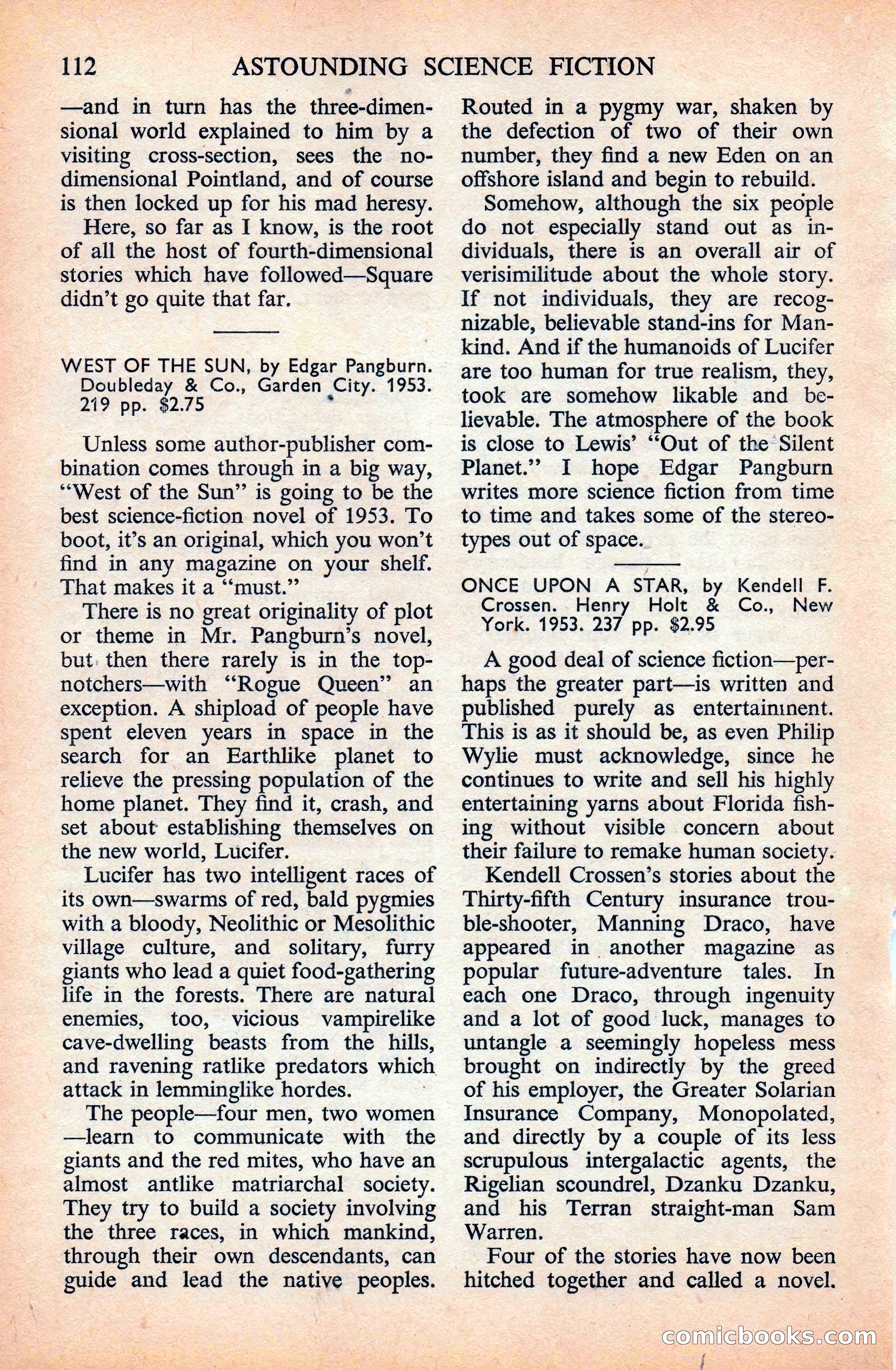
A restored page from Pulp Fiction, 1954. Page through the whole issue in the reader above.
📄 Transcribed text from this page (OCR, searchable)
Machine-transcribed from the original scan — historical spelling and the odd misread are preserved.
112 —and in turn has the three-dimen- sional world explained to him by a visiting cross-section, sees the no- dimensional Pointland, and of course is then locked up for his mad heresy. Here, so far as I know, is the root of all the host of fourth-dimensional stories which have followed—Square didn’t go quite that far. WEST OF THE SUN, by Edgar Pangburn. Doubleday & Co., Garden City. 1953. 219 pp. $2.75 : Unless some author-publisher com- bination comes through in a big way, “West of the Sun” is going to be the best science-fiction novel of 1953. To boot, it’s an original, which you won’t find in any magazine on your shelf. That makes it a “must.” There is no great originality of plot or theme in Mr. Pangburn’s novel, but: then there rarely is in the top- notchers—with “Rogue Queen” an exception. A shipload of people have spent eleven years in space in the search for an Earthlike planet to relieve the pressing population of the home planet. They find it, crash, and set about establishing themselves on the new world, Lucifer. Lucifer has two intelligent races of its own—swarms of red, bald pygmies with a bloody, Neolithic or Mesolithic village culture, and solitary, furry giants who lead a quiet food-gathering life in the forests. There are natural enemies, too, vicious vampirelike cave-dwelling beasts from the hills, and ravening ratlike predators which attack in lemminglike hordes. The people—four men, two women —learn to communicate with the giants and the red mites, who have an almost antlike matriarchal society. They try to build a society involving the three races, in which mankind, through their own descendants, can guide and lead the native peoples. ASTOUNDING SCIENCE FICTION Routed in a pygmy war, shaken by the defection of two of their own number, they find a new Eden on an offshore island and begin to rebuild. Somehow, although the six people do not especially stand out as in- dividuals, there is an overall air of verisimilitude about the whole story. If not individuals, they are recog- nizable, believable stand-ins for Man- kind. And if the humanoids of Lucifer are too human for true realism, they, took are somehow likable and _ be- lievable. The atmosphere of the book is Close to Lewis’ “Out of the Silent Planet.”” I hope Edgar Pangburn writes more science fiction from time to time and takes some of the stereo- types out of space. ONCE UPON A STAR, by Kendell F. Crossen. Henry Holt & Co., New York. 1953. 237 pp. $2.95 A good deal of science fiction—per- haps the greater part—is written and published purely as_ entertaininent. This is as it should be, as even Philip Wylie must acknowledge, since he continues to write and sell his highly entertaining yarns about Florida fish- ing without visible concern about their failure to remake human society. Kendell Crossen’s stories about the Thirty-fifth Century insurance trou- ble-shooter, Manning Draco, have appeared in another magazine as popular future-adventure tales. In each one Draco, through ingenuity and a lot of good luck, manages to untangle a seemingly hopeless mess brought on indirectly by the greed of his employer, the Greater Solarian Insurance Company, Monopolated, and directly by a couple of its less scrupulous intergalactic agents, the Rigelian scoundrel, Dzanku Dzanku, and his Terran straight-man Sam Warren. : Four of the stories have now been hitched together and called a novel. ; Comichooksico im