
Pulp Fiction, 1954 · page 113 of 133
Astounding Science Fiction (British Edition) — page 113: what you’re looking at
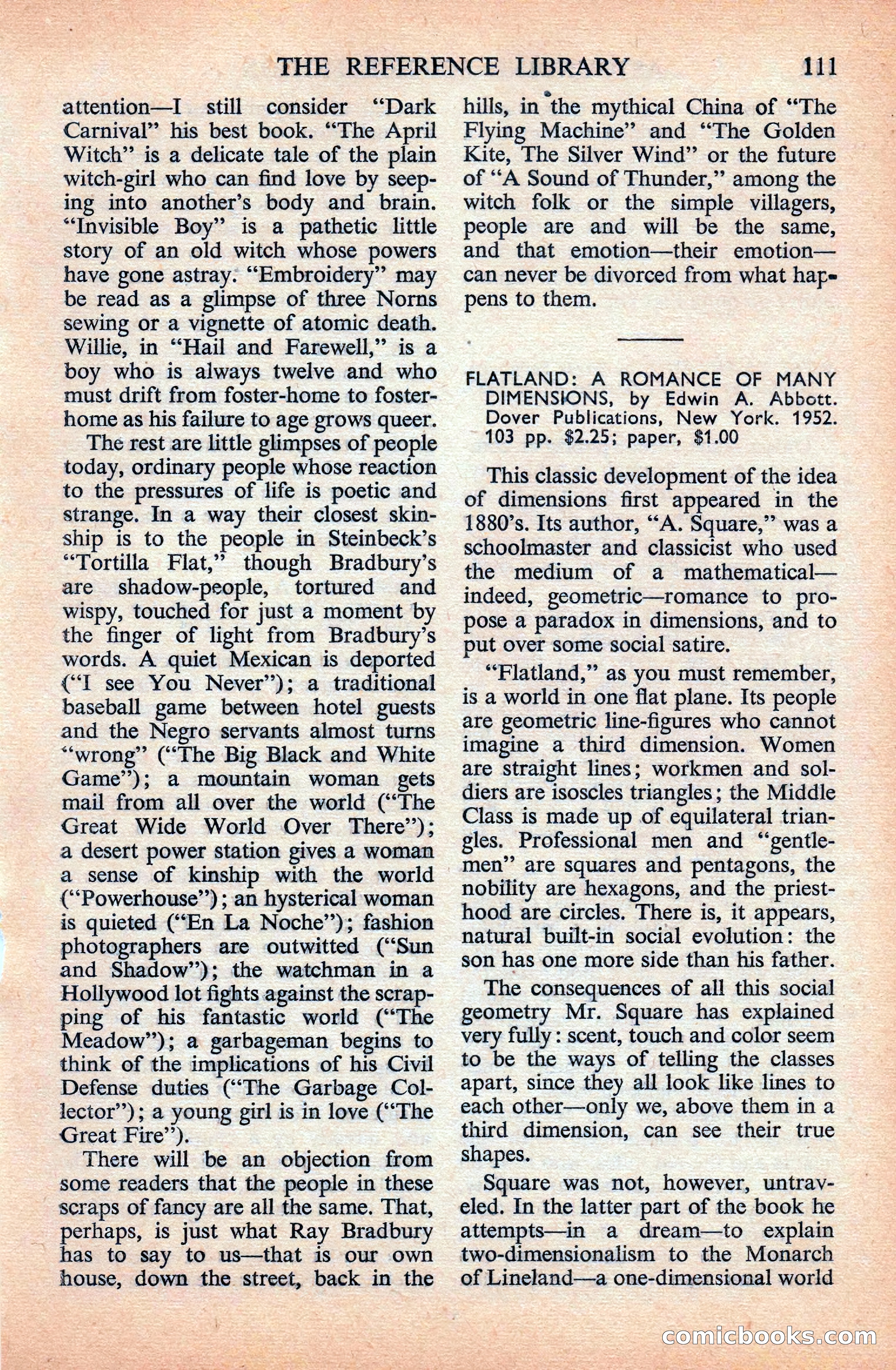
A restored page from Pulp Fiction, 1954. Page through the whole issue in the reader above.
📄 Transcribed text from this page (OCR, searchable)
Machine-transcribed from the original scan — historical spelling and the odd misread are preserved.
THE REFERENCE LIBRARY 111 attention—I still consider “Dark Carnival” his best book. “The April Witch” is a delicate tale of the plain witch-girl who can find love by seep- ing into another’s body and brain. “Invisible Boy’ is a pathetic little story of an old witch whose powers have gone astray. “Embroidery” may be read as a glimpse of three Norns sewing or a vignette of atomic death. Willie, in “Hail and Farewell,” is a boy who is always twelve and who must drift from foster-home to foster- home as his failure to age grows queer. The rest are little glimpses of people today, ordinary people whose reaction to the pressures of life is poetic and strange. In a way their closest skin- ship is to the people in Steinbeck’s “Tortilla Flat,” though Bradbury’s are shadow-people, tortured and wispy, touched for just a moment by the finger of light from Bradbury’s words. A quiet Mexican is deported (“I see You Never’’); a traditional baseball game between hotel guests and the Negro servants almost turns “wrong” (“The Big Black and White Game’); a mountain woman gets mail from all over the world (‘“‘The Great Wide World Over There’’); a desert power station gives a woman a sense of kinship with the world (‘“Powerhouse’’) ; an hysterical woman is quieted (“En La Noche’); fashion photographers are outwitted (“Sun and Shadow’’); the watchman in a Hollywood lot fights against the scrap- ping of his fantastic world (“The Meadow”’); a garbageman begins to think of the implications of his Civil Defense duties (“The Garbage Col- lector’’); a young girl is in love (“The Great Fire’’). There will be an objection from some readers that the people in these scraps of fancy are all the same. That, perhaps, is just what Ray Bradbury has to say to us—that is our own house, down the street, back in the hills, in the mythical China of “The Flying Machine” and “The Golden Kite, The Silver Wind’”’ or the future of “A Sound of Thunder,” among the witch folk or the simple villagers, people are and will be the same, and that emotion—their emotion— can never be divorced from what hare pens to them. FLATLAND: A ROMANCE OF MANY DIMENSIONS, by Edwin A. Abbott. Dover Publications, New York. 1952. 103 pp. $2.25; paper, $1.00 This classic development of the idea of dimensions first appeared in the 1880’s. Its author, “A. Square,” was a schoolmaster and classicist who used the medium of a mathematical— indeed, geometric—romance to pro- pose a paradox in dimensions, and to put over some social satire. “Flatland,” as you must remember, is a world in one flat plane. Its people are geometric line-figures who cannot imagine a third dimension. Women are straight lines; workmen and sol- diers are isoscles triangles; the Middle Class is made up of equilateral trian- gles. Professional men and “gentle- _ men” are squares and pentagons, the nobility are hexagons, and the priest- hood are circles. There is, it appears, natural built-in social evolution: the son has one more side than his father. The consequences of all this social geometry Mr. Square has explained very fully: scent, touch and color seem to be the ways of telling the classes apart, since they all look like lines to each other—only we, above them in a third dimension, can see their true shapes. Square was not, however, untrav- eled. In the latter part of the book he attempts—in a dream—to explain two-dimensionalism to the Monarch of Lineland—a one-dimensional world EComichooksnco A