
Pulp Fiction, 1954 · page 115 of 133
Astounding Science Fiction (British Edition) — page 115: what you’re looking at
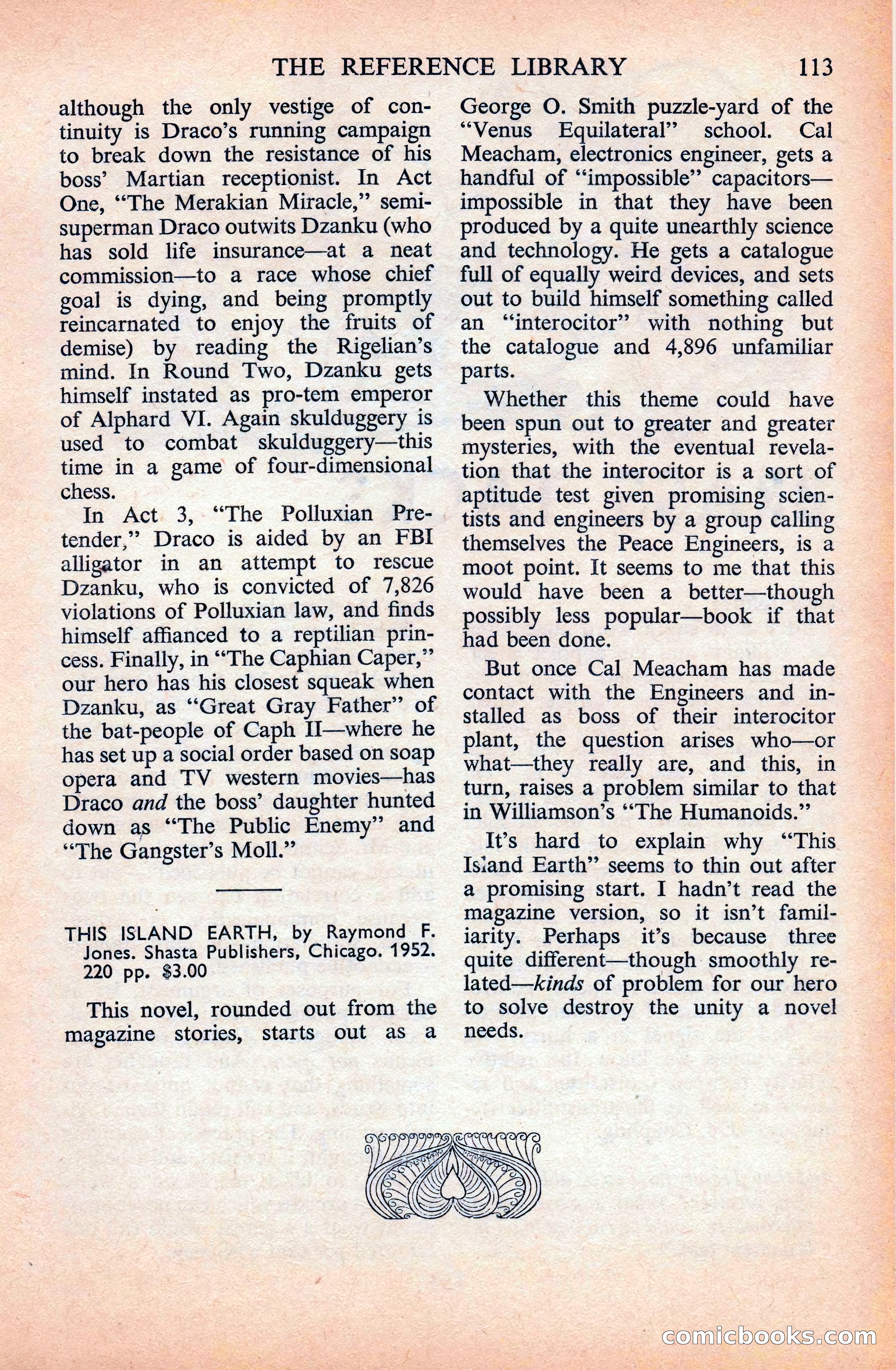
A restored page from Pulp Fiction, 1954. Page through the whole issue in the reader above.
📄 Transcribed text from this page (OCR, searchable)
Machine-transcribed from the original scan — historical spelling and the odd misread are preserved.
THE REFERENCE LIBRARY although the only vestige of con- tinuity is Draco’s running campaign to break down the resistance of his boss’ Martian receptionist. In Act One, ‘“The Merakian Miracle,’’ semi- superman Draco outwits Dzanku (who has sold life insurance—at a neat commission—to a race whose chief goal is dying, and being promptly reincarnated to enjoy the fruits of demise) by reading the Rigelian’s mind. In Round Two, Dzanku gets himself instated as pro-tem emperor of Alphard VI. Again skulduggery is used to combat skulduggery—this time in a game of four-dimensional chess. In Act 3, “The Polluxian Pre- tender,’ Draco is aided by an FBI alligator in an attempt to rescue Dzanku, who is convicted of 7,826 violations of Polluxian law, and finds himself affianced to a reptilian prin- cess. Finally, in ““The Caphian Caper,” our hero has his closest squeak when Dzanku, as ‘“‘“Great Gray Father” of the bat-people of Caph II—where he has set up a social order based on soap opera and TV western movies—has Draco and the boss’ daughter hunted down as “The Public Enemy” and “The Gangster’s Moll.” THIS ISLAND EARTH, by Raymond F. Jones. Shasta Publishers, Chicago. 1952. 220 pp. $3.00 This novel, rounded out from the magazine stories, starts out as a 113 George O. Smith puzzle-yard of the “Venus Equilateral” school. Cal Meacham, electronics engineer, gets a handful of “impossible” capacitors— impossible in that they have been produced by a quite unearthly science and technology. He gets a catalogue full of equally weird devices, and sets out to build himself something called an “‘interocitor’ with nothing but the catalogue and 4,896 unfamiliar parts. Whether this theme could have been spun out to greater and greater mysteries, with the eventual revela- tion that the interocitor is a sort of aptitude test given promising scien- tists and engineers by a group calling themselves the Peace Engineers, is a moot point. It seems to me that this would have been a _ better—though possibly less popular—book if that had been done. But once Cal Meacham has made contact with the Engineers and in- stalled as boss of their interocitor plant, the question arises who—or what—they really are, and this, in turn, raises a problem similar to that in Williamson’s “The Humanoids.”’ It’s hard to explain why “This Isiand Earth’ seems to thin out after a promising start. I hadn’t read the magazine version, so it isn’t famil- larity. Perhaps it’s because three quite different—though smoothly re- lated—kinds of problem for our hero to solve destroy the unity a novel needs. ~ COMMIElOOOKSrEO im