
Pulp Fiction, 1954 · page 112 of 133
Astounding Science Fiction (British Edition) — page 112: what you’re looking at
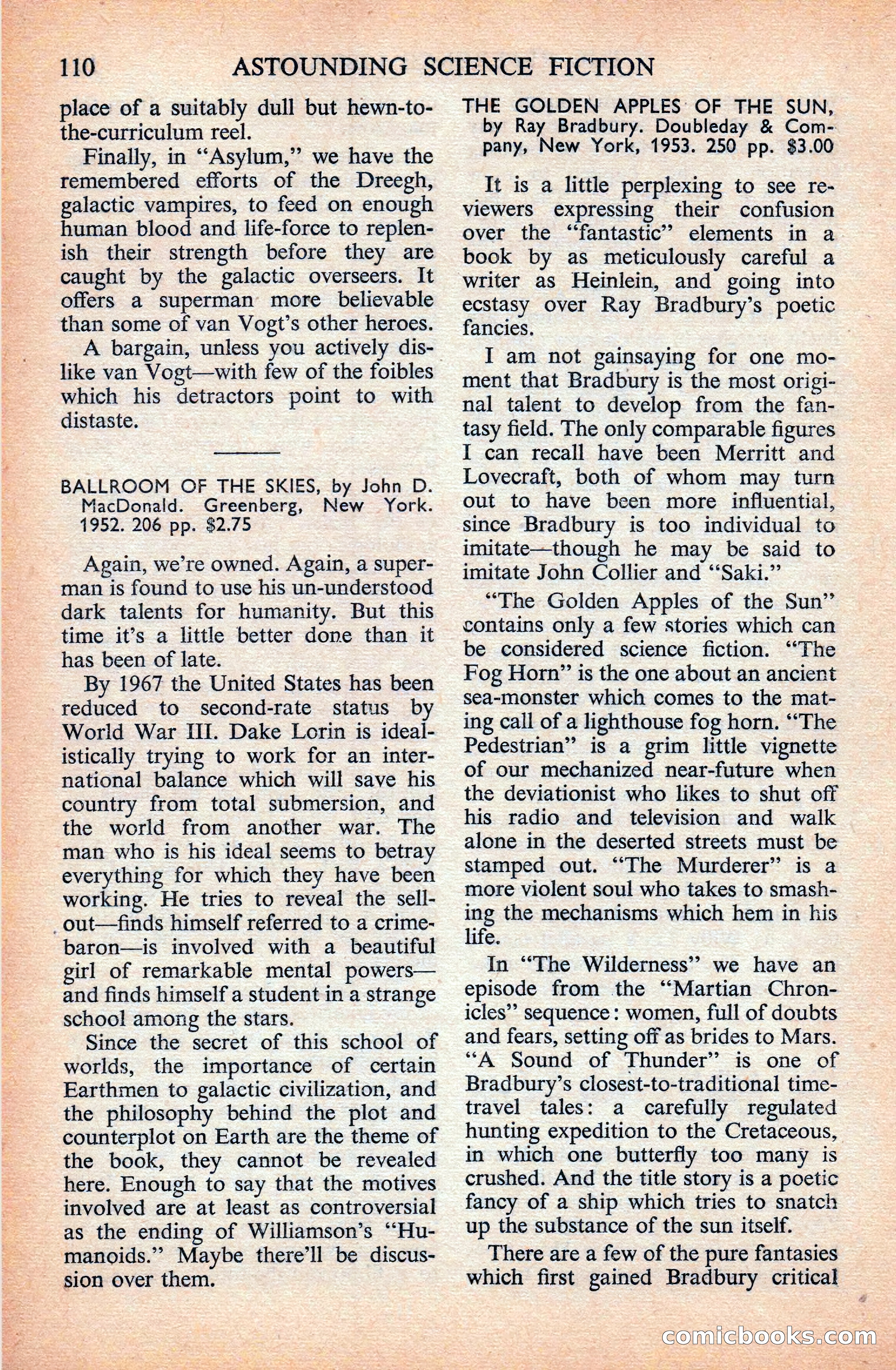
A restored page from Pulp Fiction, 1954. Page through the whole issue in the reader above.
📄 Transcribed text from this page (OCR, searchable)
Machine-transcribed from the original scan — historical spelling and the odd misread are preserved.
110 place of a suitably dull but hewn-to- the-curriculum reel. Finally, in ““Asylum,” we have the remembered efforts of the Dreegh, galactic vampires, to feed on enough human blood and life-force to replen- ish their strength before they are caught by the galactic overseers. It offers a superman more believable than some of van Vogt’s other heroes. A bargain, unless you actively dis- like van Vogt—with few of the foibles which his detractors point to with distaste. BALLROOM OF THE SKIES, by John D. MacDonald. Greenberg, New York. 1952. 206 pp. $2.75 Again, we’re owned. Again, a super- man is found to use his un-understood dark talents for humanity. But this time it’s a little better done than it has been of late. By 1967 the United States has been reduced to second-rate status by World War II. Dake Lorin is ideal- istically trying to work for an inter- national balance which will save his country from total submersion, and the world from another war. The man who is his ideal seems to betray everything for which they have been working. He tries to reveal the sell- _out—finds himself referred to a crime- baron—is involved with a beautiful girl of remarkable mental powers— and finds himself a student in a strange school among the stars. Since the secret of this school of worlds, the importance of certain Earthmen to galactic civilization, and the philosophy behind the plot and counterplot on Earth are the theme of the book, they cannot be revealed here. Enough to say that the motives involved are at least as controversial as the ending of Williamson’s “Hu- manoids.”” Maybe there'll be discus- sion over them. ASTOUNDING SCIENCE FICTION THE GOLDEN APPLES OF THE SUN, by Ray Bradbury. Doubleday & Com- pany, New York, 1953. 250 pp. $3.00 It is a little perplexing to see re- viewers expressing their confusion over the “fantastic” elements in a book by as meticulously careful a writer as Heinlein, and going into ecstasy over Ray Bradbury’s poetic fancies. I am not gainsaying for one mo- ment that Bradbury is the most origi- nal talent to develop from the fan- tasy field. The only comparable figures I can recall have been Merritt and Lovecraft, both of whom may turn out to have been more influential, since Bradbury is too individual to imitate—though he may be said to imitate John Collier and “Saki.” “The Golden Apples of the Sun’”’ contains only a few stories which can be considered science fiction. “The Fog Horn” is the one about an ancient sea-monster which comes to the mat- ing call of a lighthouse fog horn. ““The Pedestrian” is a grim little vignette of our mechanized near-future when the deviationist who likes to shut off his radio and television and walk alone in the deserted streets must be stamped out. “The Murderer” is a more violent soul who takes to smash- ing the mechanisms which hem in his life. In “The Wilderness’ we have an episode from the “Martian Chron- icles” sequence: women, full of doubts and fears, setting off as brides to Mars. “A Sound of Thunder’ is one of Bradbury’s closest-to-traditional time- travel tales: a carefully regulated hunting expedition to the Cretaceous, in which one butterfly too many is crushed. And the title story is a poetic fancy of a ship which tries to snatch up the substance of the sun itself. There are a few of the pure fantasies which first gained Bradbury critical EComichoo Sa(6O) im