
Pulp Fiction, 1954 · page 7 of 132
Astounding Science Fiction, British Edition — page 7: what you’re looking at
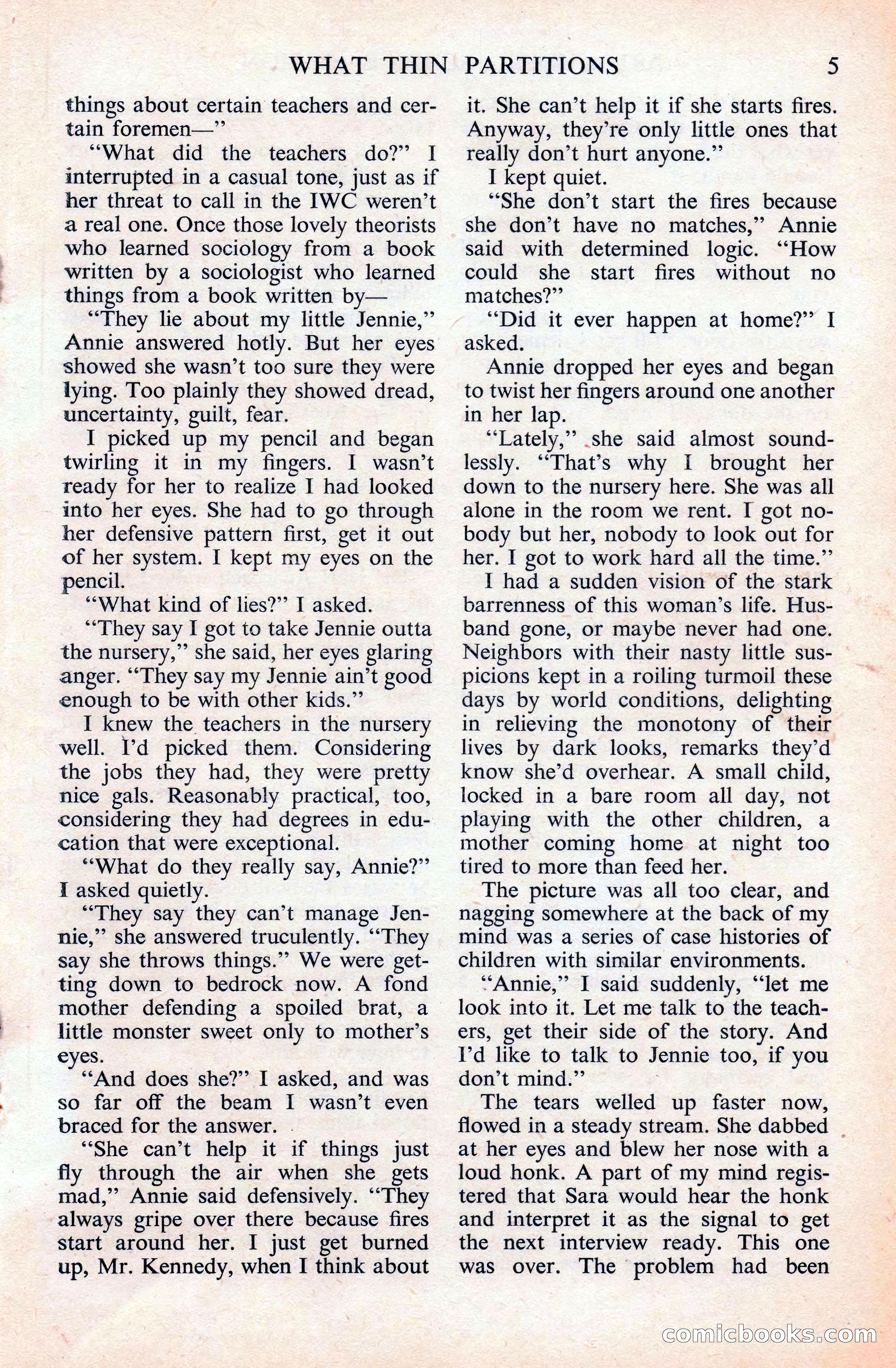
A restored page from Pulp Fiction, 1954. Page through the whole issue in the reader above.
📄 Transcribed text from this page (OCR, searchable)
Machine-transcribed from the original scan — historical spelling and the odd misread are preserved.
WHAT THIN things about certain teachers and cer- tain foremen—” “What did the teachers do?” I interrupted in a casual tone, just as if her threat to call in the IWC weren’t a real one. Once those lovely theorists who learned sociology from a book written by a sociologist who learned things from a book written by— “They lie about my little Jennie,” Annie answered hotly. But her eyes showed she wasn’t too sure they were lying. Too plainly they showed dread, uncertainty, guilt, fear. I picked up my pencil and began twirling it in my fingers. I wasn’t ready for her to realize I had looked into her eyes. She had to go through her defensive pattern first, get it out of her system. I kept my eyes on the pencil. “What kind of lies?” I asked. ‘They say I got to take Jennie outta the nursery,” she said, her eyes glaring anger. ““They say my Jennie ain’t good enough to be with other kids.” I knew the teachers in the nursery well. I'd picked them. Considering the jobs they had, they were pretty nice gals. Reasonably practical, too, considering they had degrees in edu- cation that were exceptional. “What do they really say, Annie?” I asked quietly. “They say they can’t manage Jen- nie,” she answered truculently. ““They say she throws things.’’ We were get- ting down to bedrock now. A fond mother defending a spoiled brat, a little monster sweet only to mother’s eyes. **And does she?’’ I asked, and was so far off the beam I wasn’t even braced for the answer. “She can’t help it if things just fly through the air when she gets mad,” Annie said defensively. ““They always gripe over there because fires start around her. I just get burned up, Mr. Kennedy, when I think about PARTITIONS 5 it. She can’t help it if she starts fires. Anyway, they’re only little ones that really don’t hurt anyone.” I kept quiet. “She don’t start the fires because she don’t have no matches,’”’ Annie said with determined logic. ““How could she start fires without no matches?” “Did it ever happen at home?’ I asked. Annie dropped her eyes and began to twist her fingers around one another in her lap. “Lately,” .she said almost sound- lessly. ‘“‘That’s why I brought her down to the nursery here. She was all alone in the room we rent. I got no- body but her, nobody to look out for her. I got to work hard all the time.” I had a sudden vision of the stark barrenness of this woman’s life. Hus- band gone, or maybe never had one. Neighbors with their nasty little sus- picions kept in a roiling turmoil these days by world conditions, delighting in relieving the monotony of their lives by dark looks, remarks they’d know she’d overhear. A small child, locked in a bare room all day, not playing with the other children, a mother coming home at night too tired to more than feed her. The picture was all too clear, and nagging somewhere at the back of my mind was a series of case histories of children with similar environments. “Annie,” I said suddenly, “‘let me look into it. Let me talk to the teach- ers, get their side of the story. And I'd like to talk to Jennie too, if you don’t mind.” The tears welled up faster now, flowed in a steady stream. She dabbed | at her eyes and blew her nose with a loud honk. A part of my mind regis- tered that Sara would hear the honk and interpret it as the signal to get the next interview ready. This one was over. The problem had _ been connie oolkks.c© im