
Pulp Fiction, 1954 · page 6 of 132
Astounding Science Fiction, British Edition — page 6: what you’re looking at
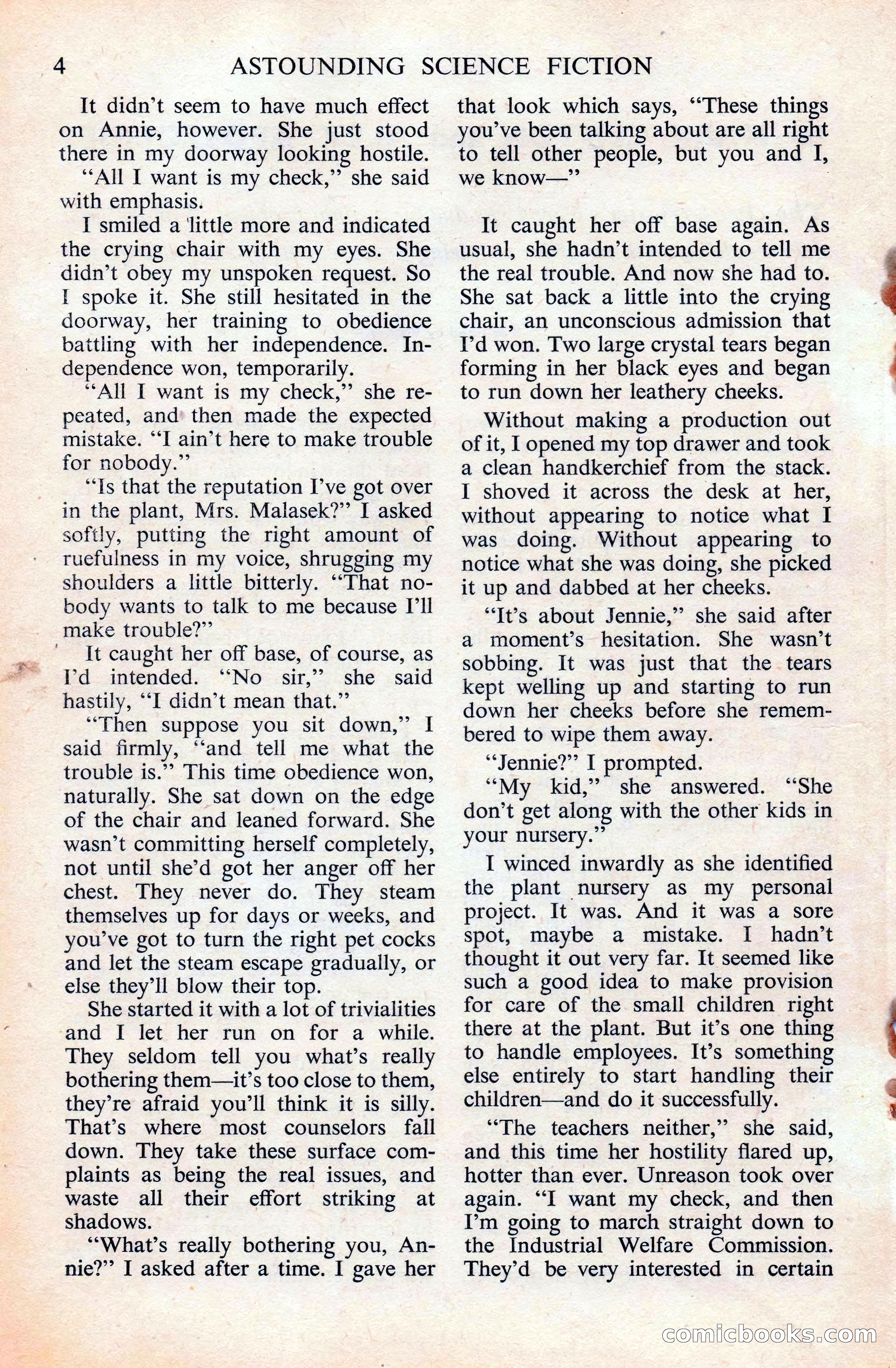
A restored page from Pulp Fiction, 1954. Page through the whole issue in the reader above.
📄 Transcribed text from this page (OCR, searchable)
Machine-transcribed from the original scan — historical spelling and the odd misread are preserved.
4 ASTOUNDING SCIENCE FICTION It didn’t seem to have much effect on Annie, however. She just stood there in my doorway looking hostile. “All I want is my check,” she said with emphasis. I smiled a ‘little more and indicated the crying chair with my eyes. She didn’t obey my unspoken request. So I spoke it. She still hesitated in the doorway, her training to obedience battling with her independence. In- dependence won, temporarily. “All I want is my check,” she re- peated, and’ then made the expected mistake. “I ain’t here to make trouble for nobody.” “Is that the reputation I’ve got over in the plant, Mrs. Malasek?’’ I asked softly, putting the right amount of ruefulness in my voice, shrugging my shoulders a little bitterly. ‘That no- body wants to talk to me because I'll make trouble?” It caught her off base, of course, as Fd antended: . “No <8,” she <said hastily, “I didn’t mean that.” “Then suppose you sit down,” I said firmly, ‘‘and tell me what the trouble is.’ This time obedience won, naturally. She sat down on the edge of the chair and leaned forward. She wasn’t committing herself completely, not until she’d got her anger off her chest. They never do. They steam themselves up for days or weeks, and you’ve got to turn the right pet cocks and let the steam escape gradually, or else they’ll blow their top. She started it with a lot of trivialities and I let her run on for a while. They seldom tell you what’s really bothering them—it’s too close to them, they’re afraid you'll think it is silly. That’s where most counselors fall down. They take these surface com- plaints as being the real issues, and waste all their effort striking at shadows. ““What’s really bothering you, An- nie?’ I asked after a time. I gave her that look which says, ““These things you’ve been talking about are all right to tell other people, but you and I, we know—” It caught her off base again. As usual, she hadn’t intended to tell me the real trouble. And now she had to. She sat back a little into the crying chair, an unconscious admission that I’d won. Two large crystal tears began forming in her black eyes and began to run down her leathery cheeks. Without making a production out of it, | opened my top drawer and took a clean handkerchief from the stack. I shoved it across the desk at her, without appearing to notice what I was doing. Without appearing to notice what she was doing, she picked it up and dabbed at her cheeks. “It’s about Jennie,’ she said after a moment’s hesitation. She wasn’t sobbing. It was just that the tears kept welling up and starting to run down her cheeks before she remem- bered to wipe them away. ‘“Jennie?’’ I prompted. “My kid,” she answered. “She don’t get along with the other kids in your nursery.” I winced inwardly as she identified the plant nursery as my _ personal project. It was. And it was a sore spot, maybe a mistake. I hadn’t thought it out very far. It seemed like such a good idea to make provision for care of the small children right there at the plant. But it’s one thing to handle employees. It’s something else entirely to start handling their children—and do it successfully. “‘The teachers neither,’ she said, and this time her hostility flared up, hotter than ever. Unreason took over again. “I want my check, and then I’m going to march straight down to the Industrial Welfare Commission. They’d be very interested in certain connicloooks.c© nn a—-—