
Pulp Fiction, 1954 · page 8 of 132
Astounding Science Fiction, British Edition — page 8: what you’re looking at
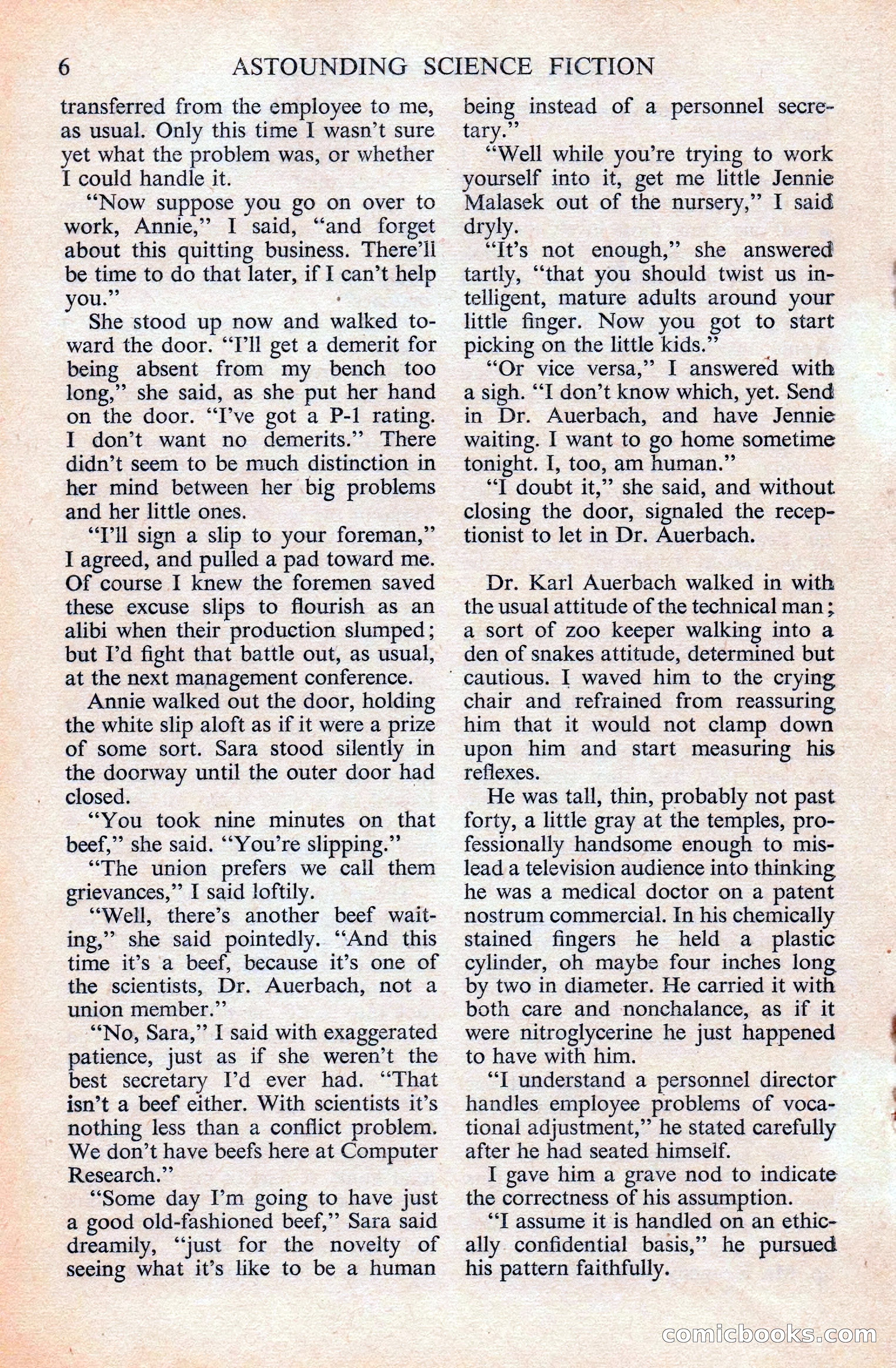
A restored page from Pulp Fiction, 1954. Page through the whole issue in the reader above.
📄 Transcribed text from this page (OCR, searchable)
Machine-transcribed from the original scan — historical spelling and the odd misread are preserved.
6 ASTOUNDING SCIENCE FICTION transferred from the employee to me, as usual. Only this time I wasn’t sure et what the problem was, or whether I could handle it. ‘““Now suppose you go on over to work, Annie,’ I said, “and forget about this quitting business. There'll be time to do that later, if I can’t help ou.” She stood up now and walked to- ward the door. “I'll get a demerit for being absent from my bench too long,” she said, as she put her hand on the door. “I’ve got a P-1 rating. I don’t want no demerits.” There didn’t seem to be much distinction in her mind between her big problems and her little ones. “Til sign a slip to your foreman,” I agreed, and pulled a pad toward me. Of course I knew the foremen saved these excuse slips to flourish as an alibi when their production slumped ; but I’d fight that battle out, as usual, at the next management conference. Annie walked out the door, holding the white slip aloft as if it were a prize of some sort. Sara stood silently in the doorway until the outer door had closed. “You took nine minutes on that beef,” she said. “You're slipping.” “The union prefers we call them grievances,” I said loftily. ‘‘Well, there’s another beef wait- ing,’ she said pointedly. “‘And this time it’s a beef, because it’s one of the scientists, Dr. Auerbach, not a union member.” “No, Sara,” I said with exaggerated patience, just as if she weren’t the best secretary I'd ever had. “That isn’t a beef either. With scientists it’s nothing less than a conflict problem. We don’t have beefs here at Computer Research.”’ “Some day I’m going to have just a good old-fashioned beef,” Sara said dreamily, “‘just for the novelty of seeing what it’s like to be a human being instead of a personnel secre- tary.” “Well while you’re trying to work yourself into it, get me little Jennie Malasek out of the nursery,” I said dryly. “It’s not enough,” she answered tartly, ‘‘that you should twist us in- telligent, mature adults around your little finger. Now you got to start picking on the little kids.”’ : “Or vice versa,’ I answered with a sigh. “I don’t know which, yet. Send in Dr. Auerbach, and have Jennie waiting. I want to go home sometime tonight. I, too, am human.” “TY doubt it,’ she said, and without closing the door, signaled the recep- tionist to let in Dr. Auerbach. Dr. Karl Auerbach walked in with the usual attitude of the technical man ; a sort of zoo keeper walking into a den of snakes attitude, determined but ' cautious. I waved him to the crying chair and refrained from reassuring him that it would not clamp down upon him and start measuring his reflexes. He was tall, thin, probably not past forty, a little gray at the temples, pro- fessionally handsome enough to mis- lead a television audience into thinking he was a medical doctor on a patent nostrum commercial. In his chemically stained fingers he held a_ plastic cylinder, oh maybe four inches long by two in diameter. He carried it with both care and nonchalance, as if it were nitroglycerine he just happened to have with him. “IT understand a personnel director handles employee problems of voca- tional adjustment,” he stated carefully after he had seated himself. I gave him a grave nod to indicate the correctness of his assumption. “I assume it is handled on an ethic- ally. confidential basis,” he pursued his pattern faithfully. Cconnicloooks.e© nn