
Pulp Fiction, 1954 · page 67 of 132
Astounding Science Fiction, British Edition — page 67: what you’re looking at
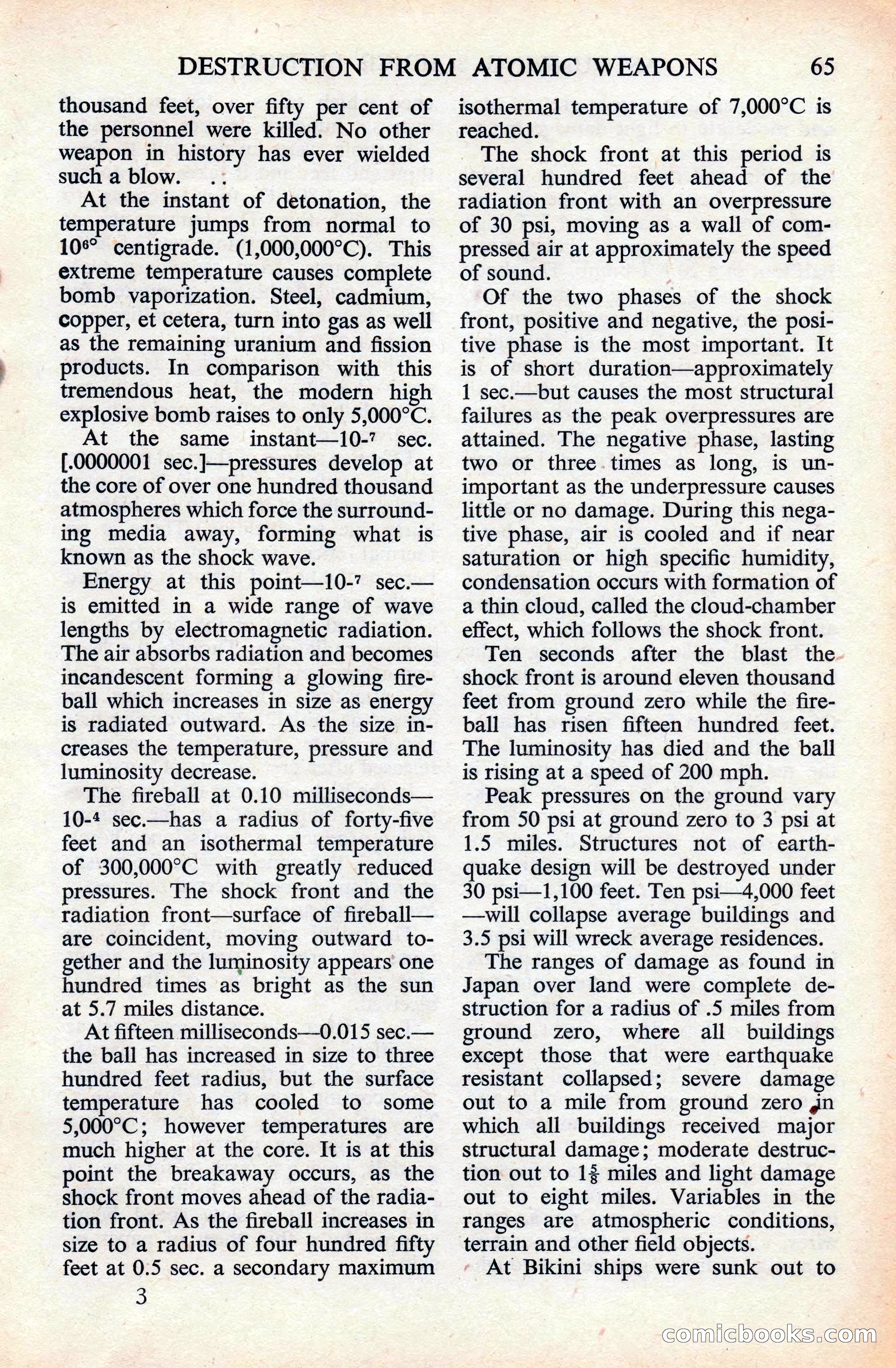
A restored page from Pulp Fiction, 1954. Page through the whole issue in the reader above.
📄 Transcribed text from this page (OCR, searchable)
Machine-transcribed from the original scan — historical spelling and the odd misread are preserved.
DESTRUCTION FROM ATOMIC WEAPONS thousand feet, over fifty per cent of the personnel were killed. No other weapon in history has ever wielded such a blow. .: At the instant of detonation, the temperature jumps from normal to 10®° centigrade. (1,000,000°C). This extreme temperature causes complete bomb vaporization. Steel, cadmium, copper, et cetera, turn into gas as well as the remaining uranium and fission products. In comparison with this tremendous heat, the modern high explosive bomb raises to only 5,000°C. At the same instant—10-7 sec. [0000001 sec.]—pressures develop at the core of over one hundred thousand atmospheres which force the surround- ing media away, forming what is known as the shock wave. Energy at this point—10-? sec.— is emitted in a wide range of wave lengths by electromagnetic radiation. The air absorbs radiation and becomes incandescent forming a glowing fire- ball which increases in size as energy is radiated outward. As the size in- creases the temperature, pressure and luminosity decrease. The fireball at 0.10 milliseconds— 10-4 sec.—has a radius of forty-five feet and an isothermal temperature of 300,000°C with greatly reduced pressures. The shock front and the radiation front—surface of fireball— are coincident, moving outward to- gether and the luminosity appears one hundred times as bright as the sun at 5.7 miles distance. At fifteen milliseconds—0.015 sec.— the ball has increased in size to three hundred feet radius, but the surface temperature has cooled to some 5,000°C; however temperatures are much higher at the core. It is at this oint the breakaway occurs, as the shock front moves ahead of the radia- tion front. As the fireball increases in size to a radius of four hundred fifty feet at 0.5 sec. a secondary maximum 2 65 isothermal temperature of 7,000°C is reached. The shock front at this period is several hundred feet ahead of the radiation front with an overpressure of 30 psi, moving as a wall of com- pressed air at approximately the speed of sound. Of the two phases of the shock front, positive and negative, the posi- tive phase is the most important. It is of short duration—approximately 1 sec.—but causes the most structural failures as the peak overpressures are attained. The negative phase, lasting two or three. times as long, is un- important as the underpressure causes little or no damage. During this nega- tive phase, air is cooled and if near saturation or high specific humidity, condensation occurs with formation of a thin cloud, called the cloud-chamber effect, which follows the shock front. Ten seconds after the blast the shock front is around eleven thousand feet from ground zero while the fire- ball has risen fifteen hundred feet. The luminosity has died and the ball is rising at a speed of 200 mph. Peak pressures on the ground vary from 50 psi at ground zero to 3 psi at 1.5 miles. Structures not of earth- quake design will be destroyed under 30 psi—1,100 feet. Ten psi—4,000 feet —will collapse average buildings and 3.5 psi will wreck average residences. The ranges of damage as found in Japan over land were complete de- struction for a radius of .5 miles from ground zero, where all buildings except those that were earthquake resistant collapsed; severe damage out to a mile from ground zero Jn which all buildings received major structural damage; moderate destruc- tion out to 13 miles and light damage out to eight miles. Variables in the ranges are atmospheric conditions, terrain and other field objects. At Bikini ships were sunk out to COMICDOOKS.CO in