
Pulp Fiction, 1954 · page 68 of 132
Astounding Science Fiction, British Edition — page 68: what you’re looking at
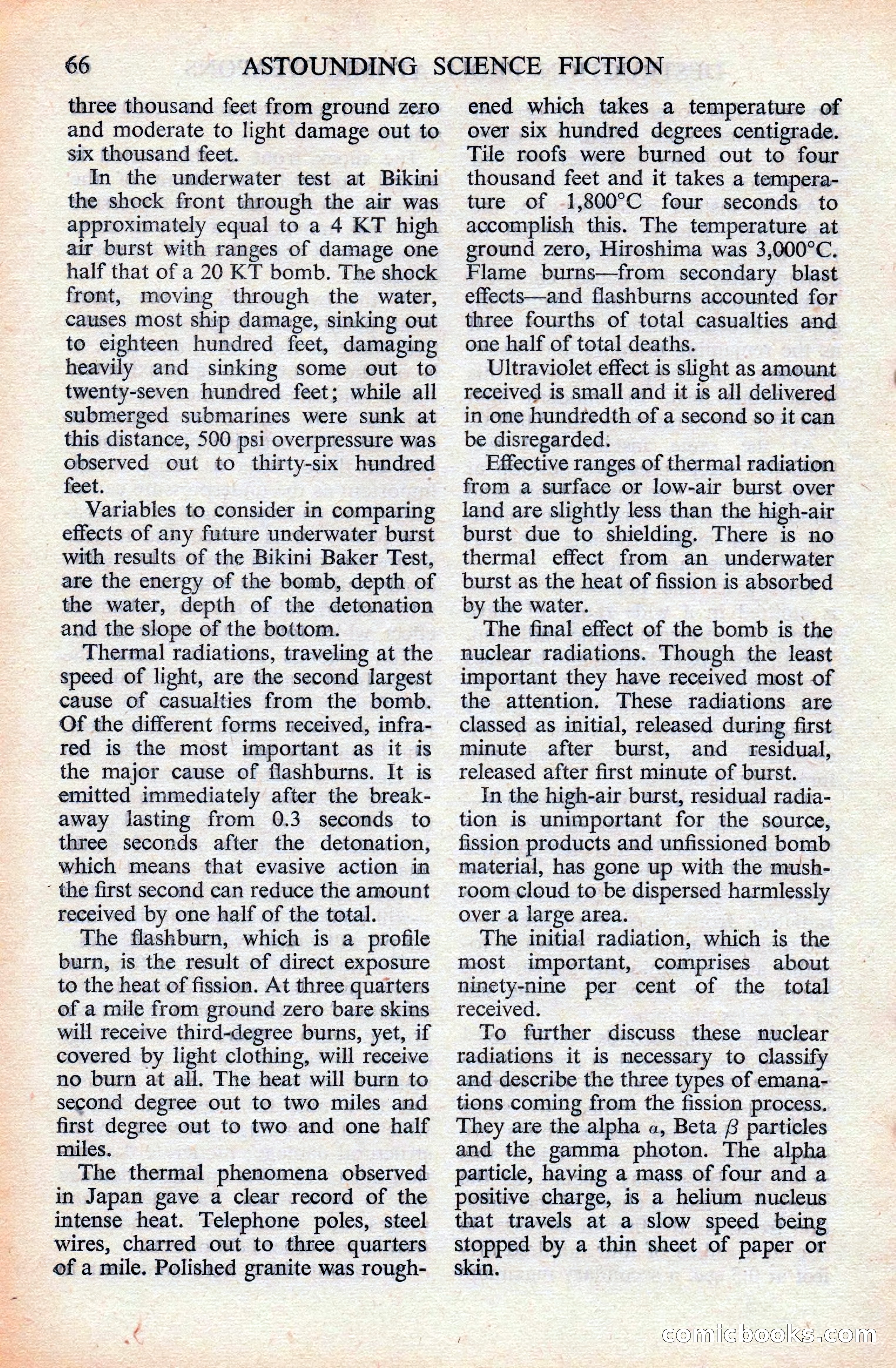
A restored page from Pulp Fiction, 1954. Page through the whole issue in the reader above.
📄 Transcribed text from this page (OCR, searchable)
Machine-transcribed from the original scan — historical spelling and the odd misread are preserved.
66 ASTOUNDING SCIENCE FICTION three thousand feet from ground zero and moderate to light damage out to six thousand feet. In the underwater test at Bikini the shock front through the air was approximately equal to a 4 KT high air burst with ranges of damage one half that of a 20 KT bomb. The shock front, moving through the water, causes most ship damage, sinking out to eighteen hundred feet, damaging heavily and sinking some out to twenty-seven hundred feet; while all submerged submarines were sunk at this distance, 500 psi overpressure was observed out to thirty-six hundred feet. | Variables to consider in comparing effects of any future underwater burst with results of the Bikini Baker Test, are the energy of the bomb, depth of the water, depth of the detonation and the slope of the bottom. Thermal radiations, traveling at the speed of light, are the second largest cause of casualties from the bomb. Of the different forms received, infra- red is the most important as it is the major cause of flashburns. It is emitted immediately after the break- away lasting from 0.3 seconds to three seconds after the detonation, which means that evasive action in ' the first second can reduce the amount received by one half of the total. The flashburn, which is a profile burn, is the result of direct exposure to the heat of fission. At three quarters of a mile from ground zero bare skins will receive third-degree burns, yet, if covered by light clothing, will receive no burn at all. The heat will burn to second degree out to two miles and first degree out to two and one half miles. The thermal phenomena observed in Japan gave a clear record of the intense heat. Telephone poles, steel wires, charred out to three quarters of a mile. Polished granite was rough- ened which takes a temperature of over six hundred degrees centigrade. Tile roofs were burned out to four thousand feet and it takes a tempera- ture of -1,800°C four seconds to accomplish this. The temperature at ground zero, Hiroshima was 3,000°C. Flame burns—from secondary blast effects—and flashburns accounted for three fourths of total casualties and one half of total deaths. Ultraviolet effect is slight as amount received is small and it is all delivered in one hundredth of a second so it can be disregarded. Effective ranges of thermal radiation from a surface or low-air burst over land are slightly less than the high-air burst due to shielding. There is no thermal effect from an underwater burst as the heat of fission is absorbed by the water. The final effect of the bomb is the nuclear radiations. Though the least important they have received most of the attention. These radiations are classed as initial, released during first minute after burst, and residual, released after first minute of burst. In the high-air burst, residual radia- tion is unimportant for the source, fission products and unfissioned bomb material, has gone up with the mush- room cloud to be dispersed harmlessly over a large area. The initial radiation, which is the most important, comprises about ninety-nine per cent of the total received. To further discuss these nuclear radiations it is necessary to classify and describe the three types of emana- tions coming from the fission process. They are the alpha a, Beta £ particles and the gamma photon. The alpha particle, having a mass of four and a positive charge, is a helium nucleus that travels at a slow speed being stopped by a thin sheet of paper or connicloooks.c© in