
Pulp Fiction, 1954 · page 66 of 132
Astounding Science Fiction, British Edition — page 66: what you’re looking at
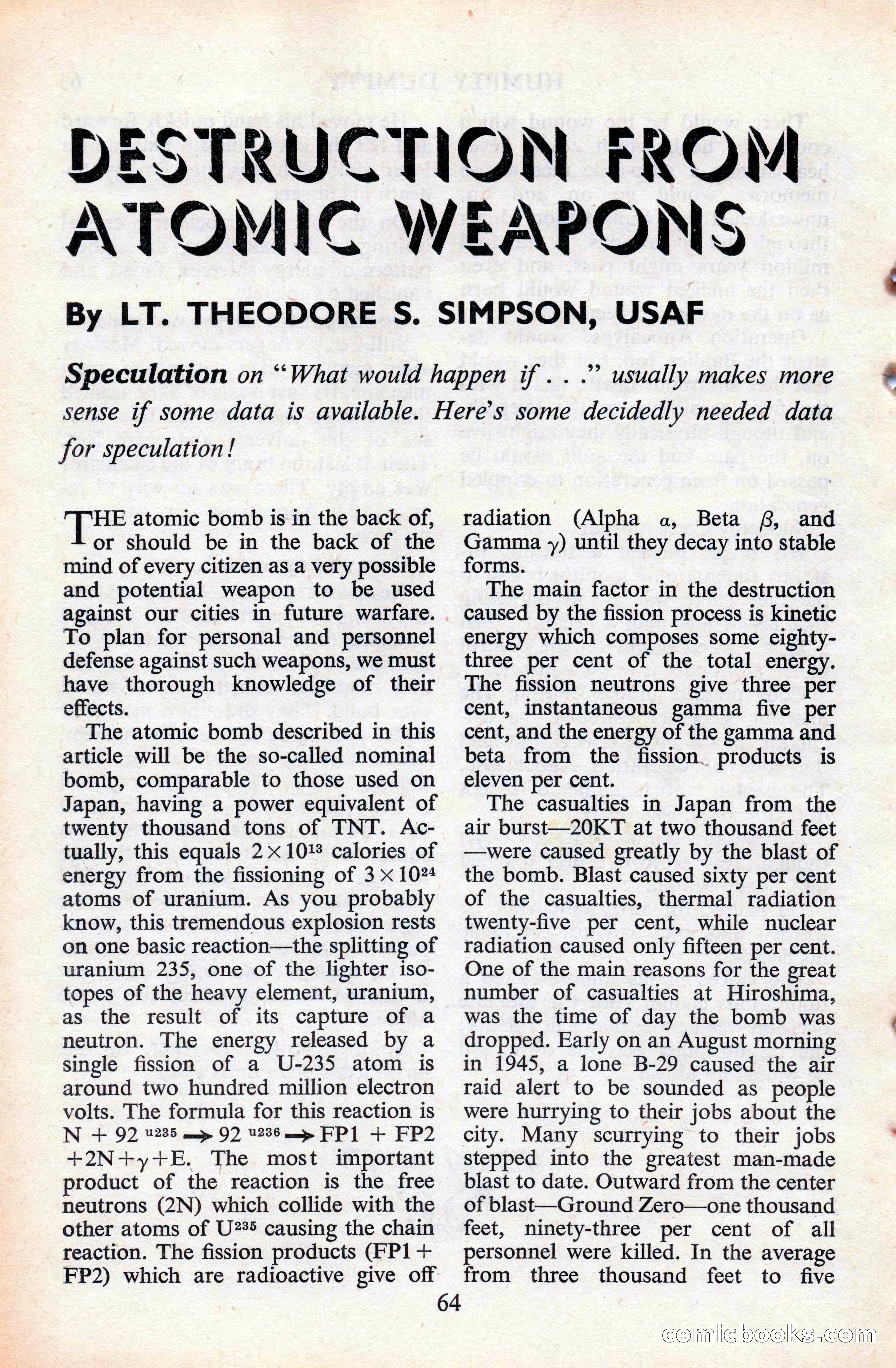
A restored page from Pulp Fiction, 1954. Page through the whole issue in the reader above.
📄 Transcribed text from this page (OCR, searchable)
Machine-transcribed from the original scan — historical spelling and the odd misread are preserved.
DESTRUCTION FROM ATOMIC WEAPONS By LT. THEODORE S. SIMPSON, USAF Speculation on “What would happen if...” usually makes more sense if some data is available. Here’s some decidedly needed data for speculation! HE atomic bomb is in the back of, or should be in the back of the mind of every citizen as a very possible and potential weapon to be used against our cities in future warfare. To plan for personal and personnel defense against such weapons, we must have thorough knowledge of their effects. The atomic bomb described in this article will be the so-called nominal bomb, comparable to those used on Japan, having a power equivalent of twenty thousand tons of TNT. Ac- tually, this equals 2 x 10¹⁸ calories of energy from the fissioning of 3 x 1074 atoms of uranium. As you probably know, this tremendous explosion rests on one basic reaction—the splitting of uranium 235, one of the lighter iso- topes of the heavy element, uranium, as the result of its capture of a neutron. The energy released by a single fission of a U-235 atom is around two hundred million electron volts. The formula for this reaction is N + 92 2235 aap 92 1236 a> FP] + FP2 +2N+y+E. The most important product of the reaction is the free neutrons (2N) which collide with the other atoms of U?*5 causing the chain reaction. The fission products (FP1 + FP2) which are radioactive give off 64 radiation (Alpha a, Beta £, and Gamma +) until they decay into stable forms. The main factor in the destruction caused by the fission process is kinetic energy which composes some eighty- three per cent of the total energy. The fission neutrons give three per cent, instantaneous gamma five per cent, and the energy of the gamma and beta from the fission. products is eleven per cent. The casualties in Japan from the air burst—20KT at two thousand feet —were caused greatly by the blast of the bomb. Blast caused sixty per cent of the casualties, thermal radiation twenty-five per cent, while nuclear radiation caused only fifteen per cent. One of the main reasons for the great number of casualties at Hiroshima, was the time of day the bomb was dropped. Early on an August morning in 1945, a lone B-29 caused the air raid alert to be sounded as people were hurrying to their jobs about the city. Many scurrying to their jobs stepped into the greatest man-made blast to date. Outward from the center of blast—Ground Zero—one thousand feet, minety-three per cent of all personnel were killed. In the average from three thousand feet to five comilclooks.c© nn